

Luanda
—
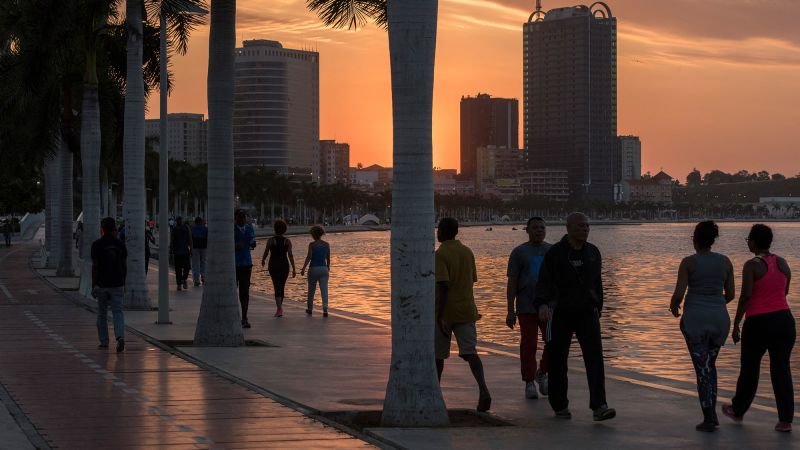
Along Luanda Bay’s Marginal Promenade, the colonial-era National Bank still dominates the landscape, formal and imposing in pink and white. But Restaurant Teimosa da Banda, tucked under a shady arch along the arcade, is buzzing with activity.
The kitchen window opens directly onto the aisle. Government officials, tourists, and local residents stop by to enjoy drinks and bijuanas (Portuguese sandwiches wrapped in marinated pork). It’s casual, affordable, and fun. It’s a quality that Luanda’s popular eateries have long lacked.
“You can sit with us,” Teimosa da Banda co-founder María Lucena said as she looked around at the restaurant’s seating and socializing options. “Or just talk to this group of people.”
For da Banda, conversation is as important as food.
“In our case, I think we got everyone together over a glass of wine. We were like, oh, we’re here! oh, the CEO, oh, yeah! oh, the painter, oh, the hairdresser, oh, the makeup artist. So everyone felt a little bit like a Teimoso community.”
This sense of community reflects broader changes in Angolan food, from the way it is grown and prepared to the companies that make the food system work.
To understand why sidewalk cafes are so important, it helps to remember how food in Luanda used to work.
When I first visited in 2002, just after the end of decades of civil war, there was little to eat in the city. There were few options other than a single hotel that catered to foreigners. I have eaten at restaurants and it was questionable pieces of meat and greasy fries. Only one road was properly paved. Dust was in the air. Along the coast, a fisherman sold fish to my colleague and me and roasted it in an old oil drum.

Ten years later, during the post-war oil boom, colleagues warned me to pack food because prices were soaring. Without asking, I went back to the beach and looked for the fisherman. The beach is now lined with upscale clubs and restaurants. One of them had a $100 cover charge. A one course meal and drink was another $300.
This time, I prepared protein bars, dried fruits, nuts, biltong, etc. And it didn’t need anything.
For decades, Angola’s food system was barely functioning. During the civil war, land mines rendered vast areas uncultivable, cutting off both agriculture and internal transportation. Anything that wasn’t grown on the windowsill was imported from Portugal and was out of reach for most people.
The oil boom created a new elite class and prompted massive food imports, further increasing prices.
Life in Angola is now settling into a different rhythm. Demining has reopened farmland for crops, ranches, and even winemaking.
This trend is reflected in trade data. Fruit and vegetable imports more than halved from 2005 to 2024, from about $70 million to $32 million, according to the International Trade Center. In 2005, Angola exported no vegetables at all and only $2,000 worth of fruit. Last year, fruit and vegetable exports reached nearly $11 million.

Although Angola remains a net importer of food, it is becoming increasingly self-sufficient and proud of its local cuisine.
“In the past, it was very expensive to go out and everyone wanted to import everything,” said restaurateur and author Claudio Silva. “There used to be no pride in local ingredients, but now it’s completely reversed. Now you go to these restaurants and the chefs are creating tasting menus that are uniquely Angola, exquisite dishes.”
After years of covering Luanda’s food scene, Silva opened her own business in October 2025. Restaurant Kissanje has transformed his family home into a fine dining experience using almost all Angolan ingredients.
He and Kissanje chef Afonso Videira are both diaspora returnees, Silva from the United States and Videira from Belgium, and are bringing their skills and perspectives back to their ancestral homeland to transform the way people eat.
Angola is growing more food, but not necessarily enough. And transporting food in a country nearly twice the size of Texas remains a challenge.
“Creativity has to be the best skill here,” Lucena said, pointing to the locally sourced cacao that Teimosa uses in its chocolate mousse. Local chocolatiers process the cacao into three types of chocolate, but supplies can be erratic. “The production quantity is very small. It’s a shame because it’s expensive.”
“There’s no transportation and the streets aren’t very well maintained,” she says. “We really have tremendous opportunity to grow our product and grow our industry here. Much has been accomplished, but we still have a long way to go.”

Some of Luanda’s new dining spots draw on a wide range of international influences. A Cordon Bleu-trained chef has opened a French pastry shop a few blocks from Teimosa. The beachfront district along the Ilha River features oceanfront restaurants with décor and menus that could easily be found in Miami or Rio.
But the changes can also be seen in neighborhood markets.
At Sao Paulo’s market, the city’s busiest, chef Anselmo Silvestre moves from stall to stall pointing out ingredients. He returned to Angola after working at La Colombe in Cape Town, which is consistently ranked among the top restaurants in the world.
He picked up a small plastic bag tied in a knot, filled with a brown paste that was peanuts blended with locally grown sunflower seeds. The other is a combination of peanuts and pumpkin seeds.
“It has a very earthy flavor and roasted flavor,” Silvestre said. He likes both traditional ways of cooking with these ingredients and finding new and innovative ways. Use one for stews and the other to make crumbles to serve with ice cream. Seller offers unique cooking tips and medicinal tips.
“She just said that these…sunflower seeds can be used to treat the prostate,” he explained. “So there’s a whole belief system behind a lot of these things.”
