

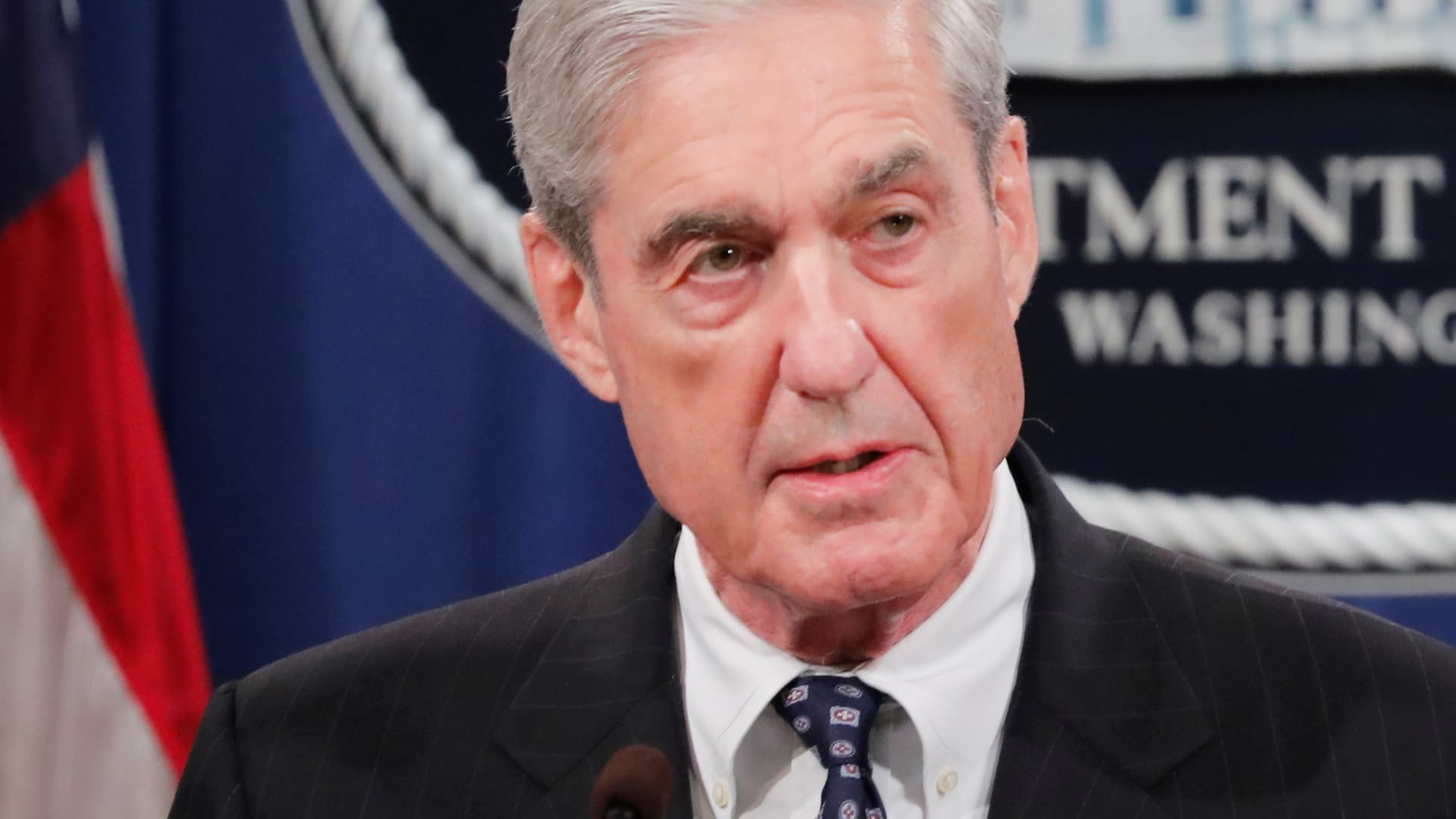
On May 29, 2019, U.S. Special Counsel Robert Mueller issued a statement at the Department of Justice in Washington regarding the investigation into Russian interference in the 2016 U.S. presidential election.
Jim Buhl | Reuters
Former special counsel Robert Mueller, who investigated Russian interference in the 2016 presidential election, died on Friday.
Mueller, also a former director of the Federal Bureau of Investigation, is 81 years old.
“It is with deep sadness that we share the news of Bob’s passing,” the family said in a statement Friday night and Saturday. “His family asks that their privacy be respected.”
MS Now first reported the news on Saturday.
Mueller concluded in 2019 that Russia interfered in the election to influence voters for President Donald Trump’s 2016 campaign.
The Russia investigation and Mueller himself quickly became a lightning rod for President Trump. Over the years, President Trump has repeatedly called the investigation a “witch hunt” and a “hoax.”
Shortly after Mueller’s death was announced, Trump posted on Truth Social: “I’m glad he’s dead.”
He added: “He can’t hurt innocent people anymore!”
From FBI director to special prosecutor
Mueller is the second-longest serving director in FBI history, after J. Edgar Hoover. He began his tenure just one week before the September 11, 2001 terrorist attacks, which triggered a shift in the agency’s priorities from solving domestic crimes to fighting terrorism.
Mueller remained in office for 12 years after then-President Barack Obama asked him to remain in office beyond the end of his 10-year term. After retiring in 2013, he opened his own private practice.
He returned to public service in 2017 when Deputy Attorney General Rod Rosenstein appointed him special counsel for the Trump-Russia investigation.
Mr. Mueller’s stern countenance and quiet demeanor matched the seriousness of the task, in which his team spent nearly two years quietly carrying out one of the most significant and divisive investigations in Justice Department history. He did not hold press conferences or appear in public during the investigation, remaining silent despite attacks from Trump and his supporters, lending an air of mystery to his work.
Ultimately, Mr. Mueller filed criminal charges against six of the president’s associates, including his campaign chairman and first national security adviser.
Special Counsel Robert S. Mueller III leaves the Capitol after a closed-door meeting with members of the Senate Judiciary Committee regarding Russian interference in the 2016 presidential election in Washington, June 21, 2017. He passed away on Friday, March 20, 2026. He passed away at the age of 81.
J. Scott Applewhite, File | AP Photo
His 448-page report, released in April 2019, identified substantial contacts between the Trump campaign and Russia, but did not allege any criminal conspiracy. Mr. Mueller revealed damaging details about Mr. Trump’s control of the investigation and even his attempts to shut it down, but he declined to determine whether Mr. Trump had broken any laws, in part because of department policy that prohibits prosecuting a sitting president.
But in perhaps the report’s most memorable line, Mueller wrote: “If we were confident, after a thorough review of the facts, that the President clearly did not obstruct justice, we would say so. Based on the facts and applicable legal standards, we cannot reach such a determination.”
That ambiguous conclusion did not give the administration the decisive punch that some Trump opponents had hoped for, nor did it spark a sustained push by House Democrats to impeach the president, although the president was later tried and acquitted on other charges related to Ukraine.
The result also left room for Attorney General William Barr to insert his own opinion. He and his team independently determined that Trump had not obstructed justice and had a private battle with Mueller over Barr’s four-page summary letter, which Mueller felt did not adequately capture the report’s damaging conclusions.
Mr. Mueller chilled Democrats during a highly anticipated Congressional hearing on his report by giving terse, one-word answers and seeming unsure of his testimony. He often seemed confused about the details of the investigation. It was a far cry from the commanding performance many had expected from Mueller, who had a huge reputation in Washington.
Over the next few months, Mr. Barr made clear his disagreement with the fundamentals of the Russia investigation and moved to dismiss the false statements charges brought by Mr. Mueller against former national security adviser Michael Flynn, even though the investigation ended in a guilty plea.
Mr. Mueller’s tenure as special counsel was the culmination of his career in government.
Vietnam veteran and career criminal prosecutor
Mueller was born in New York City and grew up in an affluent suburb of Philadelphia.
He earned a bachelor’s degree from Princeton University and a master’s degree in international relations from New York University. He then joined the Marines and served as an officer for three years during the Vietnam War. He commanded a rifle platoon and received the Bronze Star, Purple Heart, and two Navy Commendation Medals. After completing his military service, Mr. Mueller earned a law degree from the University of Virginia.
Mr. Mueller became a federal prosecutor and enjoyed handling criminal cases. He rose rapidly through the ranks in the U.S. Attorney’s Offices in San Francisco and Boston from 1976 to 1988. Later, as head of the Justice Department’s criminal division in Washington, he oversaw a series of high-profile prosecution victories against targets as diverse as Panamanian dictator Manuel Noriega and New York crime boss John Gotti.
In a mid-career move that shocked his colleagues, Mr. Mueller left his job at a prestigious Boston law firm to join the U.S. Attorney’s Office’s homicide division in the nation’s capital. There, he immersed himself as a senior litigator in a voluminous case of unsolved drug-related murders in a city plagued by violence.
Mueller was driven by a lifelong passion for the arduous task of successfully completing criminal cases. Even as FBI director, he would delve into the details of investigations, some serious, some not, often surprising agents who suddenly found themselves on the phone with the director.
“Management books say that as the head of an organization you should focus on the vision,” Mueller once said. However, “for me, there were and still are areas that require substantive personal involvement, particularly regarding the threat of terrorism and the need to know and understand the roots of that threat.”
Towards the end of Mr. Mueller’s watch, two terrorist attacks occurred: the Boston Marathon bombing and the Fort Hood, Texas, mass shooting. Both were weighing heavily on him, he admitted in an interview two weeks before his departure.
“When I sit with the victims’ families and see the pain they’re going through, I always wonder if more could have been done,” he said.
—The Associated Press contributed to this report
