

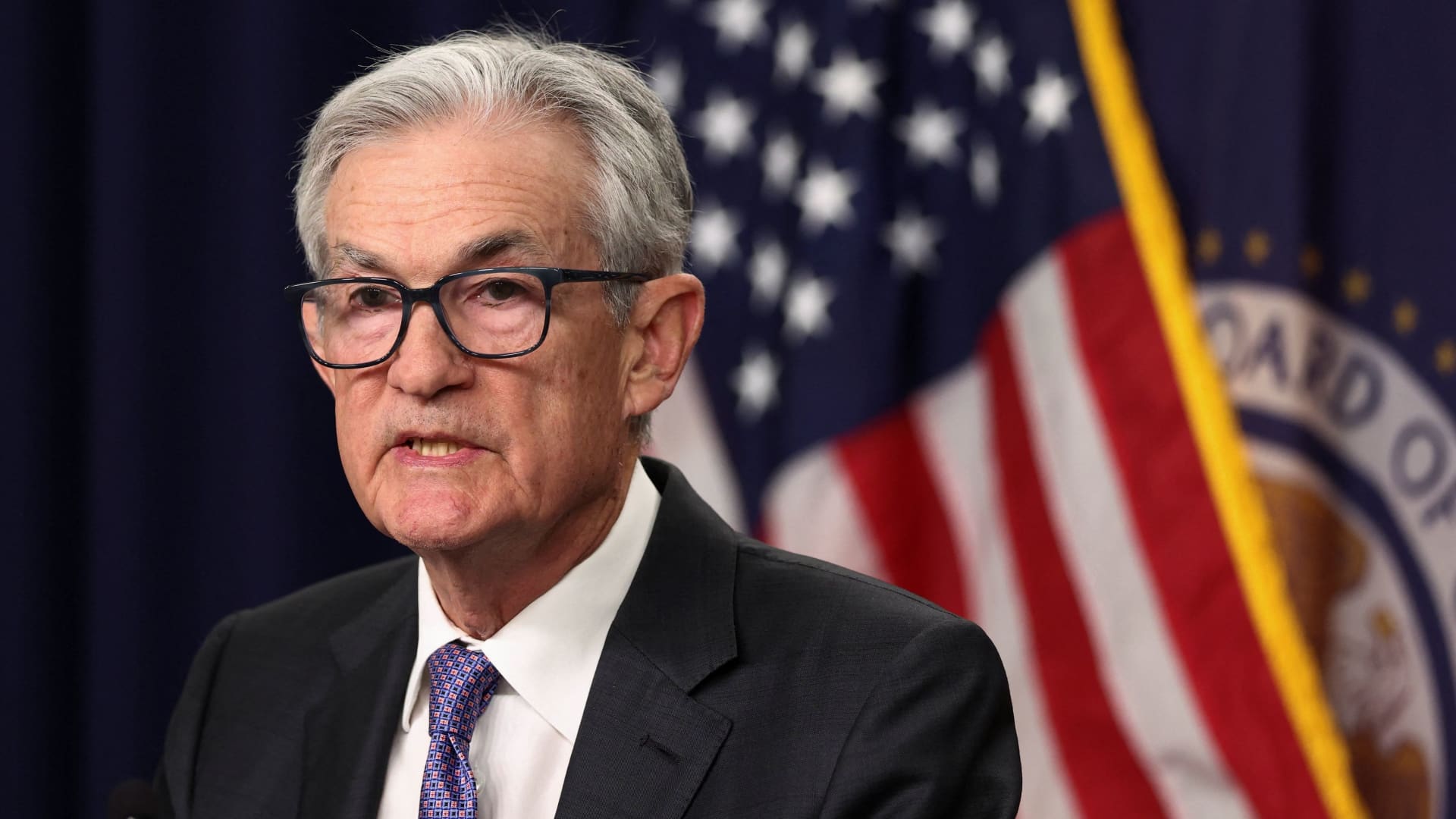
Federal Reserve Chairman Jerome Powell holds a press conference after two days of Federal Open Market Committee meetings at the Federal Reserve Board in Washington, December 10, 2025.
Kevin Lamarque | Reuters
The Fed faces many political and policy challenges heading into 2026, including a new chairman and an economy that is experiencing both tailwinds and headwinds, making policymakers’ choices even more important.
After three consecutive rate cuts, the central bank is expected to take a more moderate path over the next year, and further cuts may be difficult given expectations for solid growth and continued inflationary pressures.
One thing seems certain: After a year of extraordinary turmoil surrounding the Fed, we’ll see more of the same in 2026.
“I think there’s going to be a lot of attention. There’s going to be a lot of intrigue,” said Kathy Bojancic, chief economist at Nationwide. “There’s still a lot of uncertainty, and the Fed is in the spotlight and will probably be in the spotlight as well.”
Last year, the Fed was in the spotlight in an unprecedented way.
At the start of his second term in the White House, President Donald Trump repeatedly threatened to fire Federal Reserve Chairman Jerome Powell for not moving quickly enough to cut interest rates. Around the middle of this year, the Fed came under fire again, this time for cost overruns on a renovation project at its Washington headquarters.
Meanwhile, President Trump tried to fire Governor Lisa Cook over allegations (which have not yet been proven or even formally charged) that she committed mortgage fraud. All of this comes in the context of who will replace Mr. Powell as chairman when his term ends in May, with up to 11 candidates considered in an interview process led by Treasury Secretary Scott Bessent.
If all that sounds like a hassle, consider that 2026 begins with a Supreme Court hearing scheduled for January 21 to decide whether President Trump has the authority to fire Cook. A week later, the Federal Open Market Committee will vote on interest rates. Trump is expected to announce his pick for Fed chairman at some point this month. And while Powell has so far been passive on the issue, he will also need to clarify whether he intends to serve out his term on the board, which runs until January 2028.
There were multiple dissenting opinions in the recent interest rate vote, and the new regional president who will serve on the FOMC has hawkish tendencies and is likely to resist further rate cuts.
“It’s still a tough situation for the Fed,” Vostjancic said.
focus on policy
Still, when it comes to policy, most on Wall Street expect the Fed to put the noise behind it and continue on its path to lowering its benchmark interest rate a little further until it approaches a neutral level of around 3%. Neutral is considered a spot that neither promotes nor restrains economic activity, and the funds rate is just 0.5 percentage point above where most of the FOMC believes interest rates will land over the long term.
“Chairman Powell was instrumental in orchestrating three consecutive 25 basis point rate cuts. He was not standing in the way of the FOMC rate cuts,” Vostjancic said. Regarding further cuts, he said: “For us, it’s an economic indicator.”
Vostjancic believes the data suggests two production cuts this year. The first time was around mid-year, and the other time was near the end of the year. The “dot plot” grid of Fed forecasts shows just one rate cut, but outliers looking at labor market weakness, such as Moody’s Analytics chief economist Mark Zandi and Citigroup, show three.
Powell and his colleagues support the idea that cuts cannot be bullied into making cuts, but are actually guided by data.
Torsten Slok, chief economist at Apollo Global Management, believes the economy is too strong for the Fed to cut rates significantly and expects only one rate cut in the future.
“The problem is that the winds are really shifting for the U.S. economy,” Throck said in a CNBC interview Friday.
Fiscal stimulus and labor market stabilization will support growth in 2025, despite headwinds such as tariffs, inflation and overall uncertainty, he said.
“In my view, the tailwinds are starting to build up more and it looks like it’s going to be more difficult for the Fed to cut rates this year,” Slok added.
The role of AI
One wild card is the role artificial intelligence will play in economic growth.
Joseph Brusuelas, chief economist at RSM, said assessing the economic impact of AI, which is seen as both a productivity boost and a potential hurdle to employment, will be a top priority for the Fed.
“The Fed faces a significant challenge this year in terms of communicating its strategy,” Bruelas said. “We’re channeling this huge amount of investment into very advanced technology, and the Federal Reserve is going to need to communicate a basic view of what this means.”
After a slump in early 2026, the economy grew rapidly in the second quarter of 2026 and is on track to accelerate by 3% in the fourth quarter, according to preliminary data from the Atlanta Fed.
AI stocks not only helped propel the overall economy, but they were another great highlight on Wall Street this year, with major averages posting double-digit gains.
Adjusting monetary policy in such an environment will be difficult, Brusuelas said.
“Central banks will need to provide strategic direction at a time when the economy is clearly pivoting towards integrating this advanced technology into the production of goods and delivery of services,” he said. “This is a really big potential policy-driven shift that needs to happen.”
