

listen to this article5 minutes
information
The return of the Iranian women’s soccer team from Australia during the Israel-US war has sparked concerns and uncertainty that their safety may be at risk.
Iran was eliminated from the AFC Women’s Asian Cup 2026 after losing their final group match against the Philippines in Australia’s Gold Coast on Sunday.
Recommended stories
list of 3 itemsend of list
But it is not the team’s on-field performance that is causing controversy, but the journey home, as the world’s footballers’ unions and human rights activists are calling on the Australian government and tournament organizers to extend the players’ stay in the host country.
FIFPRO, which represents the world’s professional soccer players, said on Monday it had serious concerns for the welfare of Iranians preparing to return home after being labeled “wartime traitors” for refusing to sing the national anthem before an Asian Cup match.
FIFPRO president for Asia and Oceania Beau Bush said the federation had been unable to contact the players to discuss whether they wanted to seek asylum in Australia.
“The reality is that we can’t contact the players at this point. That’s very concerning. That’s not new. In fact, this is the first time since the crackdown really got going in February or January,” Bush told reporters in Australia.
“So we are very concerned about our players, but our responsibility now is to do everything we can to keep them safe.”
Mr Bush said his organization was working with FIFA, the Asian Football Confederation (AFC) and the Australian government to “exert all pressure” to protect players and give them “power over what happens next”.
“It’s a really difficult situation,” he said.
“There may be players who want to come back. There may also be players in the group who want to seek asylum and want to stay in Australia for a longer period of time.”
More than 66,000 people have also signed a petition calling on the Australian government to prevent players still in Queensland from leaving the country “while there remain credible concerns for their safety.”
Australia’s Department of Home Affairs told Al Jazeera it would not comment on “the team’s travel plans”, while AFC did not respond to Al Jazeera’s request for comment.
Images taken from outside the team hotel on the Gold Coast showed the presence of a Queensland Police vehicle and hotel security guard blocking part of the hotel entrance.

Players ‘eager to return’ to Iran
Although the players have not publicly expressed concerns for their safety, they have spoken about the challenges of playing in a tournament thousands of kilometers from home while being “completely cut off” from their families during attacks by the United States and Israel.
Head coach Marzieh Jafari said the players wanted to return to Iran “as soon as possible”, Australian media reported.
Australia’s Associated Press reported that Jafari said in a post-match press conference: “I want to be with my country and my hometown. … I’m eager to come back.”
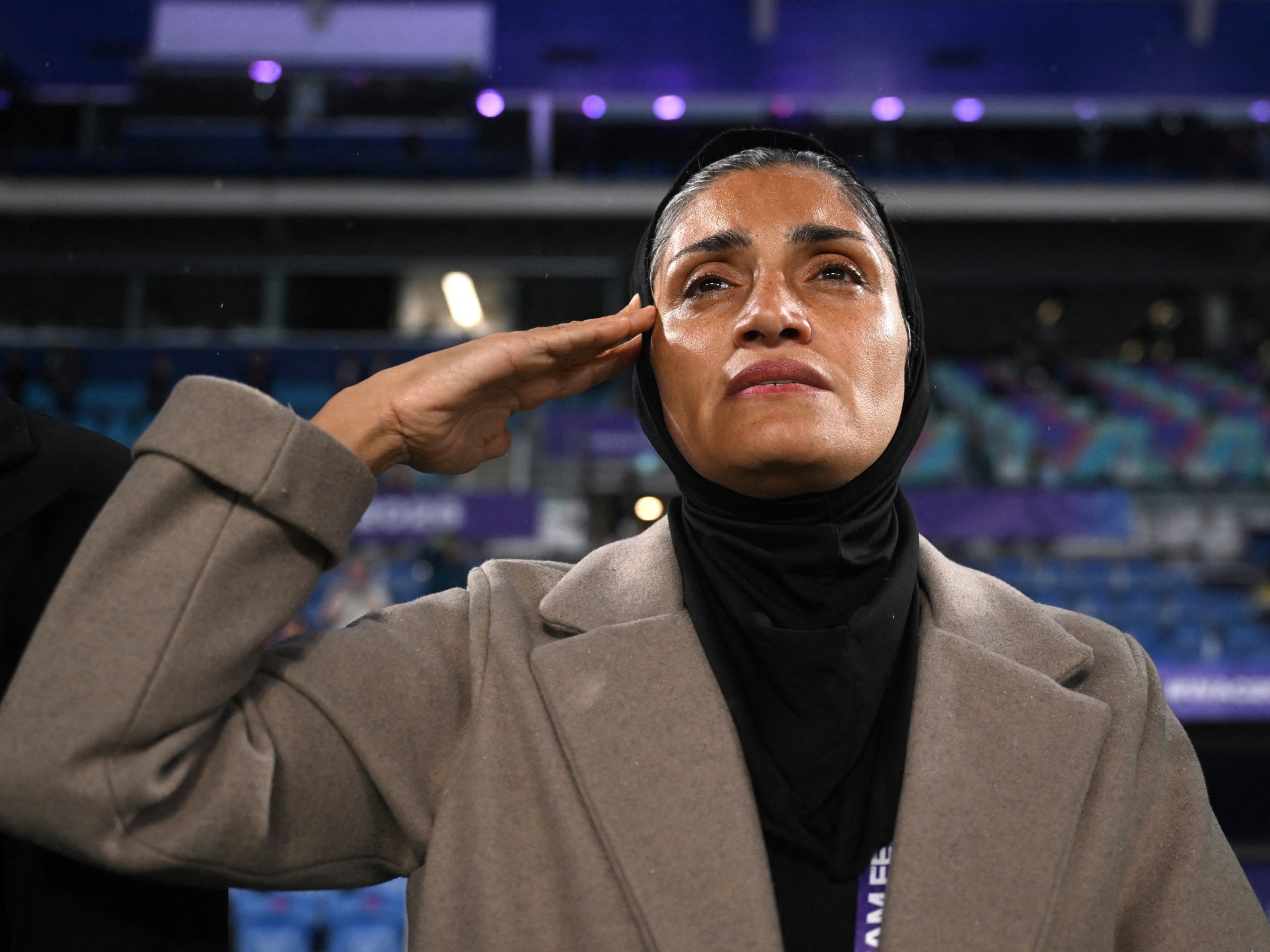
Human rights activists and members of Australia’s Iranian community voiced concern for the team’s safety after players saluted and sang the national anthem before the second and third matches of the Asian Cup.
This was in contrast to their decision to remain silent when the national anthem was played before the first match, with FIFPRO calling on the AFC and FIFA to protect the Iranian team, who were labeled “wartime traitors” by an Iranian state television presenter.

Islamic Republic of Iran Broadcasting presenter Mohammad Reza Shahbazi said in a video that the players showed a lack of patriotism and that their actions amounted to “the height of disgrace” in footage that was widely shared on social media.
“Let me say one thing: wartime traitors should be treated more harshly,” Shabaji said.
“Anyone who opposes the country during wartime must be treated more harshly. Like when our women’s soccer team did not sing the national anthem. …These people must be treated more harshly.”
In response, FIFPRO issued a strong and lengthy statement outlining its concerns.
Videos on social media showed dozens of protesters chanting “let us go” as they slowed down the team bus leaving the stadium after Sunday’s game. Protesters chanted “save the girls” as Australian police and security cleared the way for the team bus to leave the stadium.
The Iranian team has no more officially scheduled training or participation in the tournament, which will conclude with the final on March 21st.
The United States and Israel launched attacks on Iran on February 28, killing Supreme Leader Ayatollah Khamenei and sparking a region-wide conflict as Iran responds with missile and drone strikes on Israel and other countries in the Middle East where U.S. forces operate.
As a result of the war, 1,255 people died in Iran, including 165 girls whose primary school was targeted in the first wave of attacks.
