

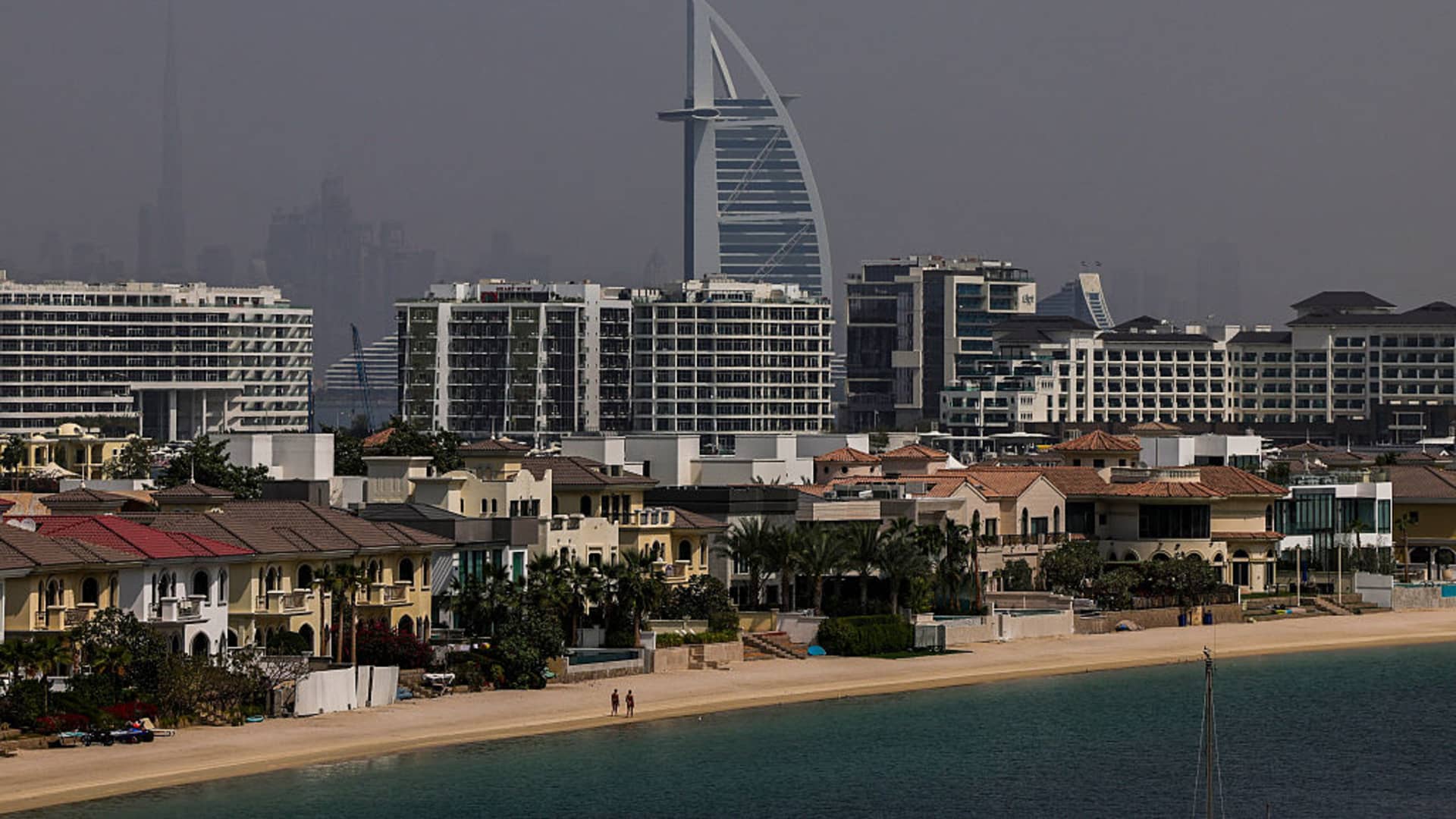

One of the UAE’s biggest developers has said Dubai’s property market could enter a “cooldown”, insisting “smart capital” will continue to invest despite Iranian missile attacks.
“There could be a slight cooldown, but I really don’t think there will be,” Mohamed Alabbar, founder of Emaar Properties, the builder of the Burj Khalifa skyscraper, told CNBC’s Dan Murphy, adding that the UAE’s real estate business “is not built on bank loans.”
“Bank borrowing is very limited in this market. Consumer confidence will be a little shaken, but as I said, the country’s policies are allowing confidence to recover very quickly,” he said on Thursday.
He was speaking on the sixth day of an escalating war in the Middle East, where the UAE is facing retaliatory attacks from Iran after the US and Israel launched attacks against Tehran on Saturday.
Each country repatriated its citizens. Dubai’s airport, one of the world’s busiest, was damaged and flights were disrupted, as were hotels and ports across the country.
“I was surprised and shocked,” Alabbar said of the airstrike. “But people with real capital understand that a country like this is possible with stable leadership and the security it represents. They will continue to strengthen this.”

He insisted that life was gradually returning to normal, adding that visitor numbers to Dubai Mall had already recovered to 190,000 per day, compared to a typical pre-war figure of 250,000 per day.
“The number of customers coming into our restaurants, our numbers are approaching about 80, 85%, but we’re only four or five days in,” Alabar said. Dubai Mall is owned by Emaar Properties and is located next to Burj Khalifa. “Life is returning to normal,” he added.
Asked why Iran targeted the UAE, Alabbar said: “This is the world’s business capital…This is where prosperity should be, where there should be a positive attitude.”
“So I think it makes sense…people who don’t value progress or quality of life probably feel that this is one of their goals. But thank God, that’s not going to happen.”b
Iranian Foreign Minister Abbas Araghchi was quoted as saying that the attack “does not target our compatriots or neighboring countries in the Persian Gulf. But we are targeting American targets.”
But other experts told CNBC that wealthy people are leaving Dubai.
Dale Buckner, CEO of security firm Global Guardian and a former Green Beret, told CNBC that by Tuesday morning, seven of his company’s clients, including large financial firms and consulting firms, were considering evacuating between 1,000 and 3,000 employees.
“This is a lot like Ukraine,” he said.
Jim Crane, a researcher at Rice University’s Baker Institute, told CNBC this week that “the U.S.-Israel war against Iran is upsetting the critical security tone in Dubai.”
“Dubai’s economic model is based on expats providing the brains, stamina and investment capital. We need stability and security to attract smart expats,” Crane added.
However, Vimana Private Jets CEO Ameer Narang told CNBC that residents leaving Dubai were traveling for business meetings, not fleeing to safety.
“They don’t feel in danger,” he says. “Life is pretty much going on as normal, just a little bit of extra noise in the background from the missile launches. But life has to go on. They have to travel.”
