

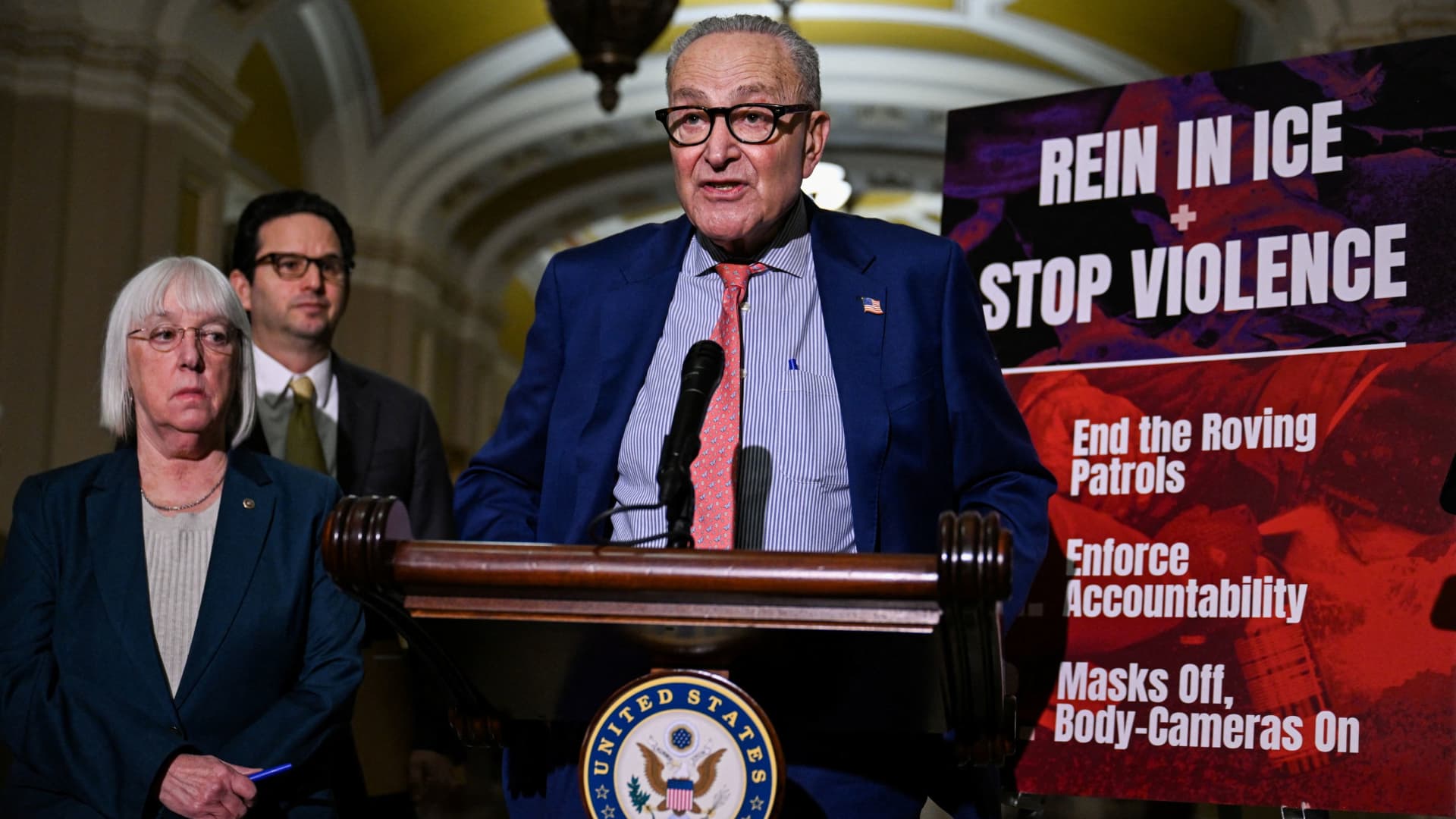
U.S. Senate Minority Leader Chuck Schumer (D.Y.) holds a press conference after the Democratic Party’s weekly policy luncheon at the Capitol in Washington, DC, on February 3, 2026.
Annabelle Gordon Reuter
Democrats in both chambers of Congress announced their calls for immigration enforcement reform Wednesday as Congress races to avoid a shutdown of the Department of Homeland Security. An agreement with Republicans seems a long way off.
Under the law enacted Tuesday that reopens much of the government, DHS received only two weeks of stopgap funding. Democrats are currently holding off on introducing a year-round spending bill until Republicans agree on immigration enforcement reform. Senate Democrats removed a year-round spending bill for DHS from a broader funding package after two Americans were shot and killed by federal agents in Minneapolis.
House Democratic Leader Hakeem Jeffries and Senate Minority Leader Chuck Schumer, both of New York, made their demands Wednesday at a press conference surrounded by dozens of Democratic lawmakers at the Capitol. Democratic demands include: Mandating body cameras. Immigration officers will be prohibited from wearing masks. Tighten restrictions on warrants and end “patrol” patrols.
“When Americans see pictures of thugs beating people, shoving people, and even shooting people, they say this is not America,” Schumer said. “It’s reminiscent of a dictatorship.”
Reaching agreement on changes to DHS procedures in the funding bill will be a difficult challenge for Congress. A spending bill would need 60 votes in the Senate to pass, meaning it would need Democratic support.
If DHS were to close, subordinate agencies such as Immigration and Customs Enforcement, the Federal Emergency Management Agency, the Transportation Security Administration, and the Coast Guard would also be affected.
Lawmakers on Wednesday lamented the difficulties in negotiations, highlighted by the impending Feb. 13 deadline for another shutdown.
“I’m a little disappointed. I don’t know if we’ve found much common ground yet,” Sen. Mike Rounds, R.S., told reporters. “I’m going to continue to work with them, but we have to fund the bill and we have to do it without compromising the law enforcement work that’s going on.”
Republicans said they were open to some of the Democratic proposals, including better training for federal workers and requiring body cameras. But bans on masks and requiring judicial warrants to arrest immigrants remain thorny challenges for Republicans.
“Training and body cameras are already in place, and we can sometimes agree on things like that,” Sen. John Hoeven (D), a member of the Senate Appropriations Committee, told CNBC in a brief interview. “The challenge with the face mask issue is that law enforcement officers have to be just as safe as the general public. … It’s a real security issue because investigators have this privacy protection.”
Hoeven said the judicial warrant requirement “would change the entire process and would make it very difficult for ICE to enforce the law.”
Sen. Markwayne Mullin (R-Okla.) echoed Hoeven, saying, “I’d be happy to talk about training,” when asked about the middle ground. However, removing the agent’s mask was Marin’s first move.
Senate Democrats are also weighing in on the other side.
“ICE agents are so determined to operate in secrecy that if the agency wants to shut down the agency, that’s their decision,” said Sen. Chris Murphy (D-Conn.), the ranking Democrat on the appropriations subcommittee that funds DHS. “We are not making unreasonable demands here.”
In the House, Speaker Mike Johnson (R-Louisiana) also declared the warrant changes non-negotiable. He was scheduled to meet with President Donald Trump on Wednesday.
“That’s not a path we should go down, nor should we go down,” Johnson said at a press conference on Tuesday regarding the warrant requirement. “We’re going to find a way to solve this problem, but we have to enforce our immigration laws.”
Earlier Wednesday, the Trump administration announced it would reduce the number of federal law enforcement officers in Minnesota by about 25% following criticism of overly aggressive behavior in the state.
— CNBC’s Emily Wilkins contributed to this report.
