


The hemp industry is bracing for layoffs, production cuts and billions of dollars in lost revenue after Congress late Wednesday passed a federal funding bill that included a surprising provision banning nearly all hemp-derived consumer products.
Hemp, a derivative of the cannabis plant, was legalized in the 2018 Farm Bill for industrial uses such as rope, textiles, and seeds. But the law’s broad definition created a loophole in federal regulations regarding THC, the psychoactive compound responsible for the high, allowing producers to extract the psychoactive cannabinoid from federally legal hemp, experts said. Companies have taken advantage of the gap and flooded the market with gummies, drinks, and e-cigarettes that produce a marijuana-like high.
The new ban, included in the legislation ending the longest shutdown in history, bans products with more than 0.4 milligrams of total THC per container. Industry executives said if the threshold went into effect within a year, 95% of the $28 billion retail cannabis market would disappear.
For reference, one hemp gummy typically contains 2.5 to 10 milligrams of THC, according to the Journal of Cannabis Research.
“This time we lost the battle,” said Jonathan Miller, general counsel for the U.S. Hemp Roundtable. “In effect, this is a complete and total ban on cannabis products in the United States.”
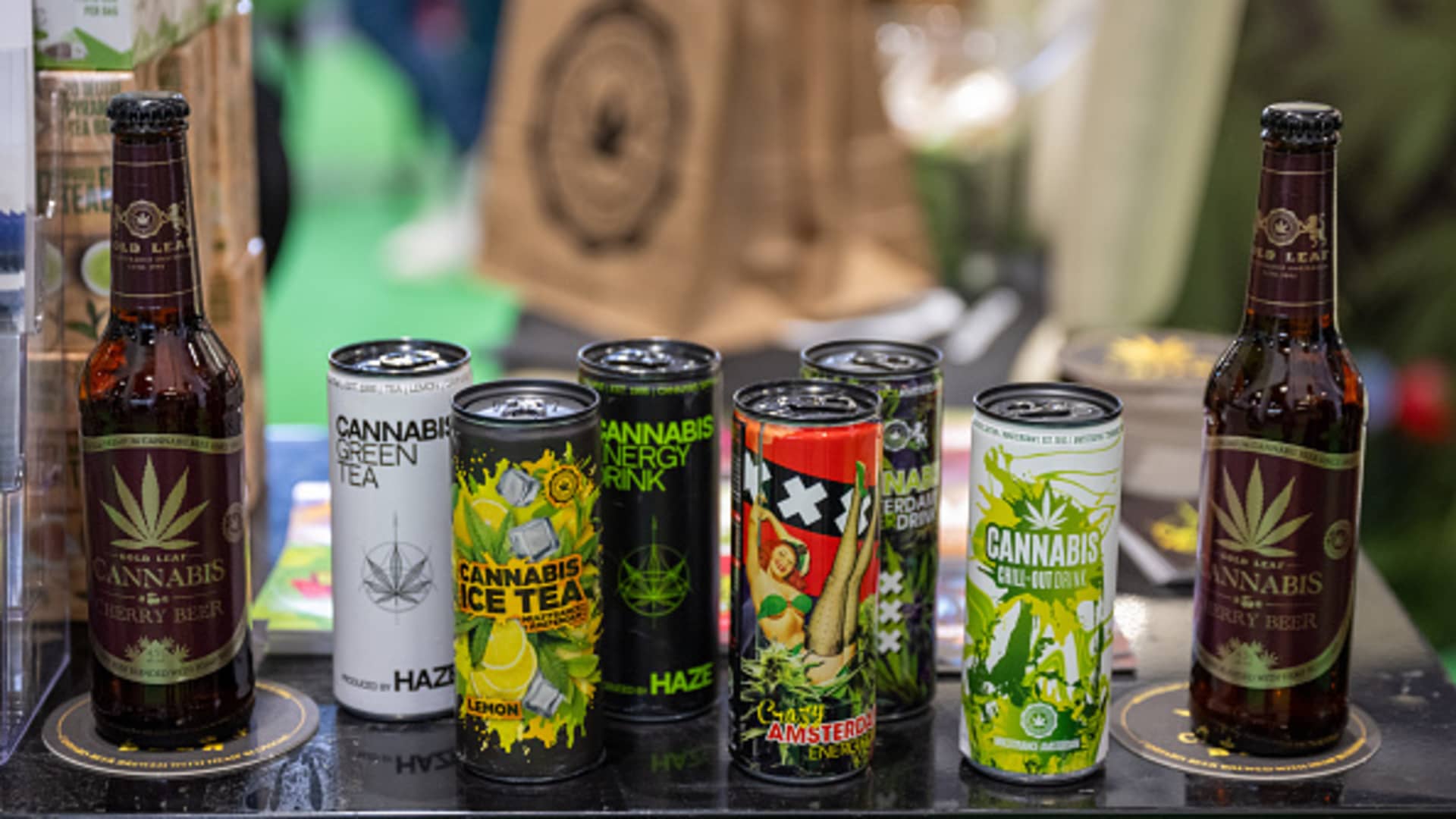
Cannabis beer and other cannabis-infused beverages will be sold at stalls at the “Mary Jane” hemp fair.
Monika Skolimovska | Picture Alliance | Getty Images
The new cap replaced the 2018 Farm Bill’s definition of hemp based on THC concentration, which allowed products with less than 0.3% THC by weight rather than total amount.
“It will take a year to resolve this, and if we don’t resolve it by then, there could be losses across the industry,” Miller said.
More than 300,000 jobs in the cannabis economy are at risk, from farmers and extractors to manufacturers, logistics companies and retailers, according to cannabis and hemp research firm Whitney Economics.
Michael Gorenstein, CEO of cannabis producer Cronos Group, said the knock-on effects could hit land use, contracted acres and capital financing, as farmers who expanded cannabis cultivation after 2018 could suddenly face contract cancellations or restructuring. States with the largest hemp infrastructure, such as Kentucky, Texas and Utah, are likely to face the most severe economic impact, hemp executives said.
“Many small retailers, small businesses and farmers rely on hemp sales to survive,” Gorenstein told CNBC. “When they start losing business, losing jobs, losing crops, that’s going to put a lot of pressure on them.”
The crackdown marks a dramatic reversal from 2018, when Sen. Mitch McConnell (R-Ky.) championed hemp legalization to create a new national agricultural commodity and economic driver for Kentucky.
But after the bill passed, a lack of federal regulation led to the emergence of a patchwork market with a wide range of safety issues, from mislabeled and untested products to products with potencies comparable to recreational marijuana, government officials and industry experts say.
McConnell and other Republicans argued that the new restrictions “restore the original intent” of the Farm Bill. McConnell said closing the loopholes will be key to preserving his farm policy legacy before he retires next year.
“This is his (Mr McConnell’s) signature law, the Cannabis Act, and he wanted to fix it,” said cannabis company CEO Boris Jordan. Curaleafhe told CNBC. “Typically, as a last act, the Senate would support a retiring senator, especially one as senior as he is. This was his last-minute request.”
But not all Republicans agree. Sen. Rand Paul of Kentucky has been debating marijuana with colleagues for months, slamming the provision as an overreach that will “kill jobs and put farmers out of business,” adding that “every marijuana seed in the country needs to be destroyed.”
“This is the most thoughtless and ignorant proposal for an industry I’ve seen in a long time,” Paul said after the ban passed.
In this July 5, 2018 photo, Senate Majority Leader Mitch McConnell is seen inspecting marijuana strips removed from a bale at a processing plant in Louisville, Kentucky. McConnell led the push to legalize marijuana in Congress.
AP Photo | Bruce Schreiner
Leaders like Jordan say the legal market will sharply shrink due to prohibition, but warn that consumer demand for cannabis-derived THC will not. Research shows that demand for marijuana and other THC-based products has continued to increase in recent years as some consumers move away from alcohol and drink less overall.
Cannabis executives have warned that its growing popularity could lead to billions of dollars in black market sales, where there are no product inspections, age restrictions or tax compliance.
“What this ban is going to do is force these smaller players into the illegal market,” Jordan said. “Companies have invested too much money in this area and the demand is still there and continues to grow. They (companies) are not just leaving, they are entering illegal markets and putting more people at risk.”
Also, as products move underground, law enforcement may struggle to trace the supply chain, Gorenstein said.
“When things disappear from the formal economy, the bad guys flourish,” Gorenstein said.
Gorenstein and Miller said state and local governments could also lose out on millions of dollars in tax revenue from marijuana sales. Some states use these funds to support addiction services, county budgets, and public health programs.
Looking ahead, industry leaders say the only lasting solution is federal standards, not bans. Many support a model that shares responsibility between agencies, with the Food and Drug Administration responsible for overseeing product safety and the Alcohol and Tobacco Tax and Trade Bureau responsible for taxation and distribution.
Executives also compared the current environment to the early e-cigarette boom, where products like Juul offered fruity, candy-like cartridges and quickly became popular with uneven oversight, before the FDA intervened.
George Arcos, CEO of cannabis company Verano Holdings, told CNBC that “too many people are taking away freedoms that put end users at risk.” “We like strict regulations. We want consumer safety to be kept in mind for every product that is manufactured, and we want to see that achieved.”
Meanwhile, the industry is preparing for a court-wide lobbying effort aimed at replacing the ban with federal testing, labeling, and age-restriction rules.
“We already have members of Congress introducing regulatory legislation, and we’re committed to supporting them and working at the grassroots to galvanize citizen action on this issue,” Miller said. “We operate across sectors.”
At the same time, the Trump administration is “considering” reclassifying marijuana from a Schedule I drug to a Schedule III drug, along with heroin and LSD. The move would not legalize recreational marijuana, but it would make it easier to sell, supporters said.
“We expect big changes across the board next year, and how that plays out could determine the future of investment and the industry,” Gorenstein said.
