

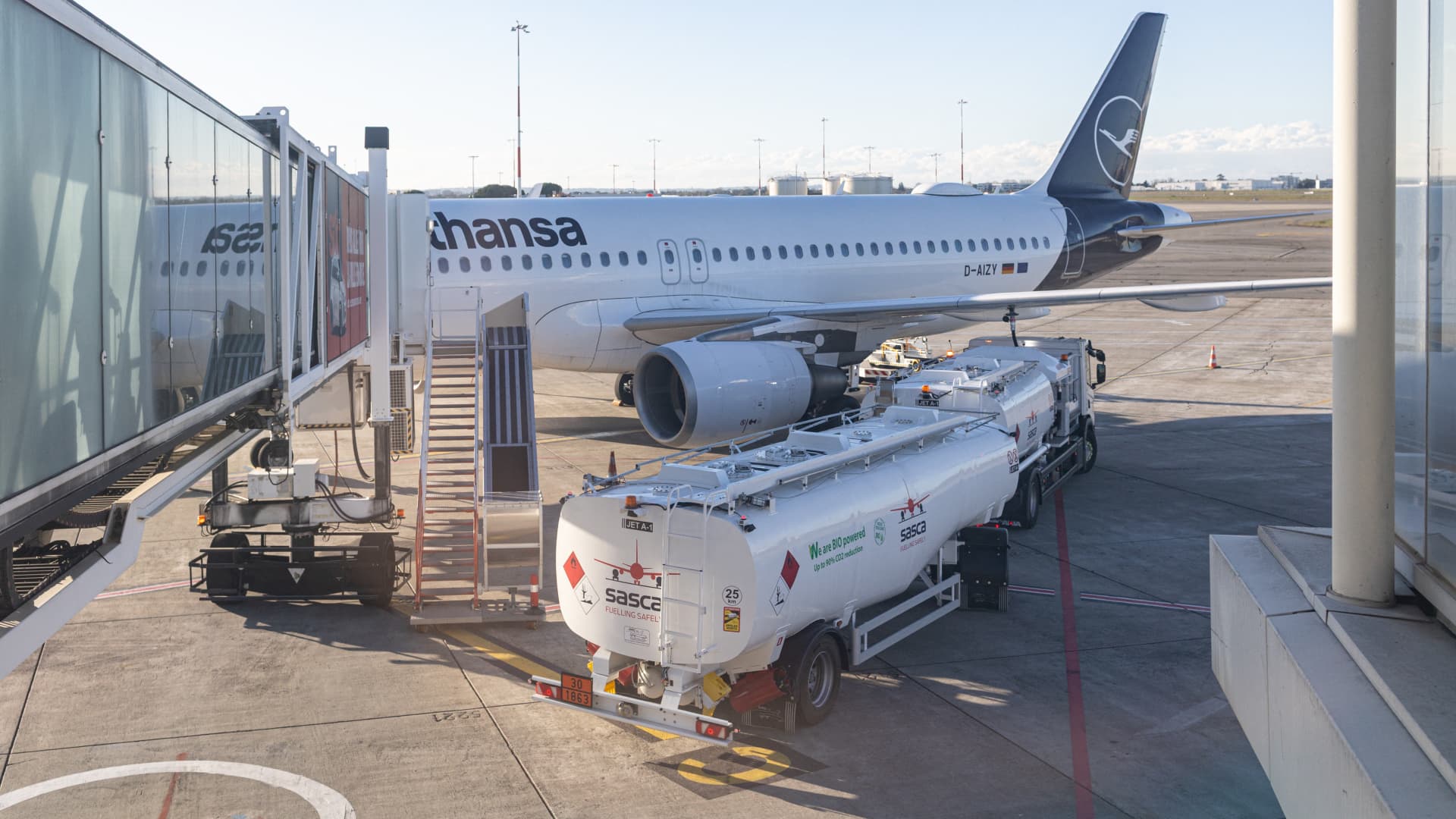
A SASCA fuel truck refuels on the apron with a Lufthansa passenger plane parked at the gate at Toulouse-Blagnac Airport in Blagnac, Occitanie, France, on March 15, 2026.
Isabel Salimento | AFP | Getty Images
The airline industry’s problem is not just the soaring price of jet fuel. Now, is that enough?
Since the United States and Israel attacked Iran on February 28, jet fuel prices in the United States have nearly doubled from $2.50 per gallon on February 27 to $4.88 per gallon on April 2, and are rising even higher in other regions. The effective closure of the Strait of Hormuz has disrupted supplies of both crude oil and refined products such as jet fuel, further pushing prices higher.
This has forced airlines to consider reducing their number of international flights.
Carsten Spohr, CEO of Germany’s Lufthansa, told employees in a webcast last week that the airline has assigned a team to plan for contingencies such as reduced demand or jet fuel shortages due to wars in the Middle East, a spokesperson said. These plans may include grounding some aircraft.
The United States produces large amounts of jet fuel and is less at risk than other regions, such as Europe and parts of Asia. But some U.S. airlines could face aircraft shortages for international travel as planes fill up locally.
united airlines Chief Executive Officer Scott Kirby told reporters late last month that the airline, which flies more to Asia than any other U.S. airline, would have to cut back on flights to Asia. He also said it was “not impossible” that airlines would have to cut services in the area en masse.
He noted that as jet fuel prices rise, the problem could be worse in areas of the U.S. that are not connected by pipelines.
“Without sufficient refining capacity, previous and future fuel prices are more susceptible to supply shortages on the West Coast than anywhere else in the country,” he said.
Mr. Kirby told employees in early March that the company was preparing for oil prices to remain above $100 a barrel through 2027 and would cut some flights in the short term.
“To be clear, nothing changes in our long-term plans for aircraft deliveries or total capacity beyond 2027, but there is no point in spending cash in the short term on flights that cannot absorb fuel costs,” he said in a March 20 message to employees.
Travel demand wildcard
While airlines as a whole often adjust their schedules throughout the year to suit demand, aircraft availability and other complex circumstances, they plan to reduce some flights in the coming months.
Domestic capacity for U.S. airlines is expected to rise 2.1% in the second quarter, below the previously projected 2.3% increase, while total capacity is expected to rise 1.1%, slowing from the 2.4% increase in the week ending March 20, UBS reported Monday.
“Further capacity cuts are expected in the coming weeks,” UBS said.
Airline executives say travel demand has been strong so far, but tight fuel and rising prices are causing headaches for airlines and passengers alike as the peak summer travel season approaches.
Fuel is typically the second-largest expense for airlines after personnel, and airlines are already raising prices for things like airfare and checked baggage to cover the additional costs.
On April 6, 2026, in Tangerang, a suburb of Jakarta, Indonesia, a truck parks after refueling a Citylink Airbus at Soekarno-Hatta International Airport following the government’s approval of jet fuel surcharges amid the ongoing conflict between the United States, Israel, and Iran.
Agen Dinar Urfiana | Reuters
As airline earnings begin Wednesday, investors will tune in for more insight into how rising jet fuel prices could impact the industry. delta airlines. The airline owns a refinery and could benefit from jet fuel sales.
Delta Air Lines joined in on Tuesday by increasing its checked baggage fees. jet blue airlines And United did the same last week.
Strong demand, especially compared to this time last year, could further isolate airlines, at least in the U.S. Bookings fell last year as President Donald Trump’s trade war began with high tariffs, markets slumped and government cuts led by Elon Musk’s so-called Office of Government Efficiency took effect.
“There remains a positive outlook on demand, but fuel at $4/4.50 a gallon for an extended period of time is not something airlines can afford to tolerate,” said Raymond James aviation analyst Savanti Sis. “If fuel remains high, capacity will only be cut.”
Airlines could face even bigger problems if higher gas prices or other consumer pressures cause spending to fall.
“We’re watching airlines very closely right now, and we don’t need this to continue at these (fuel price) levels for very long before we start to see the potential for rating pressure,” said Joseph Lorena, senior director at Fitch Ratings, which covers U.S. airlines.
