

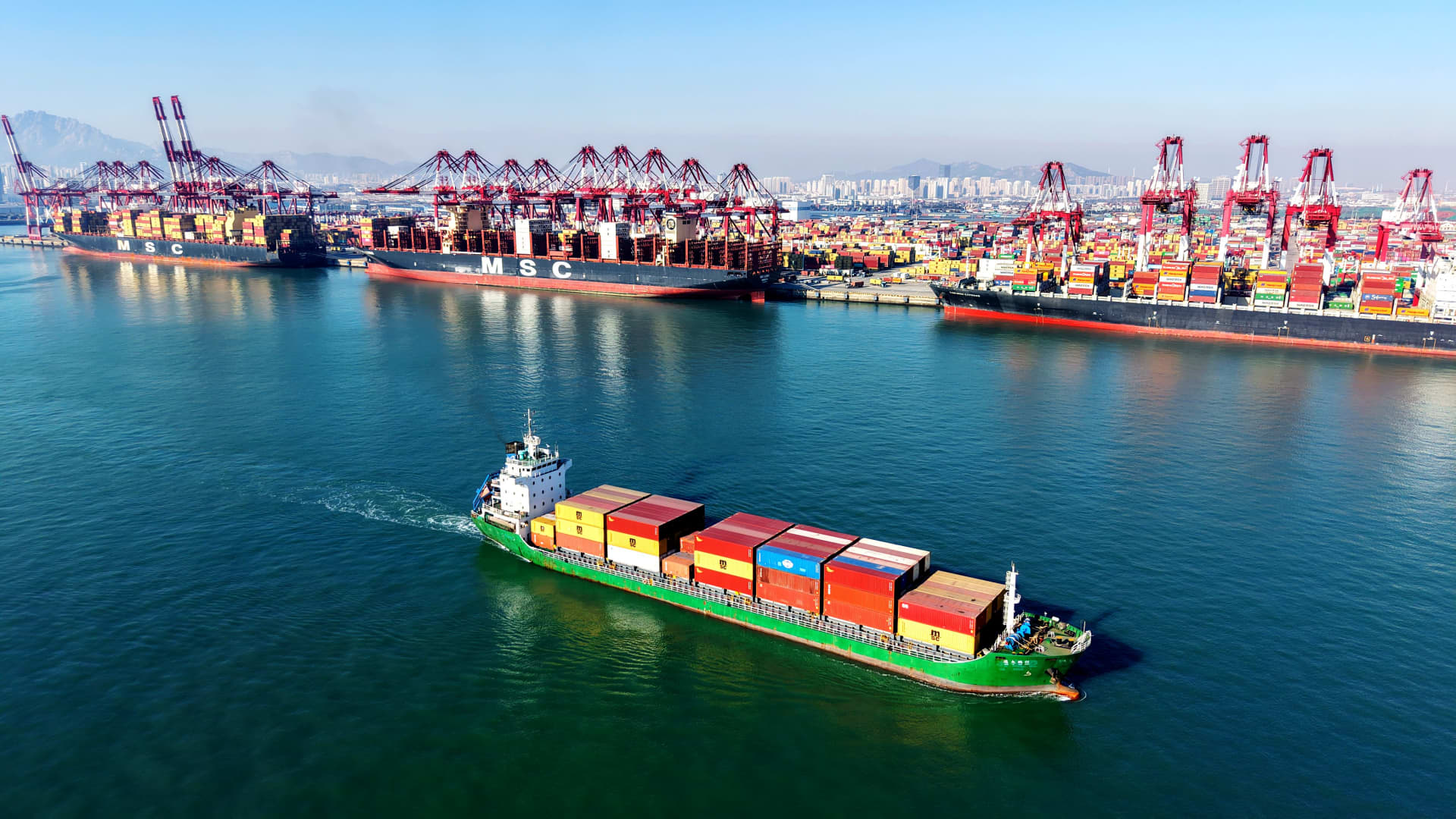
A cargo ship loaded with containers departs from Qingdao Port in Qingdao City, Shandong Province, China, on December 4, 2025.
Cost Photo | Null Photo | Getty Images
China’s trade surplus exceeded $1 trillion for the first time in history in November, despite a significant drop in exports to the United States due to the ongoing global trade war.
In the first 11 months of this year, China’s overall exports increased by 5.4% compared to the same period in 2024, but imports decreased by 0.6%, bringing this year’s trade surplus to $1.076 trillion as of November, an increase of 21.6% from a year ago.
The move comes even as overall exports in November exceeded market expectations as manufacturers piled up shipments to other markets, despite a recent trade deal between the two economies, and even as China’s goods bound for the U.S. fell for the eighth straight month.
“China continues to become less dependent on the U.S. for goods,” said Peter Boockvar, chief investment officer at One Point BFG Wealth Partners. “China has huge domestic savings and will again try to encourage consumers to release more of it to reduce dependence on manufacturing and exports.”
China’s overseas shipments rose 5.9% in US dollar terms from a year earlier last month, customs data showed on Monday, beating the 3.8% increase expected by economists polled by Reuters. The growth marks a rebound from October’s unexpected 1.1% decline, and the first negative decline since March 2024.
Imports rose 1.9% last month, falling short of the expected 3% increase, as a prolonged housing recession and rising job concerns continue to weigh on domestic consumption. The growth rate was higher than 1% in October.
Chinese authorities have renewed their commitment to expand imports and balance trade amid widespread criticism of aggressive exports.
But trade data bodes well for the country’s growth prospects, according to Citigroup.
“We were among the first to raise our 2025E full-year GDP forecast to 5% in June, and the subsequent strong trade performance has further increased our confidence in our forecast,” Xianglong Yu, Citi’s chief China economist, said in a note. “Amid the US-China tariff truce and China’s industrial competitiveness, we believe exports will remain a key driver of GDP growth next year.”

China is still able to ship goods indirectly to U.S. ports through other countries, such as Vietnam, although tensions with the U.S. have sharply reduced exports. Recent talks have helped ease some of the acrimony.
Despite President Xi Jinping and U.S. President Donald Trump reaching an agreement in South Korea in late October, exports to the United States fell 28.6% in November, marking the eighth straight month of double-digit declines in shipments to the world’s largest consumer market. Imports from the United States decreased by 19% from the previous year.
While China’s trade surplus has soared, the US trade imbalance has narrowed sharply.
The US trade deficit narrowed to $59.6 billion in August, down from $78.2 billion in July and $71.2 billion compared to the same month in 2024. Exports reached a record high of $62.4 billion, and imports also set new standards at $13.6 billion. China’s year-to-date deficit was $185.2 billion, down about 21% from 2024.
“Despite the trade ceasefire, the US still imposes higher tariffs on China than (many) other countries,” said Gary Ng, senior economist at Natixis, adding that Chinese exporters are likely to continue using third-market facilities to export to the US and “that could become the norm going forward.”
According to the Peterson Institute for International Economics, taxes on Chinese products remain at about 47.5%. The Chinese government’s tariffs on goods imported from the United States are approximately 32%.
So far this year, China’s exports to the US have fallen 18.9% from a year ago, and imports have fallen 13.2%.
The drop in U.S. exports in November was offset by a surge in shipments to other markets, particularly China’s two largest trading blocs, the European Union and the Association of Southeast Asian Nations. China’s exports to ASEAN and the EU increased by more than 8% and nearly 15%, respectively.
However, challenges lie ahead.
“In our view, despite the tariff ceasefire with the US, policymakers are likely to remain mindful of potential trade tensions,” said Yu, the Citi economist. “Our base case is that the seemingly fragile US-China ceasefire will remain in place until 2026, but as China’s trade surplus exceeds ($1 trillion), trade tensions with other partners such as France may emerge. We believe China may introduce additional voluntary trade restrictions to alleviate the trade imbalance.”
Laggard under trade agreements
After signing a trade cease-fire in October, China and the United States agreed to lift high tariffs on each other’s products and export restrictions on critical minerals and advanced technologies, and China pledged to increase its purchases of American soybeans and work with the United States to control fentanyl leaks.
China’s rare earth exports accelerated in November, with 5,494 tonnes of the critical mineral shipped, compared with 4,343.5 tonnes in October, a 24% year-on-year increase. The Department of Commerce is reportedly designing a new rare earth licensing system that could speed up shipments.
The country’s overall soybean imports rose 13% year-on-year to 8.1 million tonnes in November, but were down from October levels, indicating delays in fulfilling a promise to buy 12 million tonnes of U.S. soybeans by the end of the year.
“We expect export growth to remain resilient into 2026,” Nomura’s China economist Jing Wang said in a note. “However, in our view, export growth is likely to moderate. Despite China’s solid manufacturing progress, export growth may return to its long-term average, especially as more countries erect trade barriers.”
Wang added that the truce with the US may not be lost and that “we see a second China shock rapidly approaching, which may force Europe to impose tougher measures to protect manufacturing.”
Future policy meeting
Chinese policymakers are scheduled to meet for the annual Central Economic Work Conference later this month to discuss next year’s economic growth targets, budget and policy priorities. Specific targets will not be formally announced until a “two-session” meeting next March.
Zhiwei Zhang, president and chief economist at Pinpoint Asset Management, said a pick-up in export growth would help alleviate the drag caused by weak domestic demand and put the economy on track to achieve this year’s growth target of “about 5%.”
The Chinese government is expected to keep its 2026 growth target at “about 5%,” according to Goldman Sachs, and a lackluster outlook for the fourth quarter of 2025 will require gradual policy easing early next year to ensure growth accelerates.
China’s factory activity shrank for the eighth straight month in November, with new orders continuing to shrink, according to an official manufacturing survey. A private survey of exporters showed that manufacturing activity contracted unexpectedly.
Wall Street banks expect Chinese authorities to raise the cap on fiscal deficit growth by 1 percentage point of GDP, cut policy interest rates by a total of 20 basis points and step up economic stimulus to curb the housing recession.

Subscribe now
The renminbi’s appreciation in recent weeks does not appear to be stopping the flow of Chinese exports. The offshore yuan has appreciated nearly 5% since April and stood at 7.0669 yuan to the dollar at market open on Monday, according to LSEG data.
Despite a steady 5% annual GDP growth rate from 2023 onwards, China “urgently needs to curb export dependence and pivot to domestic consumption to ensure sustainable growth,” Weijiang Xiang, CEO of private equity firm PAG, said in an op-ed last month.
Xiang added that the contribution of consumption to economic growth could increase from the current 53% to the 2023 level of 86% as the yuan’s strength lowers import costs and increases household purchasing power.
