

Beijing
—
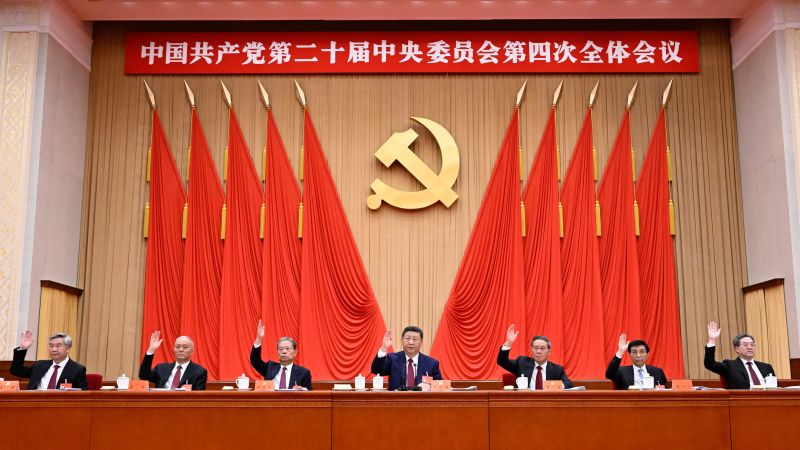
Chinese leaders have just concluded a closed-door meeting focused on developing the country’s economic blueprint for the next five years. The blueprint includes a wide range of plans, covering everything from accelerating technological innovation to streamlining the way food is grown on China’s farms.
The stakes in developing that strategy are high as Chinese authorities are under pressure to reduce dependence on high-tech imports and address economic weaknesses in the face of escalating conflict with the United States.
But the plan also provides leader Xi Jinping with a source of confidence in China’s rise, an opportunity to demonstrate the authoritarian nation’s ability to create and realize a far-reaching vision, especially at a time when Washington is bogged down by a government shutdown over spending this fiscal year.
Chinese state media and officials have been less cautious in recent days about touting its competitive advantage.
“Scientifically formulating and continuously implementing five-year plans…is an important political advantage of socialism with Chinese characteristics. Many foreign political parties envy this,” Jiang Jinquan, an official at the Policy Research Office of the Communist Party of China Central Committee, said at a press conference on Friday, adding that such plans are essential to “gaining strategic initiatives in fierce international competition.”
An editorial in the Communist Party’s mouthpiece People’s Daily published on Thursday praised China for “considering the entire country as a chessboard… and continuing to move steadily forward in the right direction,” while “some countries are still trapped in myopic thinking and constant policy changes under multiparty systems.”
Another article in state news agency Xinhua quoted Tsinghua University professor Yan Yilong as saying that “long-termism,” which combines continuity and flexibility, “is difficult for Western countries to match.”
Meanwhile, another commentary published by Beijing Daily spotlighted the “out of control” situation in the United States, pointing to the “No Kings” protests, the government shutdown, and the controversial AI-generated video meme shared by US President Donald Trump over the weekend.
“[America’s]halo is an illusion and the myth is fragile. America is in many ways a failed state, in President Trump’s own words, ‘dying from within,'” he concluded.
Of course, such rhetoric is not uncommon in China’s tightly controlled propaganda environment. And officials have long sought to exaggerate the misdeeds of other countries, especially the United States, to improve their country’s image to domestic and, increasingly, international audiences.
But the sentiment also reflects the thinking of China’s ruling Communist Party and its leader, Xi, as the two countries compete over technology and trade, grappling with how to structure their economic relationship and rivalry.
And the chance to amplify that sentiment through the glamor of developing his next five-year plan could not have come at a better time for Mr.
Full details of the next five-year plan will not be made public until it is approved by China’s rubber stamp legislature in March. But the outline of priorities approved by a powerful Communist Party committee held over four days this week exuded confidence in China’s continued rise.
“We will strive for another five years to achieve a major leap forward in our economic strength, scientific and technological strength, national defense strength, overall national strength and international influence by 2035,” said a communiqué released by state media on Thursday.
Officials will “accelerate development that builds on China’s strengths in manufacturing, product quality, aerospace, transportation, and cyberspace.”
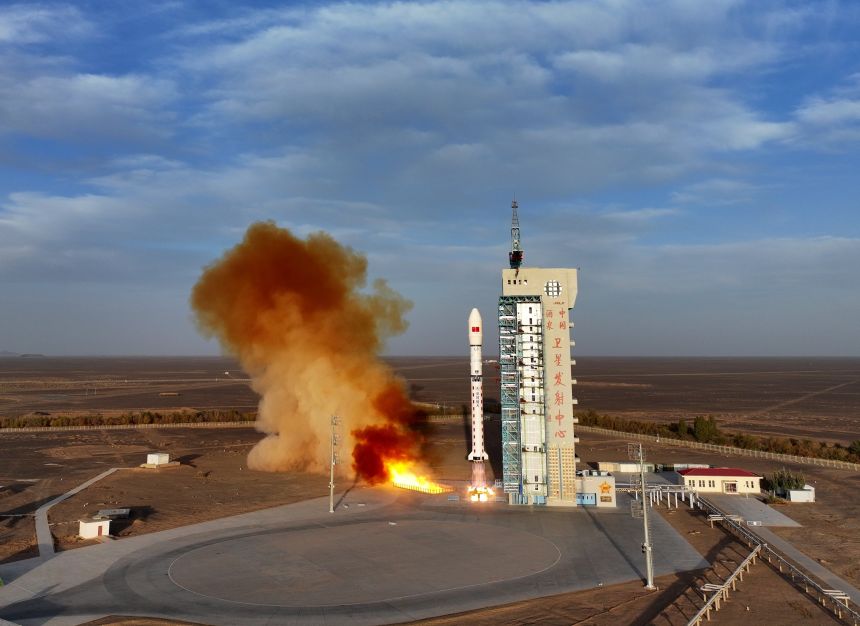
Building on China’s current efforts to improve its manufacturing and innovation capabilities, the leaders said they will adhere to “accelerating high-level science and technology independence” and introducing high technology into industry.
“The proposal puts forward a forward-looking layout for future industries that promotes quantum technology, biotechnology, hydrogen energy, nuclear fusion, brain-computer interfaces, embodied intelligence and sixth-generation mobile communications as new drivers of economic growth,” Zheng Shanjie, chairman of China’s National Development and Reform Commission, told reporters on Friday.
Signals after the Beijing meeting suggested that China will further strengthen its position as a manufacturing and industrial power, despite some analysts’ long-standing view that it should move towards a services-oriented economy like many developed countries. The communiqué also emphasized the importance of national security and the need to “accelerate the building of advanced combat capabilities” of the military.
Officials pointed to efforts to address challenges such as weak domestic consumption, socio-economic inequality and intense domestic competition related to “entrainment” or overcapacity. According to the communiqué, China will “strongly expand consumption” and “improve the social security system” as well as further open up its market to international players.
How exactly authorities plan to achieve these goals will become clearer in the coming months and years.
Observers have long noted China’s tightly controlled system’s ability to achieve far-reaching goals.
The country has raised hundreds of millions from poverty, transformed itself into the world’s second-largest economy and engine of global growth, and more recently emerged as a technology powerhouse and champion of the green transition around the world.

And as the United States reshapes its foreign and domestic policies under the Trump administration, Beijing is also touting China’s plans as proof that it, not the United States, is a responsible world leader.
“In today’s global environment, some major powers are changing their policies frequently, and such ‘unpredictability’ casts a shadow on world peace and development,” said an editorial in the state-run tabloid Global Times published on Friday.
“China’s development roadmap for the next five years announced in the Communiqué provides the world with something truly rare in these turbulent times: certainty,” he added.
Unlike Western democracies, where the country’s vision is articulated by popularly elected leaders and can often be rejected by opposition politicians, China’s five-year plans are developed at the top of the Communist Party and ostensibly through what Beijing calls “popular consultation” with various sectors of society. According to state media, Mr. Xi is “leading” the process.
Once set, five-year plans serve as marching orders to officials across the vast machinery of government, and guides for businesses, universities, and other organizations on how to align their strategies with those of the party.
Such plans sometimes had disastrous results. The Great Leap Forward, associated with the Second Five-Year Plan in 1958, was supposed to spur China’s industrialization, but instead it plunged the country into starvation, killing an estimated tens of millions of people.
In recent years, the plan has fueled China’s vigorous efforts to build new industries such as green technology and electric vehicles and upgrade factory production, but it also shows some of the shortcomings of state-backed plans.
Let’s take EVs as an example. China currently dominates this sector globally, but state aid has also caused artificial market saturation, leading to a wave of price wars and corporate bankruptcies.
But for Mr. Xi, who is determined not to see China’s rise hampered by Western export restrictions and trade barriers, it is clear that the power of his 2030 deadline vision underscores his belief that his system will ultimately prevail.
Or, in his own words, recently quoted in state media, the plan would yield “vital political advantages” when it comes to China’s “reconstruction.”
