

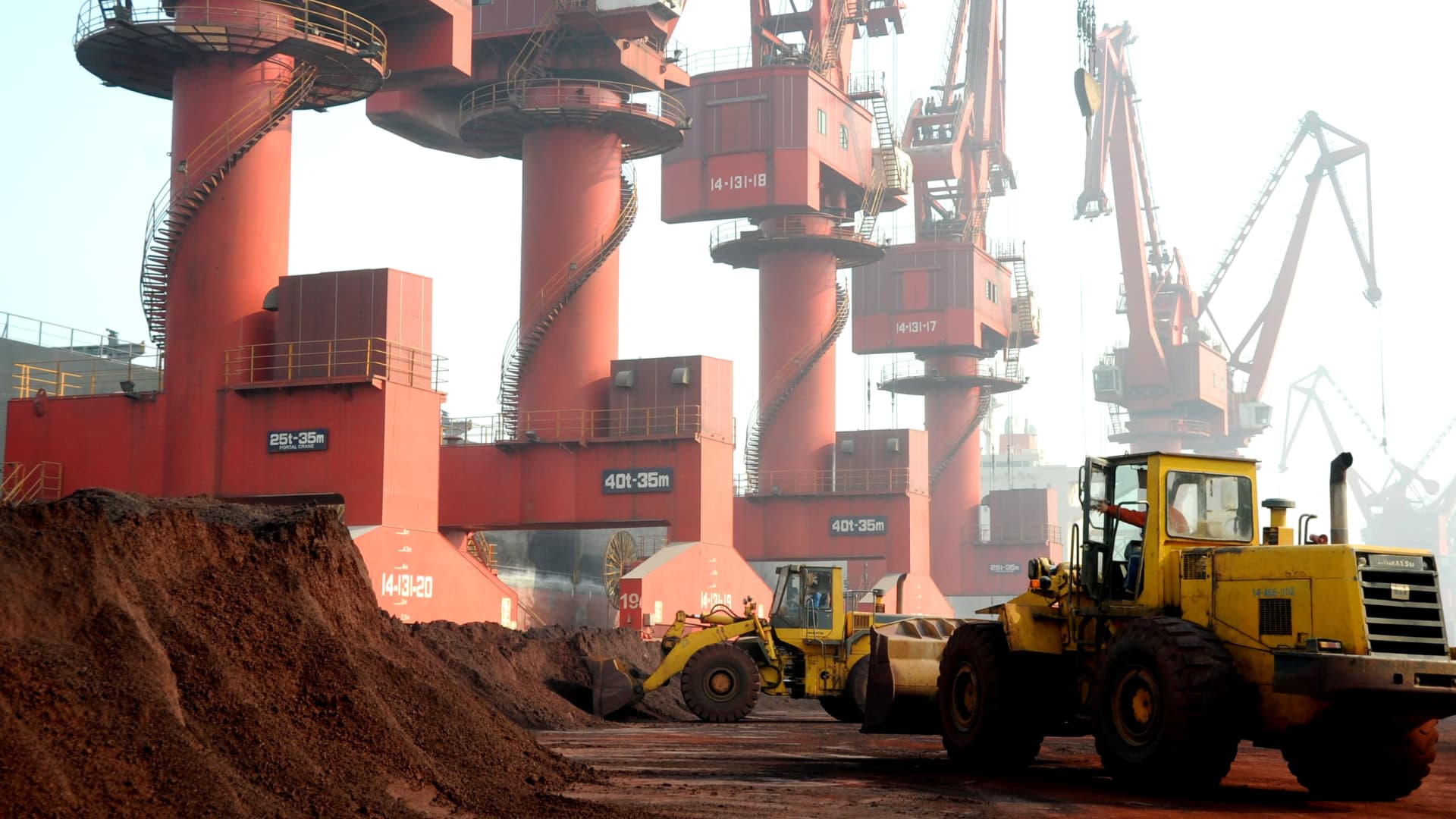
File photo: Workers transport soil containing rare earth elements for export at a port in Lianyungang, Jiangsu province, China, October 31, 2010.
Stringer | Reuters
China on Tuesday responded to the US-Australia critical minerals agreement, saying resource-rich rare earth countries should play an “active role” in stabilizing critical minerals supply chains.
A Chinese Foreign Ministry spokesperson was asked about the US-Australia Critical Minerals Agreement, which is seen as an effort to counter Chinese domination.
“The formation of global production and supply chains is the result of market and enterprise choices,” Guo Jiakun said, according to NBC.
He added: “Resource-rich countries with important minerals should play an active role in safeguarding the safety and stability of industrial and supply chains and ensuring normal economic and trade cooperation.”
Rare earths are a category of minerals that are important to a wide range of products from automobiles to semiconductors.
US President Donald Trump and Australian Prime Minister Anthony Albanese signed a deal at the White House on Monday aimed at increasing supplies of rare earths and other critical minerals.
The framework agreement is said to be an $8.5 billion agreement between the allies and comes shortly after China imposed stricter export controls on rare earths.
Earlier this month, China’s Ministry of Commerce announced expanded export restrictions on rare earths and related technology to prevent the minerals from being “misused” in the military and other sensitive sectors.
European and American auto industry groups have also warned of new export restrictions, saying the measures could pave the way for a period of supply chain disruption.
Australian Prime Minister Anthony Albanese (left) and U.S. President Donald Trump shake hands as they sign an $8.5 billion rare earth mineral agreement during a bilateral meeting in the Cabinet Office of the White House in Washington, DC, on October 20, 2025.
Anna Moneymaker | Getty Images
As the transition to clean energy accelerates, demand for rare earths and critical minerals is expected to increase rapidly in the coming years.
China is the undisputed leader in the critical mineral supply chain, accounting for approximately 60% of the world’s rare earth minerals and materials production. US officials have previously warned that this poses a strategic challenge in the transition to more sustainable energy sources.
rare earth stocks
George Cheverley, Natural Resources Portfolio Manager at Ninety One, said the US-Australia deal is a “good deal” aimed at increasing supplies of critical minerals outside China, although it will take a considerable amount of time.
“From an investment perspective, it’s not that obvious. This is a very small sector,” Cheveley told CNBC’s “Squawk Box Europe” on Tuesday.
“And clearly, when you’re dealing with an area that’s highly politicized and where government money is basically going in as a subsidy, it tells you that it’s hard to make it work economically,” he added.
Shares in Australia’s largest critical metals and rare earths companies soared on Tuesday, while others fell after early gains.
linus rare earthAustralia’s largest rare earths producer by market capitalization fell 7.6% after posting gains in early trade. mineral sand miner dolphin resources Lithium producing countries fell 0.1% Pilbara Minerals Approximately 2.6% was added.
Latrobe Magnesium, Australia’s main producer of the important metal magnesium, recorded a rise of more than 15%.
In the U.S., rare earth stocks fell slightly in premarket trading. Critical Metals fell 3.8%, US Rare Earths fell 5% and MP Materials fell 1.7%.
—CNBC’s Evelyn Cheng and Dylan Butts contributed to this report.
