

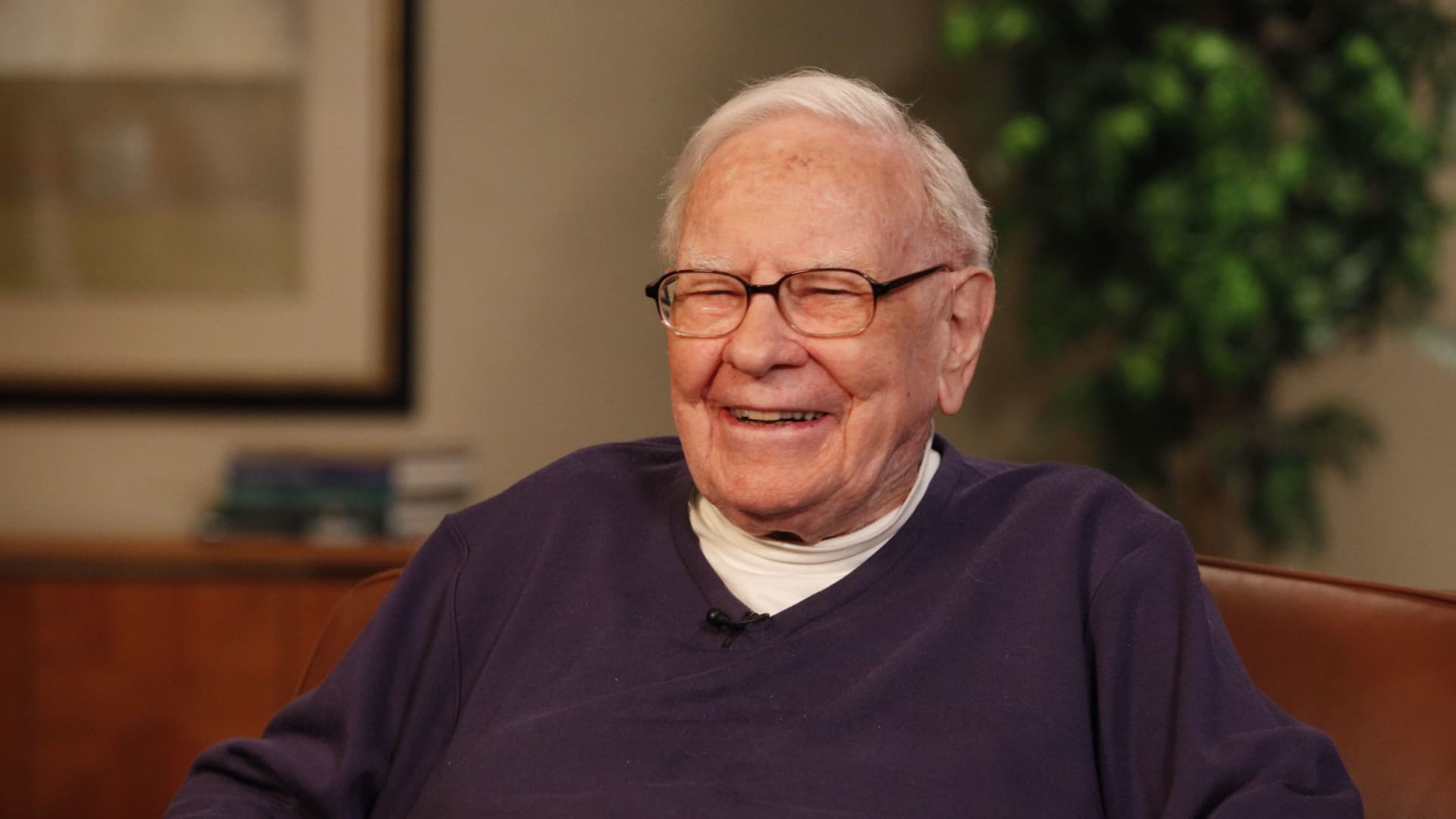
BECKY QUICK: Warren, welcome. It is wonderful to see you this morning.
WARREN BUFFETT: It is fun to be on.
QUICK: You are on for an interesting reason.
For 22 years, you had been holding an annual luncheon — an auction for a luncheon — to benefit the Glide Foundation in San Francisco.
You retired from that – from doing that — back in 2022 after you’d raised more than 50 million dollars. I think the last auction that you raised — that you did — raised – 19 million —
BUFFETT: 19 million.
QUICK: — one hundred dollars ($19,000,100) for the Glide Foundation.
And you kind of hung it up and said that was going to be the end.
You are back with a new announcement today that there is a new auction that is coming, with a twist.
This time it’s Warren Buffett, Stephen Curry and Ayesha Curry, and they’re going to be having a new luncheon to benefit not only the Glide Foundation, but the Currys’ foundation as well, which is, Eat, Learn, Play.
And this auction is going to be held May 7th. It starts at 7:30pm Pacific time. It closes on May 14 at 7:30pm exactly.
And all of the benefits of that is going to go to benefit these two foundations, Glide and the Eat, Learn, Play Foundation.
How did this come about? Why did you unretire from this?
BUFFETT: Well, let me tell you first how I got into it, because my first wife, Susie, was living in San Francisco and she said to me, this guy is real. (Laughs) And — and —
QUICK: This guy being Cecil.
BUFFETT: Cecil. Yeah, Cecil Williams, who came to that church in 1963. And it was a dying church in a changing part of the neighborhood in San Francisco. And they weren’t glad to see him, the hundred or so parishioners that were left.
But he turned it into something that became — it gave hope and life to people that the world had given up on.
And I went on Sunday still expecting something less than that — (laughs) — and I watched Cecil, and I could see what he was doing, and he was for real.
And so, Susie, at some point, said, why don’t you do something to raise some money for him? You know, and so, I think she actually selected the idea of the lunch, and then we did the lunch.
The first three lunches brought 25 thousand dollars each because they were localized. And then we got the idea of going on eBay. And then we started getting bids from around the world.
And it just generally kept moving up, although it wasn’t every single year, but it just — it just put us on the map.
And as the final amount, 19 million, was raised — now that was kind of raised because it was the last one, I think. I was doing (inaudible) that had bought an earlier lunch, but I didn’t make any calls to him or do anything. He just turned out to be — it inspires people. And Smith & Wollensky, as you know, covered it in New York sometimes.
QUICK: That’s often where you had the lunch with the winners of this.
BUFFETT: And some of them wanted to be anonymous. And a couple came to Omaha along the line because they had some special thing they wanted to talk about.
But I think everybody felt like they were glad they did it, and I was glad to do it, and —
QUICK: So why’d you stop?
BUFFETT: Well, I ran out of gas. (Laughs)
I — you know, I got to be what, 93 at that time, or something like that. And it just — same reason I gave up teaching.
I teach — I was — I taught every year from when I was 21 till 88 or 89. And there just came a period when your body said different things to you. And you should turn it over to somebody, just like I did at Berkshire.
I mean, at different times, on different things, but I — and so we thought we had a continuation of it all set up, and then for one reason or another, it fizzled.
And so the last two years they — well, I think the first year, some board member made up some members — but basically the auction disappeared.
QUICK: So they haven’t had the funds coming in.
BUFFETT: No. And Cecil Williams was about my age in all this — and it got so I couldn’t understand him on the phone or anything like that, but all he wanted was this to continue.
And so, I don’t know where the idea came from exactly, but I said I would do one more, just to get us started again and to have Steph Curry join us, I mean, in the Bay Area. I mean, it’s just a natural. And —
QUICK: Right. The Eat, Learn, Play Foundation that Stephen and Ayesha Curry have set up is in the Bay Area as well, so they’re —
BUFFETT: Exactly.
QUICK: — locally focused on all of these things.
For people who don’t know, the Glide Foundation was also, it was highlighted in the movie “The Pursuit of Happyness” with Will Smith. So people may have a little bit of an idea of what that’s about.
Why Steph Curry? How did that come about?
BUFFETT: Well, I mean, who can say it better?
I mean, he’s worked with the kids in Oakland. I mean, these are kids between five and 15, or something like that, and he plays basketball with them.
And I mean, he’s a terrific guy. I don’t — you know, I haven’t met him personally.
QUICK: But you did talk to Stephen and Ayesha.
BUFFETT: We had a long talk on the phone.
And it’s his baby, and he can carry it forth.
And, incidentally, whatever is bid this year, I will make the equal contribution. I don’t think — Steph doesn’t know this yet — but I will make an equal contribution to both Glide and to —
QUICK: The Currys’ foundation.
BUFFETT: Yeah, the foundation.
And, you know, just go on to new heights, I mean —
And Steph is the hero of millions and millions of people. So, I think it — I really think it’ll work. I think it will continue to be what Cecil hoped it to be.
And it would have killed me to have it just die off. And as much what Cecil poured into it himself, he believed everybody was worthwhile. And the world had given up on these people. And he may have started giving a little bit of food to them before he got through — he was doing all these things at Glide. And he never gave up on anybody.
QUICK: And I know you’ve said that Astrid really liked him, too.
BUFFETT: Oh yeah. It — Astrid is my second wife.
And you couldn’t help but like him. I mean, when you watched him up there with people that the world had given up on and he says to them, I’ll feed you. I’ll have a bed for you. We’ll have a vocation for you. You know, we’re not going to give up on you. And never did.
QUICK: Warren, this is the first time that we’re sitting down with you since you stepped down from the position of CEO of Berkshire Hathaway.
BUFFETT: Yeah.
QUICK: It was a long, long run — very successful run. How is your life different today?
BUFFETT: Well, it’s not much different, except for the — I mean, I go in every day.
QUICK: To the office?
BUFFETT: Yeah, I go in every day to the office. I don’t accomplish hardly anything.
I mean, in terms of — (Becky laughs) — it just takes me way longer to do things.
And (CEO) Greg (Abel) is so good. It was kind of embarrassing how good he is, because he has covered — you know, we’ve got about two hundred businesses within Berkshire, you know, that came about — and I can’t name the managers’ names or their wives’ names, or — and I haven’t seen them, you know, in a long time.
It’s easier just to write the letter once a year and kind of do my own thing.
Greg covers more ground in a day than I would in a week, even when I was at my peak, let alone my present condition.
So it’s a move that, in many ways, I could have done it earlier, and Greg would have been better than I was. But you know — and I can still contribute just a tiny bit.
QUICK: Well, are you still involved in making investments at all?
BUFFETT: Yeah. Yeah. It —
But I won’t make any that Greg thinks are wrong. And he’ll run — he’s starting to get a few calls, and he’ll call me about them. And like me, he doesn’t like them, you know — (laughs) — but —
QUICK: Calls for deals, you mean?
BUFFETT: He’ll keep me posted. Yeah, Well, yeah.
It’s investment bankers calling him.
QUICK: OK.
BUFFETT: And, they’ll sell — you know, they will try to sell anything.
But I cut them off in about 10 or 15 seconds, and he’s — he spends more time with them, but I don’t know where he gets his time, because he plays hockey with his — I mean, it isn’t like he’s as fanatic as I was, in terms of running the place. But with no more apparent effort, he just covers so many bases.
QUICK: In terms of what you’re doing with investing — I mean, that’s a huge amount of money. How much cash does Berkshire have on hand at this point?
BUFFETT: I don’t know the exact number, but it’s not much different than before. So you know, it’s probably north of 350 billion in cash and Treasury bills.
QUICK: Yeah. So —
BUFFETT: We bought 17 billion this week.
QUICK: Seventeen billion of T-bills?
BUFFETT: Of T-bills.
QUICK: Berkshire is the largest owner of T-bills?
BUFFETT: I think we’re probably the largest bidder. And ironically, I got involved in Solomon (Brothers) because they bid for too many bills.
And I don’t think they’d get mad at us now — (laughs) — if we bid for too many, but — you’re not supposed to go over 35 percent or something in the auction. And of course, you bid through the primary dealers. But I don’t even know the mechanics that well.
But one fellow in our office handles all the mechanics of the stocks and bonds we buy.
QUICK: Mark Millard.
BUFFETT: Yeah, exactly. At anyplace else they’d have 25 or 30 people. And he loves what he does, and I love what he does. (Laughs)
He’s down the hall about 20 feet. About every hour — or hour and a half — he brings me in what we’ve done. And sometimes —
QUICK: What Berkshire has done, just in terms of the markets that day?
BUFFETT: Yeah, I call him — I call him before the market opens, because I see what’s been going on, you know, pre-market, and probably change the limits only. I don’t get lots of different stocks or anything like that.
Every now and then, I’ll let it do something, and I will change (inaudible) prices daily.
QUICK: But you don’t do that — you don’t check with Greg before you’re doing that? You check with Greg on a regular —
BUFFETT: Well, Greg gets the sheet every day.
QUICK: Oh, he does, too.
BUFFETT: He doesn’t get it quite as fast as I get it. I mean — but he — it probably gets sent over at the end of the day or something of the sort.
And if Greg differed with me on anything, we wouldn’t be doing it.
QUICK: But you’re still making new purchases?
BUFFETT: Pardon me?
QUICK: You’re still making new purchases?
BUFFETT: Got one tiny purchase, but we aren’t finding things that — we weren’t finding them before.
QUICK: Well, let’s talk about that. The market has come down substantially. You’ve —
BUFFETT: Not substantially.
QUICK: Well, you’ve got both the Dow and the Nasdaq in correction territory. It’s the worst performance on a quarterly basis for stocks in about four years. Do things look cheaper to you?
BUFFETT: No.
Three times since I’ve taken over Berkshire, it’s gone down more than 50 percent. I mean, if you look at the markets of — the worst, probably, was the 2007-8 period, although it was that one Monday, when you had 21 percent in a day. I mean, this is nothing. I mean, it —
QUICK: But this is nothing to make you get excited and think there’s huge valuation drops?
BUFFETT: Well, if they’re 5 or 6 percent cheaper, that doesn’t — we aren’t in it to make 5 or 6 percent, I mean — but — we’re not a big seller, either.
In the end, we own businesses. Sometimes there’s wholly owned, sometimes they’re partly owned. That’s what I like to own.
And two thirds of our money, or more, is in our businesses.
And we bought Occidental Chemical on January 3rd. That was 9.7 billion.
And as far as I’m concerned, that’s got some advantages, some disadvantages, versus owning a stock, but it’s got the same principles attached to it.
It is a business, and it’s a business we expect to own, you know, indefinitely. I mean —
QUICK: Are you, I mean, it doesn’t sound like you’re necessarily finding businesses that you want to own flat out either, not just purchasing portions of them if you’ve got 350 billion dollars-plus sitting around.
BUFFETT: Yeah, and we get calls all the time, and there’s so many calls. But like I said, it takes me five seconds to say no. It takes — Greg’s a little more polite than I am, but — (laughter)
I — I mean — it — I’d just as soon get the calls just to see what people are doing. But they aren’t offering anything that’s at an attractive price, and what they want is a trade.
QUICK: Are you waiting for the next big drop in the market to deploy that cash, and if so, when do you see that coming?
BUFFETT: Yeah, if there is a big decline, we will deploy. I mean — but we won’t — we will deploy it because stocks are attractive or businesses are attractive to us, and we are not planning to sell them next week or next month, so we want to be right on them.
And we’ve had our American Express stock 30 years without having a —you know — Coca-Cola, close to 40 years — 35 years.
And on the other hand, there’s things I change my mind on fairly quickly.
But the goal is to own the owned businesses. And when we buy Occidental Chemical, we expect to own that 50 years from now. You know, the world can change in some way, but that is — we do not, we do not buy that with a thought of resale.
QUICK: You’ve sold a lot of stock that’s done very well for you, Apple —
BUFFETT: Well, I sold it too soon.
QUICK: Yeah. It made billions —
BUFFETT: But I bought it even sooner. So, it worked out. (Laughter)
Yeah, I think we’ve made over a hundred billion dollars in that, pretax.
QUICK: Yeah. But you’re regretting it? You say you sold it too soon?
BUFFETT: No. No, no. I don’t have any ability to predict what stocks will do next week or next month. And I will buy them if they’re cheap. I’ll buy a whole lot of them if they’re cheap and I think I really understand the business.
And Apple is still our largest single investment.
QUICK: And you like it that way?
BUFFETT: Yeah, well, if I didn’t like it, I could sell it. (Laughs)
Yeah, no, I can —
I think it’s a remark — it’s better than any business we own outright.
Now, we own a railroad that’s worth more money than our Apple position, for example. They’re both looked at the same way. I mean, they’re both, they’re both businesses.
I expect the — I think it’s more predictable, in a certain sense, that the railroad will be around 50 or a hundred years from now, but it doesn’t earn the rate remotely on capital than Apple does.
I mean, Apple is a business that, you know —
You’ve got one (iPhone), probably, and your kids have got them. I mean, you know, it’s —
QUICK: Not one, we’ve got like 20 of them.
BUFFET: Yeah.
QUICK: Devices.
BUFFETT: And actually, the Bell Telephone Company was that way at one point, but they were regulated.
QUICK: Well, do you worry about regulation coming for some of these big tech companies, in particular, Apple?
BUFFETT: I think the consumer’s in love with them too much. I don’t — I don’t think Washington will do anything that really destroys something that every one of their voters likes — (laughs) — and they’re using themselves.
So I mean, it’s a remarkable product that way.
Just think of something that is as useful as the Apple is. I mean, it’s — Tim — Tim Cook has done better with the hand (than) Steve Jobs.
He couldn’t have done what Steve Jobs did, but Steve Jobs handed him a hand that — Steve would not have done as well.
Steve picked him. I mean, when you get right down to it. And Tim is a fantastic manager. And he’s a good guy. And somehow he gets along with everybody in the world, which is, you know, that’s — that’s a technique I wouldn’t have, for example. (Laughter)
Certainly my partner, Charlie Munger, wouldn’t have had it. (Laughs)
But, it — I’m very happy to have it be our largest holding.
I was not happy to have it be as large as almost everything else combined.
QUICK: OK, that makes sense. Um —
BUFFETT: Although at a price I was — (laughs)
QUICK: Right.
BUFFETT: And they couldn’t —
QUICK: Hold it up —
BUFFETT: It’s not impossible that Apple would get to a price, we would buy a lot of it, but not in this market. I mean, it just isn’t going to happen in this market.
QUICK: How much would stocks have to come down for you to think that this is really attractive, if it’s —
BUFFETT: Well, it depends on the stock. Some stocks — now, generally speaking, they move together to quite a degree, but — but I don’t think I know what the market’s going to do.
I do think I’ve got a reasonable idea of what a business is worth. I have no idea what the stock market’s going to do, and I don’t think anybody else does, either.
QUICK: You don’t necessarily follow tech companies and Apple, people look at as a tech company, but you always looked at as a consumer company.
BUFFET: It’s a consumer —
QUICK: Yeah.
BUFFETT: — company.
QUICK: So what do you do about all of these tech stocks and the AI trends that are there? Do you try and follow any of that? Do you get involved in any of those industries?
BUFFETT: Well, I don’t because I’m — A, I wouldn’t be any good at it, and besides, I’m so late to the game.
I am not learning new things well. I still don’t know what to do with the phone, but I just recognize the fact that — that, you know, you’re going to have one, and your kids are going to want one. And — and it is a terribly useful — I mean, it’s incredibly useful.
And you get something that’s useful and offered worldwide, and where, to some extent, you’re a little worried about maybe moving your photos from one system to another.(Laughs)
All I had to do was go out to Nebraska Furniture Mart and talk to customers — is what, that’s what I did 60 years ago at American Express when they looked at — like they were, you know, done for, on the salad oil scandal.
And I went down to the Omaha National Bank, and I said, are you getting a premium for American Express tickets? They can sell their travelers check for more than Citigroup, Bank of America, you know, Barclays, everybody had — and they were getting a premium at the same time. Everybody else was worried about them getting in — getting out of business.
And the same thing, when they actually started their card, they were going up against Diners Club and Carte Blanche, who had come first. And they came — they came on later. And instead of coming in at a cut price, they came in at a price above the competition.
That — that says a lot about — (laughs) — about how consumers felt about American Express.
QUICK: Yeah.
Warren, let me ask you about the economy, because the Fed is in a bit of a quandary right now, just trying to figure out which one of its mandates it’s more worried about.
Is it worried about inflation potentially rising more? Is it worried about the jobs market and, you know, potential decline in economic output?
What — what of those two issues would worry you most if you were at the Fed right now?
BUFFETT: Well, if I were at the Fed, the thing I’d worry about, always, is, you know, you’re the reserve currency of the world.
I mean, so you’ve got very smart people, very sophisticated people. The American dollar looks, you know, like nothing can happen to it. And I don’t see how anything could happen to it.
But, if it does happen to it — (laughs) — I would — I would — I wouldn’t want the responsibility of running the Fed.
QUICK: But what would you —
BUFFETT: I mean, the world will be dependent on it doing it. And last time, in 2007 and ’08, you had Congress that essentially felt they knew more about it than, you know, secretary of Treasury.
And so they really gummed things up when they — when they turned on TARP the first time. And I mean, it was — I think now people better understand what — the Fed can print money.
QUICK: The Fed can print money, and we have a president, President Trump, who would like to see the Fed cut rates. Would you cut rates if you were there right now?
BUFFETT: I don’t know what — what I’d do there. I mean, I think that Jay Powell in — when — when the epidemic broke out — I think he acted in March of whatever — 2020.
And I think if he’d waited two or three weeks, it would have been a disaster. Once the dominoes start toppling, they just start toppling and — and that line is shorter than anybody thinks, and it topples faster.
And I think he did exactly the right thing, and he — he did it even stronger than (Paul) Volcker did. You know, I mean, he — he and Volcker are my heroes at the Fed.
QUICK: Did they keep rates low for too long? I mean, I think that’s — as they didn’t worry about inflation, as they said it was going to be transitory? Because I think even Powell himself said that he might wish he’d turned it sooner.
BUFFETT: Well, I wish they had a zero inflation target.
QUICK: Right.
BUFFETT: But, I mean, once you start saying you’re going to tolerate two percent, that compounds pretty dramatically over time.
And you’re saying to people, if you’re getting less than two percent on your money, you’re going backwards.
And, actually, if you pay tax, you may pay tax on the two percent. You know, I mean —
I don’t like — I don’t like that particular goal. But —
QUICK: So, inflation is maybe what you’d be more concerned about? I mean, that’s what Greenspan — Alan Greenspan always said.
BUFFETT: Yeah. I would be — I would care about inflation. I would compare — what I really would care about is the stability of the banks.
QUICK: Yes.
BUFFETT: I mean, the banking system is, in some sense, is very strong. In the other sense, it is very fragile.
I mean, JPMorgan, in the last couple annual reports reported doing 10 trillion of business per day.
Now, that’s an unsecured policy. Now, they know what they’re doing. Believe me. (Laughs)
I mean, there’s nobody smarter than JP — but I don’t want — I didn’t want, during the 2008 period — I didn’t want anything unsecured, you know, out there for a day. I mean, who knew?
Nobody was any good. You know, I mean, it — the world is very interconnected and everybody panics. (Laughs)
I mean, it — you know, they may say they don’t, but you can call the biggest investment banking firms and they don’t — and they say — well, they don’t answer the phone, even, if things get bad enough.
And if they do answer the phone, they — you know, they say 10 bid, 20 offered, subject. (Laughs)
QUICK: Yeah. I mean, Joe will talk about that day that you mentioned in — where the Dow was down 21 percent. I think he was, at that point, he said it himself. He was hiding under his desk for the calls that were coming in.
BUFFETT: Yeah. And —
QUICK: Because when liquidity disappears, it disappears —
BUFFETT: Twenty-one percent, and that was some day, and it just kept coming.
And most of the specialist firms, which then counted for more, in terms of the stability of the markets. They were broke. I mean, as I remember, they went around to their banks and said, just don’t pull the loans, you know.
But they — they — people — they were supposed to keep making markets, but people just kept hitting the bid.
And you can widen the spread out. You got circuit breakers now, all kinds of things.
But when people are scared, they’re scared. And people — if you yell fire in a crowded theater, everybody runs.
Still, it still pays to beat people to the door, you know —(laughter) — and I can get trampled, you know, so, I will stand back there and say everybody to stay calm, you know? But that’s because I can’t run fast.
On the other hand, when people come back into the theater, they come in one at a time. They know they don’t have to get into it. But when people panic, they panic.
QUICK: But is it the banking system we should be concerned about right now, or is it the shadow banking system, the private credit, at this point?
BUFFETT: Well, it’s all parts of the banking system because they all affect each other and the troubles from one can spread over to another. And, well, you saw what happened, I mean, in 2008.
QUICK: But at risk of potentially — I don’t want people to say that you are commenting on what’s happening in the private credit situation right now.
What do you think of the private credit situation right now? Are there enough concerning issues there that you worry that it could cause a contagion —
BUFFETT: I don’t think I know.
QUICK: OK.
BUFFETT: I don’t — I do not think I know what — but, therefore, I want to be prepared for anything. And, therefore, we will always have — we’ll always have cash around and we’ll have Treasury bills.
We won’t have money market funds. We didn’t have them in 2008. We won’t have commercial paper — in 2008.
There’s just one thing that’s legal tender. And, you know, if you own Treasury bills — and we happen to own — we don’t own Treasury bonds way out, I mean —
But every Monday, the Treasury has to sell bills. And as long as they got to sell, you know, X billions worth of bills, I mean, they can’t — they can print some money to do it, and they’ll do it.
QUICK: But just to put a fine point on it, you don’t think you know what’s happening out there? You’ve had this huge cash hoard of 350 billion dollars.
It’s just there waiting for any time. It’s not that you necessarily think that there’s something on the horizon. It’s just the longer time goes —
BUFFETT: Oh, sure. No, I always want to have —
QUICK: Yeah.
BUFFETT: — cash.
And I never want to buy anything just because people think the market is going up. (Laughs)
I mean, the idea that people think they know what the market’s going to do is just crazy.
I mean, the idea that they would shout out to the world, you know, that something they really knew — (laughs) — I mean, that’s like saying if they had gold — found gold in their backyard, they’d come on television and say, here’s where the gold is in my backyard, you know, I mean? (Laughs)
I mean, they’re selling something.
QUICK: They want other people to follow, you mean?
BUFFETT: Well, they know that there’s a certain — I mean, there’s people in the United States and other parts of the world, but you’ve seen how much they like to gamble.
And, basically, you have this incredible cathedral called the American economic system. Nobody’s seen anything like it. I mean, it’s the cathedral of all cathedrals.
But attached to it is a casino and people can walk back and forth between the two.
And believe me, people like to gamble. I mean, they gamble with the odds against them in the market.
They can actually gamble if they — well, they really aren’t gambling if they do it — but, I mean, if they just buy a stock and sit for 50 years — (laughs) — if they got a group of them, they’re going to do fine.
I mean, the American capitalism system works. And betting against the house does not work. (Laughs)
I mean, it’s just — it’s so simple. But, people do like to gamble. I mean —
QUICK: When you say gamble —
BUFFETT: On my honeymoon —
QUICK: — are you talking —
BUFFETT: I had my honeymoon in 1952.
QUICK: Yes.
BUFFETT: We went through Las – Susie and I — we just got in my Aunt Alice’s car, and we drove and we went through Las Vegas at the time.
And I watched all these people, who were dressed well, and they’d flown on jets. They’d flown, you know, for many hours, spent much money and everything else, to go and pull handles, you know, or do something that was mathematically dumb.
And I thought, this is the land of opportunity. (Laughs)
I told her we were going to get rich.
I mean, how can you have people who have perfectly decent IQs rushing to do dumb things, which they do, and industries build on it. Now, it’s become legalized. And the more they open it up, the more people like to do it.
They like to do it in the stock market. And actually in the stock market, at least they got a favorable expectancy if they just sit tight.
QUICK: Right.
BUFFETT: But they don’t sit tight, of course, if they, if they’re gamblers.
QUICK: So, you’re not a fan of prediction markets, of legalized sports gambling, even of day trading. Is that basically what you’re saying?
BUFFETT: Well, I don’t think — I don’t think you can stop it once you open it up. And once the states found out that they could pay about 60 cents on the dollar, or something like that, whatever they may have different systems for different states. There was one state it was legal in when I was a kid, and we’ve been around for hundreds of years.
But then once people saw that was working — (laughs) — other places took it up. And of course, rich people love it because they don’t have to pay. I mean, you know, to the extent that the states raise money from people who that — where the dollar really means something to them, actually relieves the taxes on me or other rich people.
I mean, it’s not direct. I mean it — but it’s — it’s the net effect.
So I don’t like things that make a sucker out of people. I don’t like them. I particularly don’t like them when the government sponsors them.
I don’t think the government should play its — I don’t think the function of the government is to play its people for suckers.
QUICK: My dad has always said the lottery is a tax on the stupid. Gambling, same thing?
BUFFETT: It’s a tax — it’s a tax on stupidity.
But it’s — but I’m not mad at the people that are stupid. (Laughter)
No, I really am not. I mean, you can’t help it, you know, to some extent. If you’re human beings, you’re geared that way when somehow, you know, it’s developed within the humans.
I don’t like it when the government that they elect decides they’re going to profit off that sort of activity.
And I particularly, —I think it’s kind of cynical. I don’t think — I don’t think you should have a cynical government. I mean it’s —
QUICK: Warren, let me let me shift gears and ask a little bit about what you think that is happening — that’s happening — about what’s happening in the Middle East right now.
BUFFETT: What’s happening with what?
QUICK: What’s happening in the Middle East.
BUFFETT: Oh.
QUICK: There’s a lot of ways we could go with this, but why don’t we start with just what it means for crude oil and energy in particular?
Berkshire owns a utility company. What do these higher prices mean?
BUFFETT: Well, it — it means the two oil positions we have, Chevron and Occidental —
QUICK: Yeah.
BUFFETT: — go up a lot.
But that doesn’t mean I can go around predicting what will happen next. I don’t know what’s going to happen tomorrow over there.
QUICK: Yeah.
You, for a long time, were involved with the nuclear initiative. I think still are funding that. And I know your very first priority in philanthropy was the nuclear problem.
BUFFETT: I think it’s the problem. I think, it — well, I’ll put it this way. When I was — when I went to school — grammar school — they told me the sun was going to burn out in four and a half billion years.
QUICK: Yeah.
BUFFETT: I took that pretty philosophically. I mean — (laughs) — I could handle that.
And now, you’ve got nine countries, including, you know, a guy in North Korea. I mean — and there will be — something (will) happen.
And we worried enormously about it when there were two. And we had perfectly — we had really pretty sane leaders in Kennedy and Khrushchev. You know, I mean, you were not dealing with unstable people or anything like that. And, you know —
(During the Cuban Missile Crisis in 1963) The ships turned around, but people were hiding under their desks with two.
I mean, just think how you feel with North Korea having it and Iran wanting to get it. I mean, it — it is — and I don’t have an answer for that.
I mean, we did the right thing in 1938, given — or 1939. You can go look at it. It’s all over the internet. The most important letter ever written.
And Leo Szilard could not get the message to — he was a famous nuclear physicist, a terrific one — very funny, too — and he couldn’t get the message to (President Franklin) Roosevelt, but he knew if (physicist Albert) Einstein signed the letter, that it would get there. And he finally got Einstein to sign the letter (warning that Germany might develop an atomic bomb and suggesting the U.S. start its own nuclear program).
And that letter was a month before the Germans started rolling into Poland.
And I don’t think Roosevelt understood U-235 any better than I do. (Laughs)
I mean, you know, but he knew if Einstein signed it, he better do something.
And the funny thing is, of course, he was doing it because he was worried about the Germans getting it. And it was actually used on the Japanese.
But it — we — we haven’t learned to live with it.
Now, we’ve been — we’ve gone 80 years since then. We’ve had a lot of close calls. I mean, we’ve had training tapes put in there that — that almost got the president to do something. They’ve had them — I mean — there is no way that the planet has an expectancy of 500 years now when it was four and a half billion when I was a kid, and —
We had to do it. I’m not faulting anybody. My dad was in Congress. He would have voted for it. I mean, everybody rejoiced on VJ day. You know, I mean, it — it — but there was no way we could undo it.
QUICK: Well, I think the question becomes today — (former U.S. ambassador to the United Nations) Nikki Haley was just on “Squawk Box” right before you. And she was saying she thinks the president should go in and find the enriched uranium in Iran right now. And that’s a controversial position. It —
BUFFETT: It’s a controversial — but I would be — I would be, for one way or another, if I were the president of the United States — I don’t want to be president of the United States — (laughs) — I don’t want that —
I one time asked one president, I said, you know, if — if the Soviets had launched — so they already were in the air, and our policy was mutually assured destruction, would you have told Strategic Air Command, unleash ours, knowing that it wasn’t going to — I mean, it was going to just kill millions and millions and millions more people and add to a supe- polluted atmosphere, that who knows what is going to happen? I mean, it — and now we have —
QUICK: What was the answer?
BUFFETT: The answer. Well — the an — this president said — he said, I’ve thought about that every day.
Because some major shows up at midnight —
QUICK: Yeah.
BUFFETT: — and says, we have incontrovertible — this is not — this is not geese above the North Pole. This is not a training tape that got put in by mistake.
We know they’re in the air and you’ve got 10 minutes to make a decision. Mr. President, what do I tell SAC to do? Do we unleash ours?
And I used to be on the SAC advisory board, but — (laughs) — believe it or not — the — but that was for political purposes as they put people on that, truly, because they were always looking for more money, and they just figured if — and I don’t blame them.
QUICK: But what did the president say? What was his answer?
BUFFETT: He said, I thought about it every day during the time I was in office. He was an ex-president.
QUICK: But did not give an answer on what he actually —
BUFFETT: No, he said — I think the answer is yes. I would tell him to do it. That is the policy of the United States of America.
QUICK: Yeah.
So if you were the president today, or if you were advising the president today, what would you say about going after the enriched uranium in Iran?
BUFFETT: I would say that one way or another, in the next hundred years — maybe it’s two hundred years, who knows — but one way or another, something will happen that causes it to be used. And we can’t take what’s out there now.
And if you thought it was dangerous with the Soviets and us — but Khrushchev, who was (a) perfectly rational guy, probably — Kennedy — just wait till we — wait till we’re dealing with, you know, the guy in North Korea that criticizes haircut or something, I mean —
Or — or, I would say the most dangerous thing is actually somebody that’s got their hand on the switch who is dying themselves, or is facing enormous embarrassment, he figures if I go, everybody goes.
QUICK: If you’re cornered, yeah, if you’re cornered.
BUFFETT: Yeah.
QUICK: So that’s still rises to the level of one of the most important and —
BUFFETT: It is.
QUICK: Yeah.
BUFFETT: It’s just that I don’t know the answer for it. But I do know that the — it’ll be more difficult if Iran has the bomb than if they don’t.
QUICK: Yeah.
Warren, I’m going to shift topics again.
You have given away almost 60 billion dollars since 2006, when you first started giving money away. The bulk of that has gone to the Bill Gates Foundation.
What have you thought about all the emails in the Epstein files related to Bill Gates?
BUFFETT: Well, I won’t say what I thought about them, particularly related to Bill Gates.
But I would say, it astounds me how human people are. (Laughs)
It — here you had a guy that was a convicted guy, a sensational con man, and the percentage of people that he knocked off, I mean, whether it was — he found their weakness.
It might have been sex. It might be power. It might be — whatever it might be.
And I don’t see how anybody could have pulled that off. And then — and of course, all these figures think that it’s going — when he dies, that “ha” — you know, they’ve — they’ve — they basically lied about it before. But I mean, you know, it —
QUICK: They lied about their associations with Epstein, you mean?
BUFFETT: Well, I mean, you know, they’ve rationalized it one way or another.
But — and now it’s all getting opened up and, of course, I’m just — I’m so happy the guy didn’t — that he didn’t stop in Omaha ever — I mean — or that I didn’t live in New York.
If I had lived in New York, at some party — I would have been at some damn thing — and where people always are asking to take a picture, and I usually do — I’m so used to doing it with students — I always do these gag pictures where I’m picking some guy’s pocket or proposing to some woman or some damn thing — (laughs) —
And — I — thank heavens, I — I never — and I never came near the guy.
And I had read the article in “Vanity Fair” in 2003 that —
QUICK: The one that lay — that laid out who — what a mysterious and strange —
BUFFETT: And it didn’t quite —
QUICK: — figure he was.
BUFFETT: It went as far as somebody who that’s worried about libel suits goes.
QUICK: Well, it made him sound like a fraud, for sure. Yeah, I’ve read that article recently —
BUFFETT: Well, the guy was a con man.
QUICK: — at your suggestion.
BUFFETT: — and the interesting thing is, you know, he got his start at Bear Stearns —
QUICK: Yeah.
BUFFETT: And they knew him. They knew he lied to them on all kinds of things. And —
And Ace Greenberg was a good friend of mine. Well, Jimmy Cayne may have been actually running the firm by then, I’m not sure.
But Ace Greenberg always was looking for — he had a guy that the son of a friend of mine, that he hired just to be his ferret.
His — and his job was to look for anything that was old or large that traders might have stuck in their desk or — I mean, he was worried about — about people.
But somehow — Ace’s daughter, I guess, was dated by — dating Epstein or something.
And that guy must have been the con man of all time (inaudible).
QUICK: But it’s one thing to be a con man. It’s another thing to be trafficking minors.
BUFFETT: Absolutely.
QUICK: It’s sexual prostitution.
BUFFETT: Well, and be prosecuted.
And even though he managed to jiggle his way through that thing with, you know, whoever the attorney general was then — it — one way or another, he — he did not really spend much time in his cell, you know, and —
But he had a way of conning everybody. I mean, he probably — who knows what he offered the guys, you know, to do that. He could con anybody.
QUICK: Have you been concerned —
BUFFETT: He found their — he found their weakness.
QUICK: Have you been concerned —
First of all, have you learned things from the Epstein files?
BUFFETT: Sure. I can’t read them myself because my eyesight is so bad, but I’ve got a friend — (laughs) — that reads them avidly for me.
And it is astounding to me that anybody could be that successful as a con person.
But you know, PT Barnum said it many years ago, too — (laughs) — there’s one born every minute.
And, you know, men are going to like sex. And some — some of them are going to like not paying taxes.
And whatever it was, he figured out what their weakness was, and then he was — had this ability to prey on them.
But that doesn’t excuse the people on the other end. I mean —
QUICK: Right. What — what are the consequences for what —
BUFFETT: The consequences should — are very likely to be, in my view, the same thing that happened back in 1969 when the Johnson administration left and the Ford Foundation hired a whole bunch of people that were let go from government.
And it’ll take — it takes something where Congress feels that, net, they’re better — they’re better off going after the foundations than not.
And foundations have got plenty of — I mean, money, and foundations have plenty of more power in Washington.
I mean, it’s kind of — it’s kind of irritating. We can talk about that later, maybe.
But in ’69, I think Wilbur Mills was — (inaudible) as head of the Ways and Means Committee. I don’t remember exactly how it came about, but that was the last — that was a big revision of what foundations could do.
QUICK: OK.
BUFFETT: I think this is the same — is going to have the same effect.
QUICK: Is there anything that you’ve read, or been read, from the Epstein files that concerns you about the money that you donate to the Gates Foundation — money you’ve given in the past or money that you may have –
BUFFETT: There was a lot — there was a lot I didn’t know.
QUICK: Like what?
BUFFETT: What is very clear — well, I didn’t know a lot of things.
I mean, there were three trustees of the foundation —
QUICK: You, Bill and Melinda.
BUFFETT: — and I was one of the three.
Now, we only met once a year. I did not ask probing questions.
I mean, you know, if I had — if I thought I had to ask probing questions, I would — wouldn’t have put the money in, in the first place.
But — (laughs)
But — and incidentally, the guy, the CEO of the foundation, wasn’t necessarily present during all these things, but he’s not the real CEO. I mean, in the end, Bill ran the foundation.
And it was — and — but I learned — learned, I guess — I guess — when the divorce action happened, because I resigned a month later — less than a month later, I think.
QUICK: What did you learn then that —
BUFFETT: I learned that I didn’t know what was going on — (laughs) — and — which didn’t mean something terrible was going on, necessarily, but I certainly didn’t know what was going on.
We didn’t — and I didn’t ask the questions, either, though.
I mean, in terms of being on the foundation board — or it — it was — I made a decision on it in 2006 and — and I didn’t think butting into so many marital problems — (laughs) — or anything like that was particularly appropriate at foundation meetings.
But they went through and they talked about all these little things that didn’t mean anything and — and then they’ve hired a few people that — that are really bad news, you know. And I never met any of those people, you know. That — that guy —
QUICK: You’re talking about Boris Nikolic?
BUFFETT: Yeah. And I — I don’t even know what —
QUICK: He was mentioned pretty prominently in the Epstein files.
BUFFETT: I never heard of him.
And I, you know, I was around the — that — that guy, so far in the proceedings, I mean, he looks like a terrible guy to employ. Now, I’ve employed terrible people, but we’ve gotten rid of them.
QUICK: Boris Nikolic eventually was gotten rid of at the foundation as well.
Have you talked to Bill Gates about any of this?
BUFFETT: I haven’t. No. I haven’t talked to him at all since the whole thing was unveiled.
I don’t want to be in a position where I know things — (laughs) — at the moment.
I could get called as a witness.
QUICK: Are you going to continue to give money to the Gates Foundation? You have every June since 2006.
BUFFETT: Well, yeah, actually, I agreed to do it every year, but I’ve done it around June 30 most of the time, and I’ll wait and see what unfolds.
The stock isn’t going anyplace. It isn’t like I’m giving it all away to something else, or won’t have it.
But I’ll wait and see what —
I’m learning — I’ve learned things I didn’t know about something — for all these years. And —
I didn’t know how the marital thing would play out. I mean, I just didn’t know about it.
You can guess sometimes that people aren’t getting along, you know, at a given time. But that’s true in every marriage. (Laughs)
There are times when they get irritated with their spouse, or something like that. So —
In any event, I’ll just wait and see. And there’s three and a half million, or whatever it is, pages. I mean, it is astounding.
QUICK: In the Epstein files.
BUFFETT: In the Epstein files.
And there’s a lot of redacted stuff. And obviously, anybody that was involved in Epstein, I mean, they’ve been miserable, probably from the moment they learned that things are going to get released. And that — and they can’t bury it now. I mean, it’s gone too far.
QUICK: Are there situations — I guess you’re caught in a position where if you don’t —
BUFFETT: The money’s all going to get given it away. That’s for sure.
QUICK: Right. If you don’t give the money to the Gates Foundation, are you in violation of the pledge that you made? Or if you do give the money, are you condoning the behavior that has taken place?
That you may or may not — that you may not have — we haven’t learned everything, potentially, yet, about.
BUFFETT: That’s why I want to learn.
QUICK: Yeah.
BUFFETT: I don’t have to make that decision today. And I haven’t made it today.
But I do keep reading things. I mean, I (inaudible) — somebody reads them for me, actually.
And I — I was always astounded somewhat by the Epstein thing when it was taking place.
But what this reveals about humans and the degree, whether — whether it’s money or whether it’s sex or whatever. I mean, this guy found people’s weaknesses, but they did do things. (Laughs)
QUICK: Yeah.
BUFFETT: I don’t think — if you ask me my personal opinion, I don’t think Bill had anything to do with girls or the island or anything like that.
But I am learning things about all kinds of stuff when I read this, and it is ruining one person after another.
I mean — it — it’s just astounding to me how bad —
People always do things. I mean, there’s consensual sex and all kinds of things.
But — but this guy — how many hours are there in the day? I mean, three and a half million, or whatever — (laughs) — of his communications, and all the thinking that goes into —
And — and he found people’s weaknesses. And boy, did he know how to use it.
And he used — he obviously used this guy, Boris somebody. And he used the woman at Goldman Sachs, I mean, just every place you looked.
QUICK: Yeah. Yeah.
BUFFETT: I’ve never seen anything — (laughs) —
And I’m sure that once you get rid of the redacting of a few things, you know, you’re going to learn more.
QUICK: So you’re waiting to hear what else comes from the files —
BUFFETT: Sure.
QUICK: — potentially what comes from congressional hearings?
BUFFETT: Yeah.
I think they may change the law on foundations, too.
QUICK: You may think — I’m sorry, you think —
BUFFETT: I think — I think there’s a good chance. But Congress doesn’t act that fast — they — they — so the —
But — I — I just think that — that Congress reacts to whatever the public’s mad about, and they’ll be mad about the Epstein thing.
QUICK: But you said that you think they could change the law on foundations as a result?
BUFFETT: Oh yeah. I think there could be major foundation hearings.
QUICK: And the changes that would go after the foundations, that would do what, strip their tax status?
BUFFETT: Congress will want to look like they’re doing something about it. And foundations have done a lot more lobbying in the past.
I mean, there’s been — hasn’t been any anti-foundation lobbying to speak of. And there’s been —the foundations are there, and everybody goes to Washington.
QUICK: Do you —
BUFFETT: It’s astounding to me how — how — no — Washington is — it’s really become important. That’s where the money is doled out. That’s where the rules are doled out.
QUICK: Do you think the foundation — foundations in general — have done good work? Do you think the Gates Foundation has done good work?
BUFFETT: Oh, I’m sure they’ve done some good work.
I don’t think they’d be around if they hadn’t done some good work.
The question is whether the rules get changed in terms of what they can do, or their taxation gets —
I mean, look at — look at the Harvard, I mean — you know, that — it — it —
Once public opinion changes, Congress changes. You know, it’s — it’s just the way it works.
QUICK: Are you sorry you’ve given the money to the Gates Foundation?
BUFFETT: No. No. I’m —
QUICK: So you’re happy that it’s gone —
BUFFETT: Yeah, well I mean, I — it’s —
But I wish that certain things hadn’t happened, obviously.
But I don’t — but it isn’t like they’re stealing money for themselves or anything like that.
I mean, Bill pours his efforts into it. Melinda poured her efforts into it. The present guy that runs it does — he’s — he’s a guy who I’d hire myself, you know, I mean it — it —
QUICK: Mark Suzman.
BUFFETT: Yeah.
QUICK: Yeah.
BUFFETT: And — and I think he’s actually the best CEO they’ve had, you know, and I don’t envy his job. But I also — I also think that — that I’ll wait and see. (Laughs)
They’ve got 96 billion dollars that they’re sitting on now.
QUICK: At the foundation.
BUFFETT: At the foundation.
Nobody’s got anything like that.
QUICK: Although Bill has also said that he plans to spend that money down —
BUFFETT: Well —
QUICK: — pretty rapidly over the next 20 years.
BUFFETT: He’s got plenty of his own money. Add to it. (Laughs)
I don’t — I don’t know what will happen.
QUICK: There’s been — you and Bill and Melinda also created the Giving Pledge —
BUFFETT: Yeah.
QUICK: — where you got billionaires around the world to sign up and agree that they would give away at least half of their wealth, either while they were living or upon their death. And you got hundreds of people to sign up to that. There’s —
BUFFETT: Two hundred and some —
QUICK: Yeah, 250-some —
BUFFETT: Yeah.
QUICK: — people to sign up to that.
BUFFETT: It — it’s astounded me that we’ve gotten that many, and we —
Look, what — what Bill has done, and which I give him credit for, is he’s taken it abroad. And you’re changing — you’re changing the behavior of societies to some small degree.
The United States is — now they’ve got it partly by laws that favor it, too, and everything else. But —
The United States is an experiment, not only in a lot of other ways, but also, actually, in terms of private philanthropy.
And Bill has made small, little cracks in that around the world, which I think always defies centuries and centuries of behavior.
So — his — the energy he brings to anything he’s involved in is incredible. I mean, you know —
I’m too lazy. (Laughs).
I’m not going to go around the world. I just, you know — I feel we launched something good, and I feel that there is no one that’s a member of the Giving Pledge that is giving less than they would have given otherwise.
Now we never told them what to give it to. We never told them when they should give it. We didn’t make it a legal pledge, I mean —
But, we really got response on that.
QUICK: There has been — there’ve been some articles written recently about the backlash in certain sectors, technology billionaires, in particular — Peter Thiel, Marc Andreessen — who have said that they don’t like the Giving Pledge, and they think it’s woke.
BUFFETT: If — if they don’t like it, they don’t have to belong to the – (laughs)
They can retire from it.
They didn’t make a legal pledge, anyway.
QUICK: Right.
BUFFETT: There may be any one of a lot of reasons why rich people don’t like other rich people — or who knows what happens — (laughs) —
But — but I would say this, that — well, I just would bet a lot of money that nobody is giving less because of it than they would have otherwise given.
And a fair number of people — not — not huge numbers — but not insignificant numbers either — are giving it earlier or giving more.
The biggest objection that people would raise with me, and it usually was by the mother, was that they just didn’t want to become targets of articles about how rich they were. And you can’t blame them for that.
I mean, they’re worried about — they can be worried about anything, but —
A lot of people joined.
One guy even joined, because he — he said, all I want is to have lunch with Becky Quick. (Laughter)
I said, I think — I think — and he didn’t — he didn’t follow through, apparently, but — but —
QUICK: No, I never heard from him.
BUFFETT: But — but I mean that —
If you get a lot of billionaires, you get a lot of peculiar people, but they — (laughter) — they —
Not that that’s peculiar. I know I shouldn’t present you with that.
But it was amazing, to me, the reception we got. And we just started dialing.
QUICK: Yeah.
BUFFETT: And we hit the obvious — I mean, obviously, it’s fallen off — the rate of additions.
And obviously, you know, we made — we genuinely said we’re not judging the people.
We’re not going to judge whether if they made their money in liquor. We weren’t, you know —
What counts is what — what they’re doing with it, you know. I mean, that’s all we’re talking about, is, for God’s sakes, you know, give away half of it.
And that’s so different from a — for a family that’s got a family farm for a hundred years, and they planned on giving it to their kids and all kinds of things — than it is for some guy like me that just made it in stocks, you know, I mean.
It would be a big, emotional decision if I were like a bunch of — well, you’ve got certain very rich farmers, you know, that own lots of acreage, and they’ve been building it their whole life for their — turn over to their kids, and they buy the farm next to them and everything. So, it — it —
I think I — I feel good about the Giving Pledge.
QUICK: You said you haven’t talked to Bill about any of the issues that have come out from the Epstein files. Are — are you still good friends with him?
BUFFETT: We’ve had great times together. But — and he’s treated me better than I think he’s probably treated anybody else. I mean, he’s arranged trips that — that — arrange for the kinds of foods I like, to the Wall Street Journal being in China, or what — I mean, he’s been terribly thoughtful with me throughout this.
But I think until it gets cleared up, I don’t — I just don’t think it makes sense to do a lot of talking.
For one thing, I don’t want to be under — my memory is no good anymore.
I don’t want to be under oath, in terms of trying to remember everything over 30 years, or 20 years, the foundation’s done, or anything like that.
I didn’t have anything to do with it, except I put — put the money in. But —
And you may say, you can — you can say, well, you’re derelict in not — in not doing it.
But I’m giving money to my children’s foundations and I’ve never looked at what they give, either, you know. I mean, I just — I — I trust people.
And I think I’ve trusted very good people. But I think —
I can see where if somebody gets a guy like Epstein involved in their life, they don’t want to talk about it.
QUICK: Yeah. Yeah.
BUFFETT: You know, I wouldn’t — I mean, it’s been very useful to me that Bill never said, come on along, I want you to meet — (laughs) — Epstein.
So he — he could have — he could have done things that that would have been — screwed up my life.
I’d have gone along with him. If — if he’d said to me, after the annual meeting or sometime, and he said, you know, I’m going to New York, why don’t you fly along, and there’s this interesting guy, or something, I probably would have gone, you know.
And so, I’ve got him to thank for not doing that.
But you can’t get away from what happened, either. And — and you can’t get away from the fact that foundations are a peculiar — they’re something that our country has really endorsed, I mean, charitable deductions, and donor advised funds and all of that sort of thing.
And that’s worth looking at, probably more often than every 30 or 40 years.
Foundations just — what they do is they lobby, just basically leave us alone. (Laughs)
QUICK: We — we have 87 seconds left in the show.
Any other thought that you’d like to throw in, because I don’t think we’ve covered enough ground.
BUFFETT: Well, I think the interesting thing is, you’ve got America, which is the wonder of the world.
And at the same time, you’ve got a great number of people that — and they’re just as much human beings as you or I — (laughs) — and you know, they may not — they may not have the same IQ or anything like that, but I think the differentials are too great, but I also think it’s worked.
So how do you actually solve all that through an entity which is basically broken down into two sides that sort of automatically vote against each other no matter what the issue is. I mean —
QUICK: You mean Democrats and Republicans?
BUFFETT: Yeah, Democrats and Republicans. I mean —
QUICK: We have 20 seconds.
BUFFETT: It — (laughter) — it’s become more partisan than — than ever. And — and we’re more prosperous than ever than anybody ever dreamt.
So you have to say, capitalism’s worked. But it still needs, you know — it —
I guess we’re finished.
QUICK: We’re finished, three seconds.
You — you start —
Are you a Democrat or a Republican?
BUFFETT: I’ve been both. And I — I was — I was actually on the ballot as a Republican in 1960, but — and my dad was very Republican.
I went to the Democratic side. And now I’m an independent. (Laughs)
QUICK: OK. We’re going to leave it on that, and that’s enough of a tease till the next time we talk with you. But Warren, thank you very much for your time.
BUFFETT: It’s a lot of fun.
