

Violence between Thailand and Cambodia continued on Wednesday, defying calls from the United States to halt fighting and abide by a months-old peace deal backed by President Trump, but is now on the verge of complete collapse.
At least eight people have been killed since the latest skirmishes began, according to reports from both sides. By Tuesday, fighting had spread to more points along the disputed border, with some areas claiming rocket and drone attacks.
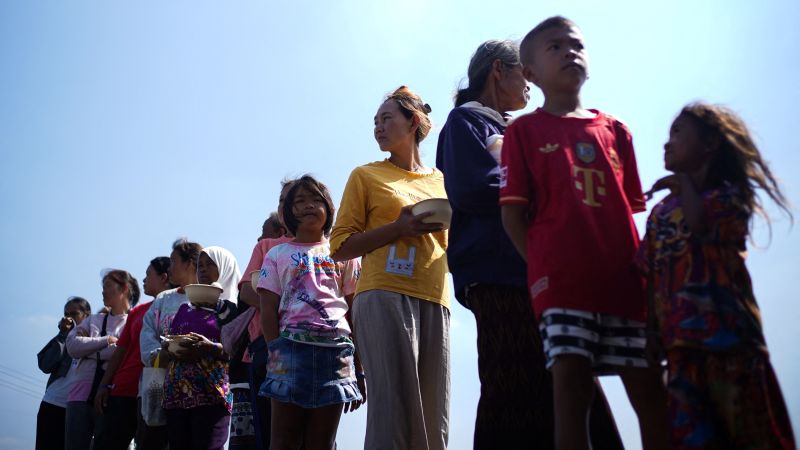
As the situation escalates, approximately 400,000 people living along the borders that divide Southeast Asian countries have been evacuated.
In a sit-down interview with CNN, Thailand’s Foreign Minister Sihasak Phunketkeo said military action would continue “until we feel our sovereignty and territorial integrity is not threatened,” hinting that the conflict could escalate.
Thailand and Cambodia have been in a decades-long territorial dispute along their 500-mile (800-kilometer) land border, the most violent conflict since a deadly five-day conflict in July.
The already fragile peace deal, signed in October in the presence of US President Donald Trump, who hailed it as proof of the country’s ability to end the war, is now on the verge of collapse.
President Trump said Tuesday he would “make a call” on Wednesday to stop the fighting.
Here’s what you need to know:
I don’t know exactly.
Both sides have accused each other of firing first, but CNN has not been able to confirm who fired the first shot.
According to the Royal Thai Air Force, Cambodia was mobilizing heavy weapons and repositioning its combat forces.
Cambodia’s Ministry of Defense denied the allegations. The Cambodian military said the Thai military “carried out numerous provocations over a period of days,” but did not provide details.

The Thai military said gunfire was reported on Tuesday in six of Thailand’s seven provinces that border Cambodia.
The navy said the Cambodian military fired heavy weapons, including BM-21 rockets, into civilian areas and accused Cambodia of deploying special operations forces and snipers to the border, digging trenches to fortify positions and invading Thai territory in the coastal province of Trat, posing a “direct and serious threat to Thailand’s sovereignty.”
The Cambodian military said on Tuesday that Thai forces conducted “continuous firing throughout the night” using “large drones” and “toxic smoke” in several border areas.
According to the Cambodian Ministry of Interior, seven Cambodian civilians were killed and about 20 injured. Thailand announced that one soldier was killed.
The UN Secretary-General and the European Union called on both sides to exercise restraint. President Trump spoke at a rally in Pennsylvania on Tuesday and promised to make a call to end the fighting.
“Who else is going to say, ‘I’m going to call you and stop a war between two very powerful countries, Thailand and Cambodia?’ They’re going to do it. But I’m going to do it,” Trump said.
However, there appears to have been little effort on the ground to ease tensions.
Thailand’s Foreign Minister Sihasak told CNN that Thailand would not rule out further attacks and that military action would continue “until we determine that our sovereignty and territorial integrity is not threatened.”
And on Monday, Thai Prime Minister Anutin Charnvirakul told reporters in Bangkok that “Cambodia must comply with (Thailand’s) demands to stop the fighting.”
Asked about the peace deal that President Trump signed and supported in Malaysia, he said, “I don’t remember that anymore.”

“Our armed forces of all kinds must fight back at every point where the enemy attacks,” Hun Sen, Cambodia’s influential former leader and current Senate president, said in a Facebook post on Tuesday.
The fiery rhetoric underscores the deep-seated suspicions and mistrust between the two countries that have come to define relations since the deadly July conflict that left dozens dead and some 200,000 displaced on both sides of the frontier.
The agreement was signed in Malaysia in October. Trump, who presided over the ceremony, had previously helped mediate the deal, threatening not to sign a trade deal if both countries refused.
However, tensions have been high for several weeks, with a mine explosion in November injuring four Thai soldiers.
Following the explosion, Thailand halted all work on a peace deal and accused Cambodia of violating the joint declaration by laying new landmines, an allegation Cambodia vehemently denies. The provisional release of 18 Cambodian prisoners captured during the July fighting was also suspended.

President Trump saw the peace deal as a major diplomatic victory and a further boost to his vaunted and often exaggerated campaign to end several wars.
The conflict stems from former colonial power France’s mapping of Cambodia’s borders, and analysts have warned there is a long road ahead before a lasting peace deal is reached. The peace declaration did not resolve the territorial issue.
“It’s up to Cambodia and Thailand to resolve the situation,” Thai Foreign Minister Sihasak said in response to CNN’s question about whether Thailand plans to discuss the recent border clashes with President Trump.
