


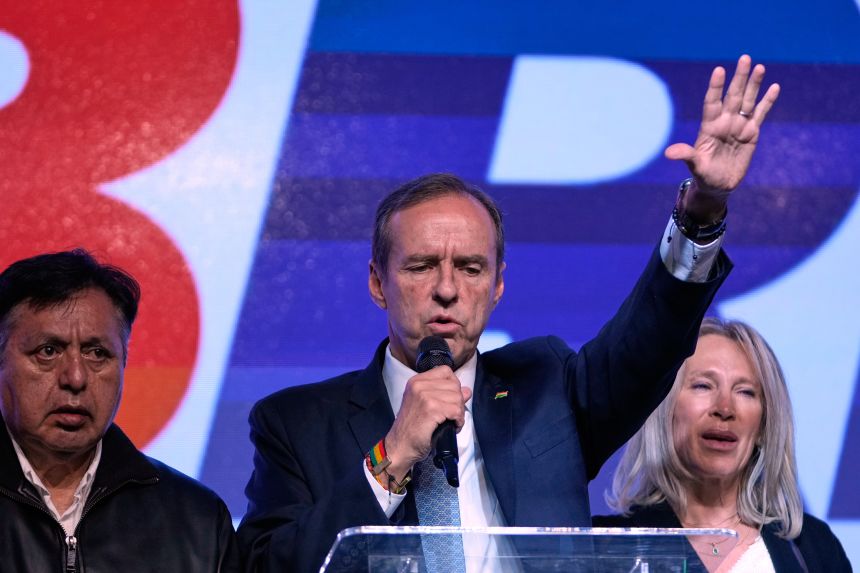
Centrist Rodrigo Paz defeated conservative rival Jorge “Tuto” Quiroga in Bolivia’s presidential run-off election on Sunday, as the country’s worst economic crisis in a generation helped end nearly two decades of left-wing rule.
Initial results from Bolivia’s Electoral Court show that Christian Democrat senator Paz received 54.5% of the vote, to Quiroga’s 45.5%. But Paz’s party does not have a majority in the country’s parliament and needs to form alliances to govern effectively.
The new president will take office on November 8th.
The 58-year-old senator’s victory marks a historic shift for the South American country, which has been ruled almost continuously since 2006 by the Bolivian Movement for Socialism (MAS), which once enjoyed overwhelming support from Bolivia’s indigenous majority.
Paz’s moderate platform of promoting private-sector-led growth while maintaining social programs appears to have resonated with left-wing voters disillusioned with the ruling party MAS, founded by former President Evo Morales, but wary of the austerity measures proposed by Quiroga.
Support for MAS was crushed in the first round in August, amid a deepening economic crisis.
“This election marks a political turning point,” said Graeldis González Calanche, Southern Andes analyst at the International Crisis Group. “Bolivia is moving in a new direction,” she said.
Both candidates in the runoff vowed to strengthen diplomatic ties with the United States, which have been strained since 2009, and seek financial support from the United States to stabilize Bolivia’s fragile economy.
In late September, Paz announced plans to sign a $1.5 billion economic cooperation agreement with U.S. authorities to secure fuel supplies.
Secretary of State Marco Rubio said this week that both presidential candidates “want a stronger and better relationship with the United States” after decades of anti-American leadership. “This election is an opportunity for change,” he said on October 15.
Outside a polling station in La Paz, Lourdes Mendoza said she was tired of the MAS era. “My children were born and grew up under a single government,” she said. “I hope they can find other possibilities and alternatives.”
Bolivia’s fragile economy prevailed in the run-off. If abundant natural gas exports plummet, inflation will rise to the highest level in 40 years and fuel will become scarce.
Both candidates campaigned on reversing elements of the MAS-era state-led model, but differed on how drastically to reform. Paz supports gradual reforms such as tax breaks for small businesses and regional fiscal autonomy, while Quiroga has proposed deep cuts and an IMF bailout.
“We are aiming for a new phase of Bolivian democracy in the 21st century,” Paz told Reuters at his family’s ranch in the southern gas-producing region of Tarija, two days before the election.
“We are going to try to build an economy for the people,” he said, adding that he had built an economy in which “the state is no longer the central axis.”
Some voters said they were not convinced that his victory signaled a real departure from MAS. “I think he is a puppet of the outgoing government,” said Esther Miranda, a 21-year-old nail salon worker from La Paz.
Paz’s campaign was boosted by his running mate, Edman Lara, a former police officer known for his viral TikTok videos exposing corruption. Analysts say Lara’s populist appeal has helped Paz connect with young and working-class voters.
Economists warn that the next government faces pressing challenges, including securing fuel supplies and building coalitions in a divided parliament.
Hydrocarbon Resources Release Minister Alejandro Gallardo said last week that the state-run energy company was struggling to earn foreign exchange to import fuel.
Pass told Reuters he was already working on the issue through post-payment deals with fuel suppliers to ensure diesel and gasoline arrived within days of taking office.
Mr Paz said he would also begin phasing out universal fuel subsidies. Targeted aid would go to vulnerable people, and larger industries such as agribusiness would pay market prices for fuel.
“The market will have to adjust prices, but some sectors could benefit from government support until the economy restarts,” he said.
Bolivia’s main trade union, the Central Obrera Boliviana (COB), had previously warned that it would oppose any threat to the social and economic gains achieved so far, in a sign that the Paz government is trying to avoid street protests.
Paz’s PDC won 49 of 130 seats in the lower house and 16 of 36 in the Senate, slightly more than Quiroga’s coalition won 43 seats in the lower house and 12 in the upper house.
