

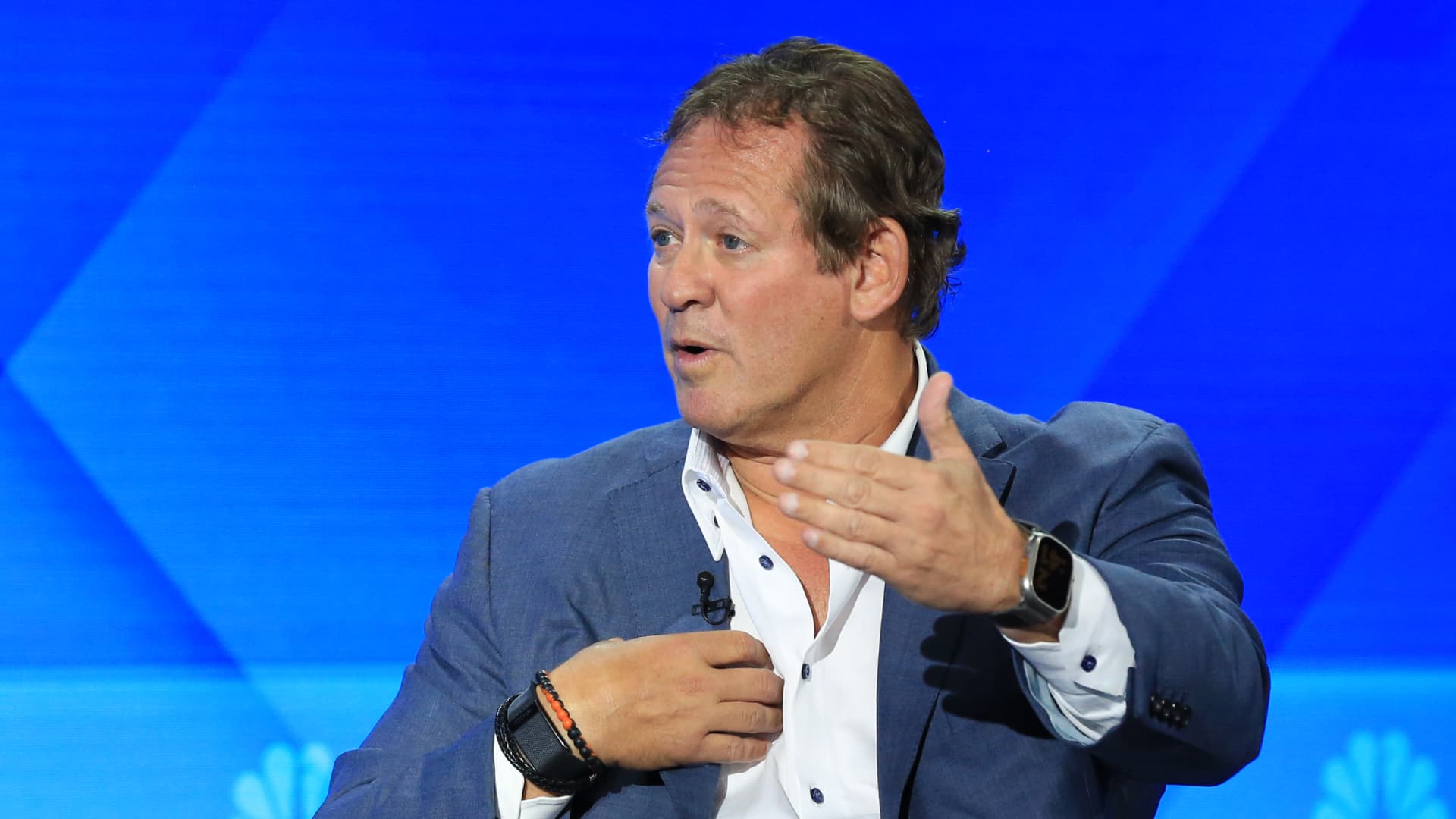
BlackRock’s Rick Rieder says there are still “generational” opportunities to earn attractive incomes, but they won’t last for long. “This generation is maturing little by little,” he says. Still, the bond market continues to offer historically attractive levels of income. That means there’s plenty of opportunity for those who are willing, Reeder, the firm’s chief investment officer for global fixed income, said in an interview with CNBC. Bond yields move inversely to prices. “We need to be a little more innovative,” he said. Investors should also keep in mind that dividends can grow over time, he said. In BlackRock’s fourth-quarter bond outlook released Tuesday, he referred to it as “a little bit of money over and over again.” Interest rates will fall Rieder expects interest rates to fall as the Fed continues to cut rates. The central bank cut the federal funds rate by 25 basis points (0.25 percentage points) at its September meeting and signaled it may cut it two more times this year. Rieder said both the U.S. economy and the business sector remain in good shape. However, he noted that as companies implement artificial intelligence to increase productivity, fewer workers will be hired as a result. “When you look at large companies that are growing and have great revenues, and you look at what they’re doing in terms of hiring, it’s lukewarm to say the least,” Rieder said. This is important, he explained, because the Fed’s mission is full employment, not economic growth. “This is a long-term trend, it’s real, and it’s going to be part of the reason why we think interest rates will go down,” he said. Rieder said lower interest rates in the short term and the potential for slower job growth due to improvements in technology and productivity in the medium term could mean interest rate policy is structurally very different over the next decade than it was before COVID-19. “Indeed, prior to COVID-19, the Fed was struggling to keep inflation (which was contained at the time) up, and we could now see a shift to a situation where the central bank struggles to increase employment,” Reeder said in the firm’s outlook. Spotting Opportunities Mr. Rieder has advocated for investors to focus on income, as duration is no longer the reliable hedge against equities that it once was. He suggested that consistently high coupons could perhaps act as a protection against stock market declines. Reeder, who also manages the iShares Flexible Income Active ETF (BINC), said investors need to broaden their thinking about bonds as spreads have tightened recently. The fund, founded in 2023, just hit $13 billion in assets. The 30-day SEC yield is 5.15% and the net expense ratio is 0.40%. For example, he swapped some of his U.S. investment-grade corporate bonds into liquid mortgage-backed securities. He told CNBC that Europe is a popular destination, with its investment-grade credit, high yields and securitized products. “The opportunity set is expanding, like securitization, but (cross-currency) swaps are also great,” he said. Mr. Rieder has expanded into emerging markets, which he initially avoided because he could get yields anywhere. “Right now, with the dollar subdued, there are some local rates in emerging markets that give some carry,” he said. He added that corporate bonds from emerging countries are also attractive due to weaker currencies. Overall, Rieder believes the yield curve is stable and will continue to perform well, which is why he is positioned at the belly of the front of the curve. That said, he did add some interest rate exposure. Specifically, I like long-term municipal bonds. Munis are exempt from federal tax and, if the issuer resides in the state in which the bond is issued, state tax. “I feel that the current real interest rate situation has improved considerably,” he said. “Interest rates should be well contained.” Complacency Unites Leaders are committed to being innovative to find yield, but investors don’t have to sacrifice quality. According to him, BINC’s average rating is a low investment grade single A. “We are seeing a bullish market with a sense of satisfaction,” he said. “When yields go down, people will say, ‘Okay, I want these yields to stay where they are,'” he added. “Certainly, we’re seeing some activity, or in some areas, a willingness on the part of people to reduce collateral, reduce structure, pay a price, which I think is… overly aggressive.” (Learn the best strategies for 2026 from inside the New York Stock Exchange with Josh Brown and others on CNBC PRO Live. Tickets and information here.)
