

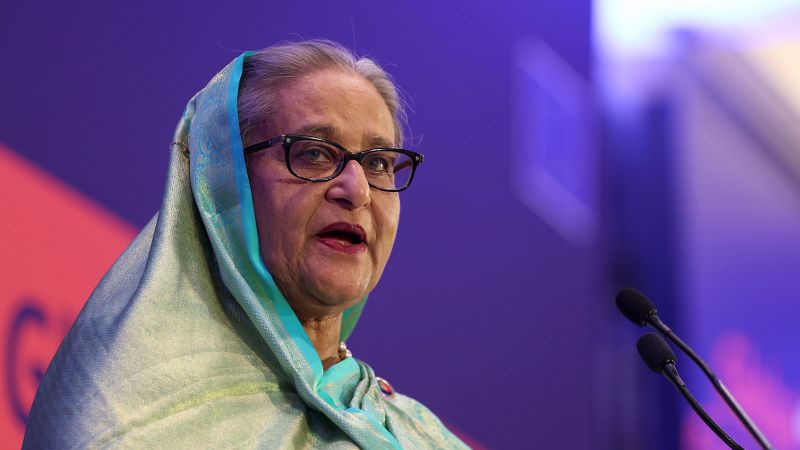
Sheikh Hasina, ousted as Bangladesh’s prime minister, has been found guilty of crimes against humanity and sentenced to death for the violent crackdown on student protests last year that led to the collapse of her government.
A three-judge panel of the International Crimes Tribunal, Bangladesh’s domestic war crimes tribunal, delivered its verdict on Monday, holding Hasina responsible for instigating hundreds of extrajudicial killings by law enforcement.
The courtroom, where the victim’s family was also present, erupted into applause as the judge handed down the sentence.
“Sheikh Hasina committed crimes against humanity at her instigation, orders and failure to take punitive measures,” one of the judges said while delivering the verdict.
It was “quite clear” that she “represented that she had incited the activists of her own party…and furthermore that she had ordered the killing and removal of the protesting students”, the judge said.
What started as peaceful student demonstrations last year over civil service quotas has turned into a nationwide movement demanding Hasina’s resignation. The turning point was a government crackdown that may have killed up to 1,400 people, according to the United Nations human rights office. Up to 25,000 people were injured, the court said.
Hasina was charged with five charges, mainly related to abetting the killing of protesters, ordering protesters to be hanged, and ordering the use of deadly weapons, drones and helicopters to quell the riots. She denies the charges.
The former leader ruled the South Asian country with an iron fist from 2009 until his ouster in 2024, but there are fears Monday’s ruling could trigger a wave of political turmoil ahead of national elections expected next February.
Hasina has been living in self-imposed exile in India’s capital New Delhi since August last year after student protesters forced her and her Awami League party from power.
She was not present in the Dhaka courtroom, and the trial was criticized last week by her lawyers, who filed an appeal with the United Nations special rapporteur on extrajudicial, summary or arbitrary executions, citing “serious concerns about the lack of fair trial rights and due process.”
Bangladesh’s interim government has formally requested her extradition, but New Delhi has so far remained silent on the request.
The verdict was preceded by violence in the capital Dhaka, where police said several petrol bombs thrown by people on bicycles exploded on Sunday.
Security was stepped up, with armored vehicles and officers with riot shields stationed around the courthouse, and police, Border Force and rapid action teams deployed near key government buildings.
Hasina’s son told Reuters on Sunday that her party’s supporters would block next year’s elections if the ban on the party was not lifted, warning that the protests could turn violent.
“We will not allow elections to be held without Awami League,” he said. “Our protests are going to get stronger and we’re going to do whatever it takes. If the international community doesn’t do something, eventually there will be violence in Bangladesh, probably before the elections… There will be conflict.”
Hasina’s political journey is a story of tragedy, exile, and power, and is closely tied to the history of her homeland itself. Under her stewardship, Bangladesh ushered in a period of remarkable economic development, albeit with accusations of corruption, democratic backsliding, authoritarianism, and human rights abuses.
The eldest daughter of Sheikh Mujibur Rahman, the founding father of Bangladesh, she became involved in politics at an early age after witnessing the Bengali struggle for autonomy from Pakistan.
Her father, mother and three brothers were assassinated in a military coup in 1975, forcing Hasina and her sister into exile. She returned to Bangladesh in 1981 to lead her father’s Awami League and, after years of political opposition, became prime minister for the first time when the party won the 1996 elections.
She returned to power in 2008 after serving one term and ruled Bangladesh with the Awami League until last year.
Although Bangladesh had experienced strong economic growth under Hasina, human rights groups warned that Bangladesh and its government were heading toward a one-party dictatorship. Critics expressed concern over increased reports of political violence, voter intimidation, and harassment of media and opposition figures.
During her time in power, the government used cybersecurity laws to crack down on freedom of expression online, arresting journalists, artists, and activists, and there were also reported cases of arbitrary detention and torture, according to human rights groups.
But Hasina has managed to weather many previous protests against her rule, particularly those that erupted during elections.
That changed last year, with the success of the Gen Z-led revolution that ousted her authority.
Many of her family members reside outside Bangladesh, along with prominent party leaders and former government ministers.
Hasina’s supporters deny the lawsuit is politically motivated and aimed at removing her from the political arena. The Awami League party has been banned from political activities while the trial against Hasina and party leaders continues.
Conversely, the interim government, led by Nobel laureate Muhammad Yunus, argues that these trials are an important step toward restoring accountability and rebuilding public trust in the country’s democratic institutions.
This is a developing story and will be updated.
