

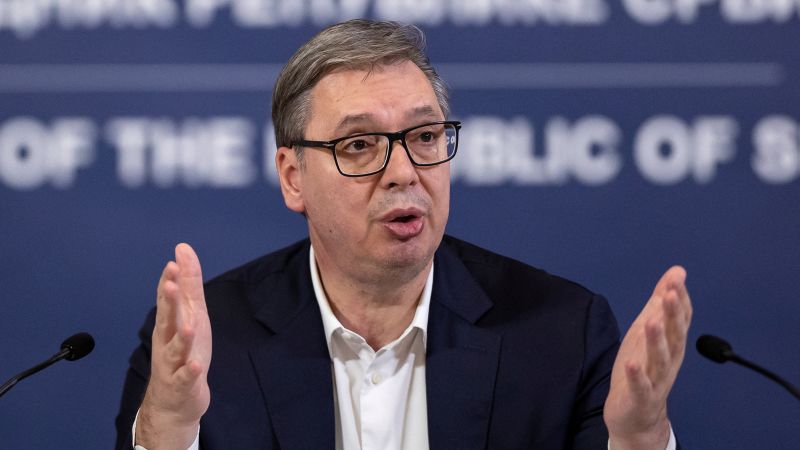
Serbian President Aleksandar Vučić announced on Sunday that two backpacks containing explosives had been found near a pipeline transporting Russian gas in Serbia, near the Hungarian border.
Both Serbia and Hungary remain highly dependent on Russian energy supplies, putting them at a disadvantage to other European countries seeking to reduce their dependence on Russian supplies.
Vučić said the backpack contained “two large packages containing explosives with detonators” and was found in Kanziza, northern Serbia, “a few hundred meters from a gas pipeline”.
Videos and images published in Serbian media showed a heavy police presence in the area, with barricades and helicopters in the air.
Vučić said he had informed Hungarian Prime Minister Viktor Orbán of the “initial results of the investigation by our military and police authorities into threats to critical gas infrastructure.”
Prime Minister Orban, who is in the midst of a tough election campaign ahead of next weekend’s national vote, said on TVX that he would convene an emergency defense council meeting later on Sunday.
As for the source of the explosives, Vučić said there were “certain signatures” that he could not immediately talk about.
He added that the explosives “put many lives at risk” and could have caused significant damage to the pipeline.
Both Mr. Vucic and Mr. Orban have strong ties to Moscow. Last month, Serbia secured another three months of gas imports from Russia following a meeting between Vučić and Russian leader Vladimir Putin.
Prime Minister Orban has frequently complained that Ukraine is blocking oil supplies through Russian pipelines that cross Ukrainian territory.
Hungary’s prime minister on Saturday posted a video warning that “a serious energy crisis is approaching and accelerating by the day” due to the Middle East war, and called on the European Union to end sanctions on Russian energy imports.
Hungary has used its own exemption from EU sanctions to deepen its dependence on Russian fossil fuels.

Prime Minister Orban has long been at odds with the European Union over relations with Russia, aid to Ukraine and immigration.
He is also an outspoken ally of President Donald Trump and has received vocal support from Trump administration officials.
In the final week of the Hungarian election campaign, US Vice President J.D. Vance will visit Budapest to meet with Prime Minister Orbán. US Secretary of State Marco Rubio said in February that relations between Washington and Budapest had entered a “golden age” and told Prime Minister Orban at a press conference: “Your success is our success.”
Analysts say Prime Minister Orbán faces the biggest challenge to his rule in 16 years.
Two opinion polls released last week showed Hungary’s centre-right Tisza party widening its lead over Prime Minister Viktor Orbán’s ruling Fidesz party ahead of April 12 parliamentary elections, but a majority of voters remained undecided.
