

Latest information on Spanish
The chaos caused by the murder of Mexican drug lord Nemesio “El Mencho” Oseguera has sparked fears that the country faces a new wave of violence as it makes final preparations to host the world’s biggest sporting event.
Mexico is expected to welcome more than 5 million visitors to the FIFA World Cup, which it is co-hosting with the United States and Canada, and will capture the world’s attention when the opening match begins on June 11 at Mexico City’s Banorte Stadium.
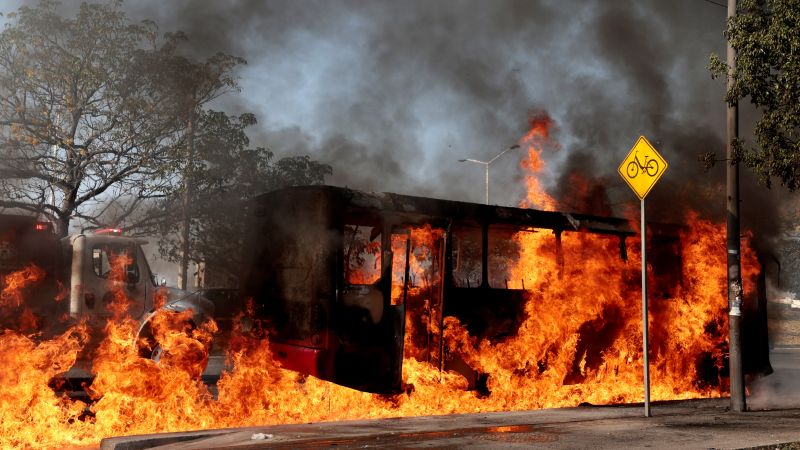
But the murder of Mr. Oseguera, who led the Jalisco New Generation Cartel, made Mexico, and especially the state of Jalisco, in the headlines for all the wrong reasons. His death Sunday at the hands of Mexican troops sparked days of violence, mostly in the state of Jalisco, where gang members from one of the country’s most powerful criminal organizations clashed with security forces and burned buses and businesses. The situation is so dire that the U.S. State Department has issued a shelter-in-place warning for travelers.
Although the initial riots have subsided, president Claudia Sheinbaum insisted on Tuesday that there was “no risk” to fans and FIFA president Gianni Infantino said he had “complete confidence” that everything would “go in the best direction”, but not everyone is so sure.
Some analysts fear that a succession dispute among the Jalisco cartel’s commanders is becoming more likely. That possibility has been acknowledged by Mexican authorities, with Security Secretary Omar García Harfucci saying on Monday that his team was “very attentive” to “any kind of reaction or realignment within the cartel” and was “specially monitoring several leaders.”
Security analyst David Saucedo told CNN that such a scenario is very likely, and warned that even if factions within the cartel reach an agreement, it may not rule out further violence.
If the cartel’s surviving leaders interpret the operation against “El Mencho” as an existential threat to that operation, the group may feel it has no choice but to up the ante.
“(The cartels) could take an all-out war stance against the Mexican state,” Saucedo said.

Mexico is set to host 13 of the 104 games at the World Cup, but its first test will come months before the official kickoff, when it will host play-offs and warm-up matches next month.
Estadio Akron in Guadalajara, the capital of Jalisco state, will host a playoff match between Congo, Jamaica and New Caledonia from March 26th to 31st, while Estadio Banorte in Mexico City will host a friendly match between Mexico and Portugal on March 28th.
The Portuguese Football Federation has indicated that the match in Mexico City will go ahead as scheduled pending an ongoing evaluation, but some analysts are more concerned about the match being played in Jalisco state, the epicenter of recent violence. In addition to the playoffs, four World Cup matches are scheduled to be held in Guadalajara, the capital of Jalisco state, featuring the national team, South Korea, Colombia, Uruguay, Spain, and two other teams determined by the playoffs. Nearly 3 million tourists are expected to visit Jalisco, a state on the Pacific coast known for its tequila and mariachi music, during the tournament.
Jalisco Governor Pablo Lemus has insisted that World Cup matches will go ahead as scheduled after some Mexican League matches were postponed following El Mencho’s death. “FIFA has no intention of removing any venue from Mexico. The three venues remain completely firm,” Lemus said.

Victoria Dittmar, a researcher at Insight Crime in Mexico City, said ensuring the area was safe had always been a challenge. After the government eliminated “El Mencho,” the task became one of “calming the country and the city, especially the cities that receive a lot of tourists,” she said.
The depth of the challenge became clear in the hours after the drug lord was arrested. Mexican Defense Secretary Ricardo Torrevira Trejo said on Monday that authorities had originally planned to fly the injured “El Mencho” by helicopter to Guadalajara for treatment, but his death en route forced them to change course and avoid the city, fearing a violent reaction from the cartel that his killing would provoke.
Dittmar said one option to calm the situation is to reach a deal between the government and the gangs. “Territorial pacification is often done through (such) agreements,” she says.
Another, more forceful option is a “massive deployment” of troops into the region to keep the peace, said sociologist and crime expert Marcelo Bergmann. It could also help appease US President Donald Trump, who is pressuring Mexico to crack down on organized crime.

One of the problems facing Mexican authorities is that El Mencho has no clear successor.
Although cartels are typically dynastic organizations, security analyst Saucedo noted that Oseguera’s son, known as “El Mencito,” is imprisoned in the United States, while his brother and son-in-law have been unable to “exert influence among other commanders.”
“The line of succession has collapsed,” Saucedo said.
Dittmar said there are three possible scenarios cartels are currently facing. Limited power struggle between some factions. Or, in the most extreme cases, a cartel may split entirely into several smaller gangs in a struggle for control.
Dittmar said that if the cartel splits, it would create an opening for rivals looking to push into the territory, adding that some violence is “inevitable” given that Oseguera’s unifying role has been left vacant.

“His role had a lot to do with keeping the group together. It was like a cult of personality,” she added.
Other analysts stressed that an increase in violence is inevitable. Cecilia Farfan Mendez, director of the Global Initiative Against Transnational Organized Crime’s North American Observatory, said the cartel leadership “doesn’t want to attract attention at this point.”
“It would be inconvenient for our members to be on the most wanted list because it would generate a lot of attention and pressure from the state and make their operations more complicated,” she said.
Still, Farjuan Méndez said the violence following the El Mencho killing was greater than that caused by previous military operations against drug cartels, with incidents recorded in more than 20 states.
“This kind of (incident) has happened before in Jalisco, but what is unprecedented is the scale and territorial scope of the response. I don’t think we’ve ever seen anything like this before,” she said.
CNN’s Ruben Correa and Ray Rodriguez contributed reporting.
