

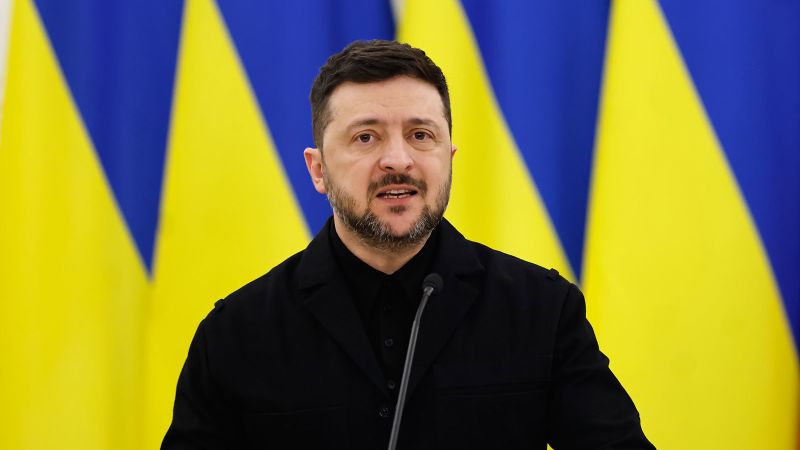
Ukrainian President Volodymyr Zelenskiy on Sunday highlighted progress made by Russian, Ukrainian and US negotiators in the United Arab Emirates’ capital Abu Dhabi, even though the path to peace remains uncertain.
“Many things were discussed, but it is important that the dialogue was constructive,” Zelenskiy wrote on social media, adding that “the central focus of the discussions was the possible conditions for ending the war.”
In a separate post on Monday, Zelenskiy said negotiators discussed “a series of important, primarily military issues essential to ending the war” as well as “complex political issues that remain unresolved.”
The trilateral talks, held on Friday and Saturday, were the first time officials from all three countries met together since Russia invaded Ukraine in 2022. A U.S. official said the meeting was an important step forward after months of silent diplomacy, stressing that while a final agreement was not guaranteed, progress could not have been made without face-to-face talks.
The diplomatic effort comes as Russia launches its largest night air raid on Ukraine so far this year.
Although no breakthrough was achieved during the two-day session, both parties expressed hope for a future agreement. President Zelenskiy said on Monday that preparations were underway for “a new tripartite meeting this week.”
US President Donald Trump’s special envoy Steve Witkoff similarly called the meeting “very constructive” and said “plans have been made to continue the dialogue next week in Abu Dhabi.”
“President Trump and his entire team are dedicated to bringing peace to this war,” Witkoff said.
The next round of talks will begin in Abu Dhabi on February 1, U.S. officials said.

President Zelenskiy said on Sunday that a document outlining Ukraine’s security demands is “100% ready”, an important issue for the country’s post-war stability.
He said Kiev now wants to set a time and place for signing the contract.
“For us, security is primarily bilateral security with the United States. The document is 100% ready. We hope that our partners will be ready about the date, time and place of signing,” Zelenskiy said at a press conference in Lithuania.
He added that the document would then need to be approved by the US Congress and the Ukrainian parliament.
The United States has been leading bilateral negotiations with Ukraine and Russia for months, trying to resolve outstanding issues as fighting escalates.
In Abu Dhabi, negotiators discussed a revised 20-point plan that would address territorial, economic, security and other issues.
Territory remains a key issue
Despite progress touted by the U.S. and Ukrainian sides, the issue of dividing the territory into two remained a point of contention, with no clear resolution in sight.
Control of the eastern region of Ukraine, known as the Donbass region, consisting of the coal-rich Donetsk and Luhansk regions, is a core demand of Russia.
After the meeting, Russian Deputy Foreign Minister Sergei Ryabkov told the state news agency TASS that the Kremlin wants to develop a plan that “fully corresponds to the basic understandings” agreed to by President Vladimir Putin and President Trump at their summit in Alaska last year.
Meanwhile, Kremlin spokesman Dmitry Peskov told reporters on Monday that territorial issues remain key for Russia in Ukraine peace talks.
“It’s no secret. Our consistent position, the president’s position, is that the territorial issue, which is part of the ‘Anchorage method,’ is, of course, of fundamental importance for the Russian side,” Peskov said.
The agreement provided for Ukraine to cede the remainder of Donetsk and Luhansk oblasts in exchange for a ceasefire.
Peskov said ahead of the Abu Dhabi talks that Ukrainian forces “must leave Donbas and withdraw from there. This is a very important condition.”
Ukraine has consistently rejected the idea of conceding territory for a peace deal.

In between the Abu Dhabi talks, Russia continued its offensive against Ukraine, targeting the capital Kiev and Ukraine’s second-largest city Kharkov with a barrage of missile and drone strikes.
At least one person was killed and four others were injured in Kyiv, Kyiv Mayor Vitali Klitschko said.
Klitschko said falling debris started fires, damaged buildings and left about 6,000 apartment buildings in Kiev without heat in the middle of a bitterly cold winter.
Foreign Minister Andriy Sibikha accused President Putin of “cynically” ordering a “savage attack” as the diplomatic process unfolded in Abu Dhabi.
“Every Russian attack on our energy infrastructure proves that there should be no delays in the supply of air defense equipment. We cannot turn a blind eye to these attacks. We must respond with a strong response,” President Zelenskiy said on Facebook.
Ukraine said it had attacked multiple Russian targets overnight into Monday, including an oil refinery in the Krasnodar region, which the Ukrainian General Staff said was “involved in supplying the invaders’ forces.”
The Russian Ministry of Defense announced that 34 drones were “intercepted” overnight in the Krasnodar region, and the region’s operational headquarters said that debris from the fallen drones caused fires in two “enterprises.”
On Sunday, President Zelenskiy said Russia had “done everything possible” to use the peace process to gain full control of eastern Ukraine, but said it was “not yet able to do it” on the battlefield.
He stressed that Ukraine’s territorial integrity should be respected.
“We are fighting for our country, for what is ours. We are not fighting on foreign territory. What questions do we have?” said the Ukrainian president.
The United States is demanding territorial concessions from Ukraine, which President Trump has characterized as a necessary trade-off to reach a peace deal with Russia.
Zelenskiy acknowledged that finding common ground between the two “fundamentally different positions” would require compromise.
“These are just the first steps to finding a compromise,” he added. “But to compromise, all sides must be ready to compromise. And by the way, this includes the American side.”
