

Beijing
—
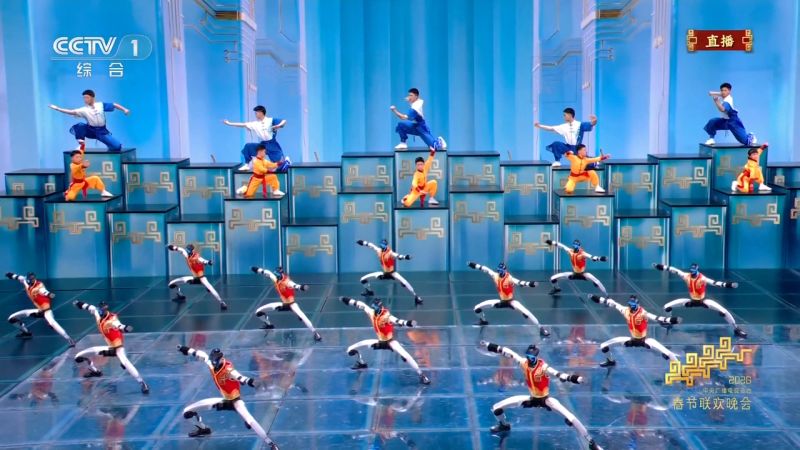
A backflip, nunchaku-wielding humanoid robot delighted and amazed viewers with its kung fu choreography during the annual televised Chinese New Year celebration. But they, and the rivals who took to the stage Monday night, also conveyed a message about how quickly China’s androids are progressing.
The fluid movements, agility and breakdown recovery of the robots from Chinese company Unitree Robotics, which kicked and flipped on stage alongside young human fighters during the broadcast, were far ahead of the steady handkerchief-twirling and shuffling footwork of the Unitree models, which performed to great fanfare last year.
And it wasn’t just Unitree. This year’s Chinese New Year Festival on state broadcaster CCTV put China’s growing technological capabilities and fierce competition within the high-tech sector on full display.
This is not a new theme for the gala, China’s biggest television event, roughly comparable to the Super Bowl in terms of television programming. But it underscores China’s growing desire to transform into a technology power amid a broader conflict with the United States.
Several major robotics companies won coveted slots at the nearly four-hour celebration.
MagicLab’s humanoid robots performed the choreography as the human pop star sang “We Are Made in China” in a dance number pointedly titled “Intelligent Manufacturing Future.” The company’s robot dog wore a panda suit in another segment.
Noetix Robotics saw the actress deploy an android version of herself in a comedy skit, showcasing her ability to create humanoids made to look like real humans. Robots from Beijing-based company Galbot also showed how they can perform everyday tasks such as cracking walnuts, skewering sausages and folding clothes.
AI also had its moment. This year, the gala’s sponsor, ByteDance’s Doobao platform, sent users of its AI chatbot app a ton of hongbaos or red envelopes containing virtual cash during the show, and at one point a comedian asked the app for advice. The company also said that its AI video generation model Seedance 2.0 participated in the visual creation of several programs.
The robot’s superiority was praised by many across Chinese social media, as topics related to robot performance racked up millions of views and users marveled at the speed at which robots were developing.
“This is the most amazing performance of this year’s Spring Festival celebrations. It may even send shockwaves across the Pacific,” one commentator on China’s X-like platform Weibo wrote about Unitree’s choreography, alluding to US-China competition.
However, the show was also criticized for focusing too much on androids. “We are looking for humans in a world full of robots,” one user wrote on the same platform, a comment that resonated widely across social media discussions.
State media also reported on the celebrations as stimulating consumer demand, with the Global Times reporting that robots from brands such as MagicLab, Unitree and Noetix sold out after being offered by online retailer JD.com during the celebrations.

The race to perfect robots and automate is part of the Chinese government’s overall push to improve the country’s manufacturing capabilities and protect its status as the world’s factory floor in a new era of high technology, rising labor costs and a shrinking workforce.
According to the International Federation of Robotics, China is already the world’s largest market for industrial robots, with more than half of the robots installed worldwide by 2024.
Humanoids have so far been best seen for their novelty looks and entertainment, like Monday’s show, but they’ve also been piloted on assembly lines, logistics hubs and science labs. Dozens of companies are working on developments in this area with grants.
Last year was a year in which the public became accustomed to seeing androids become increasingly adept at movement and featured as a centerpiece at promotional sporting events and other events. However, 2026 is widely seen as the year when work on real-world applications will take center stage, especially in industry.
Unitree CEO Wang Xingxing noted the high stakes in this sector in comments to state media after the celebration.
“I’ve been under a lot of pressure personally over the last month or two. I had to perform significantly better than last year,” he said.
“We hope that through our efforts and the combined efforts of society as a whole, we can contribute to the development of the robot industry as a whole.”
