

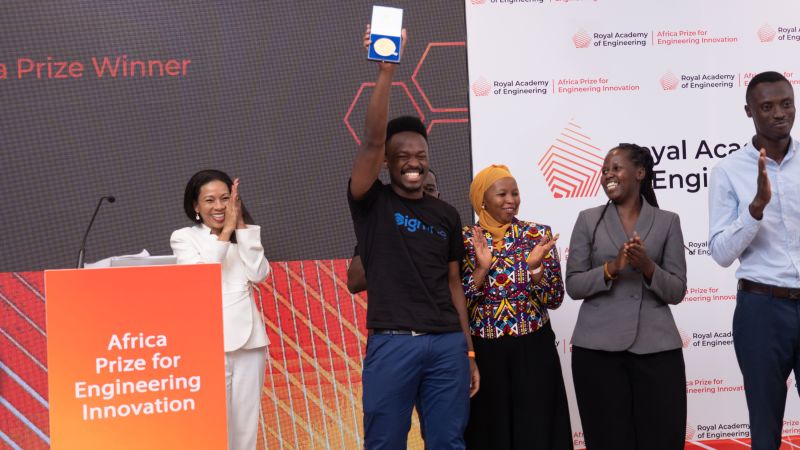
A Kenyan entrepreneur who designed an app that uses AI-powered 3D avatars to translate speech into sign language has won a major award for innovation in Africa.
“Think of it like Google Translate for sign language, where you input voice and text and output a photorealistic avatar signature,” said Elly Savatia, creator of Terp 360, a web-based app that uses 3D avatars to provide real-time sign language translation from voice. This allows users to communicate without relying on human interpreters.
On October 16, Sabatier was awarded a £50,000 ($67,000) prize by the Royal Academy of Engineering for winning the prestigious African Engineering Innovation Award, which recognizes entrepreneurs who have developed technology to address the continent’s challenges. His innovation was selected by a seven-judge panel from four finalists from across Africa at an awards ceremony in Dakar, Senegal.
“The African Engineering Innovation Prize is a way to support, showcase and celebrate African innovation,” said Rebecca Enonchon, chair of the prize jury.
“What really stood out about Ellie’s solution, and Ellie herself, was the level of innovation,” she said. “This was proof that Africans can use cutting-edge technology to solve problems within the continent as well as beyond,” she added.

Savatia explains that deaf people in Kenya often struggle to access vital services. This is because many of the people working in these services do not know sign language.
“We need communication to go to work, to education, to health care,” Sabatier says. “But the deaf community is being left behind.”
Human sign language interpreting is expensive, and the lack of interpreters means many deaf people across Africa are unable to access higher education, he says.
Despite a government bill earlier this year requiring Kenyan employers to reserve at least 5% of jobs for people with disabilities, Sabatier says many roles are still often inaccessible to deaf people.
“Companies can’t afford to hire interpreters…[and]they just don’t have the tools to effectively integrate these people,” he says. “We see ourselves as enablers. We can do sign language, but on a large scale,” he added.
Terp 360 was developed with Kenyans who are hearing impaired and records more than 2,300 signs containing commonly used phrases and words. A motion sensor was attached to the signer’s hand to capture hand movements in space.
Other avatar-based sign language translation technologies already exist, but these were not designed with African sign languages or cultural backgrounds in mind, Savatia said.
There are over 300 sign languages in use around the world, and around 30 in Africa. Terp 360 currently translates from English and Swahili to Kenyan Sign Language. Savatia said the app is being developed to translate from other major African and world languages, and will also support Rwandan, Ugandan, South African, British and American sign languages by mid-2027.
To train the AI in new languages, Terp 360 developers plan to partner with local NGOs and projects with visual sign language datasets, as well as news stations with years of sign language videos. Savatia says he has also set up a motion capture studio in Nairobi, Kenya, where he can record and study 1,000 words per day.
“One of the criteria we judge is social impact,” Enoncheon said. “We want to see the impact of this solution beyond job creation and wealth creation. And assistive technology is one of the underserved areas, not just on the continent but around the world,” she added.
“(Sabatyr) has real solutions that work and can really change lives.”
