

An armed jihadist group linked to al-Qaeda is closing in on Mali’s capital, Bamako. The country’s military junta and its Russian partners are struggling to counter jihadists who now hold sway in many parts of the vast Sahel country.
Fuel is running low in Bamako as militants belonging to a group called Jamaat Nusrat al-Islam al-Muslim (JNIM) have blocked roads into the capital, attacked military patrols and ambushed tanker trucks.
As the situation worsens, countries including the UK, US and Germany are calling on their citizens to leave Bamako. On Thursday, the United Kingdom warned its citizens to “leave the country immediately by commercial aircraft if you deem it safe to do so,” while the U.S. State Department cited the “unpredictability of the security situation in Bamako” in encouraging Americans to leave.
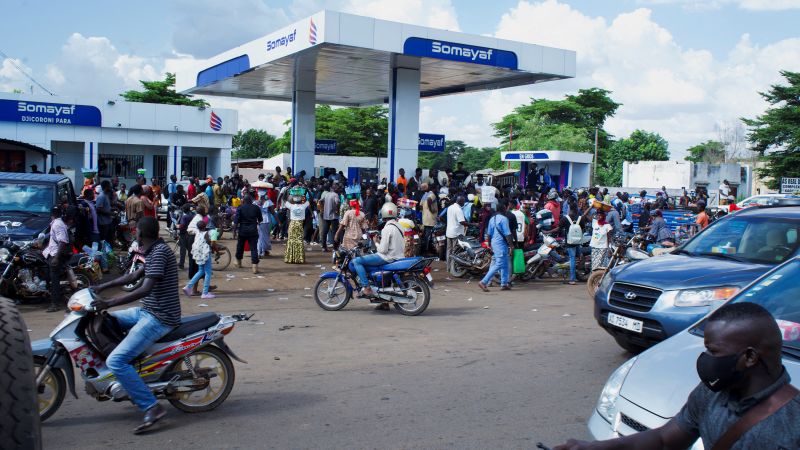
Videos and images from the city in recent days show long lines of motorcycles and other vehicles lined up at gas stations. According to local media, some residents have accused police of sequestering fuel supplies. Due to the shortage, schools and universities were closed.
Over the past two months, JNIM has stepped up attacks on fuel supplies, ambushing tankers on roads from Ivory Coast and Senegal.
In one attack in mid-September, insurgents attacked a convoy of more than 100 fuel trucks and set half of them on fire, according to the Armed Conflict Location and Event Data (ACLED), which maps the conflict.
The Counter-Extremism Project (CEP), which analyzes terrorist groups, said the insurgents had seized large amounts of weapons from government forces and demonstrated the ability to use drones.
Terrorism analyst Daniele Garofalo told CNN that JNIM is “diversifying its tactics and intensifying its economic warfare campaign with roadblocks, extortion/taxation, and fuel blockades.”
In a video released last month, JNIM spokesman Abu Huhayfa al-Bambari asked people to cooperate by stopping at checkpoints in areas controlled by the group and advised against accompanying military convoys.
Government forces have stepped up patrols and carried out helicopter attacks, claiming they have killed dozens of militants. But attacks continue, fuel shortages are widespread across central and southern Mali, and government garrisons are isolated.
JNIM has long been active in Mali, a French colony until it gained independence in 1960, and other parts of the Sahel region, particularly neighboring Burkina Faso. It was formed in 2017 as a coalition of jihadist factions and quickly declared allegiance to al-Qaeda. Its influence has expanded in recent years, destabilizing large parts of central and central Mali.
This summer, it launched an economic war in western Mali. Garofalo said “factories, industrial facilities, infrastructure projects and artificial gold mining sites were attacked.”
“JNIM conducted operations hundreds of kilometers apart, demonstrating a new level of coordination,” he added.
Russian mercenaries have been deployed to Mali on counterterrorism missions since 2021, first as part of the Wagner Group and now as part of what the Russian government calls the Afrika Korps. However, they were unable to stop the advance of the insurgents, resulting in many casualties.
Last year, JNIM claimed that a “complex ambush” wiped out a convoy of Russian contractors and Malian soldiers in the north of the country, killing 50 Russians.
Russia’s presence appears to have alienated large parts of Mali’s population. A recent Human Rights Watch report stated that the military regime and its Russian backer have carried out “dozens of summary executions and enforced disappearances of Fulani men…which they accuse of collaborating with JNIM.”
Mali and its neighbors, particularly Burkina Faso and Niger, have experienced chronic fluctuations in recent years. JNIM and other extremist groups are active in all three countries. In July alone, JNIM claimed 54 attacks in Burkina Faso, 36 in Mali, and 7 in Niger.
Last week, JNIM claimed to have carried out its first attack in northern Nigeria, which is also plagued by insurgent violence.
Many analysts believe that a new coup in Mali or the collapse of Assimi Goita’s current government could further destabilize the Sahel and allow armed groups to expand their activities.

According to the CEP, JNIM is “integrating into the region’s illicit economy by exploiting fuel and arms smuggling routes in the tri-border region of Ivory Coast, Burkina Faso, and Ghana.”
“This is a conflict within fluid borders between Mali, Niger and Burkina Faso, and there is a risk of contagion to other countries, such as northwest Nigeria and Ivory Coast,” said Edmund Fitton-Brown, former coordinator of the UN Sanctions Monitoring Team and now a senior fellow at the Washington, D.C.-based Foundation for Defense of Democracies.
But Burkina Faso, with its weak military government with no warrants outside the capital, is most at risk. “It is almost certain that the virus will spread to Burkina Faso,” he told CNN.
There is no indication that the militants are preparing a frontal attack on Bamako. Their strategy appears to be to strangle the capital and create unrest against the military regime.
While the Malian military moves slowly and predictably, JNIM militants integrate into local communities and take stock of their surroundings.
“JNIM is very adept at communicating the grievances and demands of the poorer and minority segments of the population,” Garofalo said, believing that JNIM’s purpose appears to be to present itself as a better government.
Garofalo added that it has the ability to “create a protracted crisis, disrupt supplies, target secondary centers, and influence public opinion to put serious pressure on an already politically fragile military regime.”
“However, converting this pressure into regime collapse or replacement will require a significant escalation of previously sporadic operations. JNIM focuses on weakening the regime and the military regime’s loss of local control.”

So far it’s been successful. JNIM’s ultimate intentions remain unclear, but according to CEP, “Mali could become the first country to be controlled by (al-Qaeda) in its 40-year history.”
Fitton-Brown said the military junta in Bamako has no outside support. They “essentially drove out the French and came into conflict with both the United Nations and regional force ECOWAS. The Russians were never a replacement.”
“JNIM will ultimately insist on a government more to its liking in Bamako, even if it does not take the initiative itself and accepts something softer than an al-Qaeda-aligned regime,” Fitton-Brown added.
