

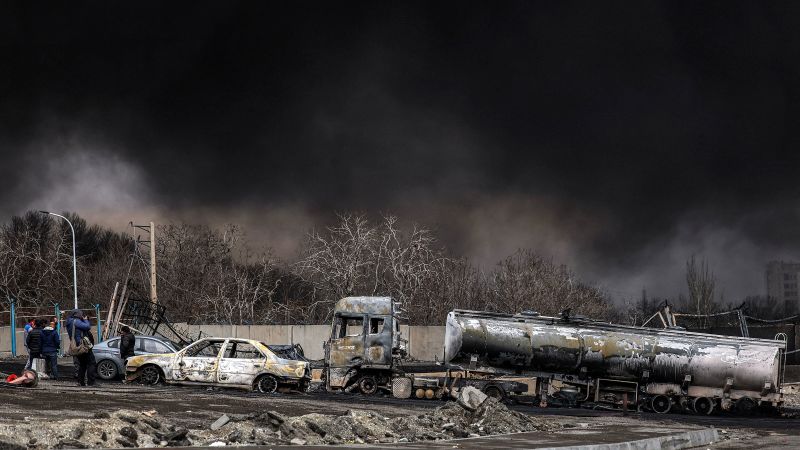
A month into the escalation of conflict in the Middle East, more and more civilian infrastructure has been attacked, many by design.
A factory that produces steel, aluminum, and chemicals. Refineries; Reservoirs; Desalination plants. All civilian airports and universities were also damaged.
Some of these targets could be said to support the country’s war machine. Israeli Defense Minister Israel Katz warned last week of attacks on “additional targets and areas that support the regime in the production and operation of weapons against Israeli civilians.” Shortly thereafter, Israel closed several steel mills.
Analysts say the economic and social costs of attacks by Iran and Israel are rising.
U.S. attacks so far have tended to be more narrowly focused. But in a post on Truth Social on Monday, US President Donald Trump threatened to “end his nice ‘sojourn’ in Iran by blowing up the power plant, oil wells, Kharg Island (and possibly all the desalination plants too!) and obliterating them completely.”
Iran has repeatedly warned that attacks on its economic and social infrastructure would result in retaliation and possible evacuation of similar facilities in countries supporting U.S.-Israeli operations.
“Retaliation for Iran’s infrastructure attacks is being carried out by destroying strategic industries associated with America’s Zionist enemies in the region,” said Brig. Islamic Revolutionary Guard Corps Aerospace Commander General Majid Mousavi said on Monday.

Both Israel and Iran have targeted refineries and production facilities in a region where energy industries such as oil, natural gas and petrochemicals are the lifeblood of the economy, but the United States has vowed to avoid such targets.
Earlier in the conflict, Iranian drones attacked part of the giant Ras Tanura refinery on Saudi Arabia’s east coast. A similar complex in Fujairah, United Arab Emirates (UAE) has been repeatedly attacked.
Qatar Energy has declared force majeure, meaning it cannot fulfill its contract, following several attacks by Iran on Ras Laffan, one of the world’s largest liquefied natural gas (LNG) facilities.
Refineries in Kuwait have also been targeted, with the Mina al-Ahmadi refinery suffering two waves of attacks on March 19 alone.
Meanwhile, an Iranian ballistic missile targeting Israel was intercepted on Monday. But on Monday, debris crashed into the refinery facility, causing a fire in Haifa Bay, the second time this month the facility was damaged.
Israeli attacks include targeting a large fuel storage tank in Tehran on March 7, causing severe contamination. While Israel claims the tanks were used for military purposes, Amnesty International said the “predictable and potentially catastrophic potential for severe civilian harm caused by attacks on energy infrastructure” by all parties to the conflict means that “such attacks carry a significant risk of violating international humanitarian law.”
Port and aluminum factory
Iranian missiles and drones hit ports in Dubai, Bahrain and Qatar. The Iranian government is also targeting two Omani ports, Salalah and Duqm, which serve as a partial diversion through the blockaded Strait of Hormuz.
Secondly, several Iranian ports have come under attack in Hormozgan province, which includes the Strait of Hormuz.
The UAE and Bahrain are important aluminum producers and are already facing supply shortages due to the Hormuz closure. On Saturday, Iranian drones and missiles struck both Aluminum Bahrain and Emirates Global Aluminum-owned facilities in Abu Dhabi, causing “significant damage,” it said.
Aluminum prices rose 5% in early London trading on Monday following the attack.
These strikes came after two major Iranian steel mills in Mobarakeh and Khuzestan were attacked. “Israel and six steel mills in five regional countries have been declared new targets for potential retaliatory attacks by Iran,” the semi-official Tasnim news agency reported.

Doha, Qatar, and Dubai, UAE, have become two of the world’s most important hubs for international travel in recent years.
Iranian drones repeatedly attacked Doha’s airport but failed, causing damage to Dubai’s main international airport. Extensive delays and cancellations at both hubs have resulted in significant economic losses. Qatar Airways sent several planes to storage in Spain as operations were reduced.
Kuwait’s international airport was attacked on Sunday, causing a massive fire and damaging radar systems.
In Iran, Tehran’s main domestic airport was repeatedly attacked by Israeli airstrikes in mid-March, with the Israeli military saying the targets were Islamic Revolutionary Guards Corps (IRGC) aircraft at the airport.
In regions where fresh water is scarce, desalination plants are as important as oil refineries, providing drinking water to around 100 million people in the Gulf region. Early in the conflict, Bahraini officials said Iranian drones damaged a desalination plant, but the attack did not affect water supplies. On March 7, Iranian Foreign Minister Abbas Araghchi claimed that the United States had attacked a desalination facility on Iran’s Qeshm Island. The United States denied involvement.
Just a week ago, Iran pledged not to disrupt desalination infrastructure in the Gulf. However, Kuwait’s Ministry of Electricity announced on Monday that one worker had been killed in an Iranian attack on a power plant and water desalination plant. Iranian state media accused Israel of carrying out the attack.
Attacks on universities and research centers
Israel has attacked Iranian universities and research centers, claiming they are being used for military purposes. Malek Ashtar University and Imam Hossein University were among the targets, and Tehran University of Science and Technology was also targeted over the weekend, Fars News Agency said.
Iran denies any military use of the sites and accuses Israel of seeking to neutralize its scientific infrastructure. He is threatening to retaliate in kind.
“Israeli universities and American universities in the West Asia region are legitimate targets for us until two universities are attacked in retaliation for the destroyed Iranian universities,” the report said on Sunday.
New York University’s Abu Dhabi campus said in an email to students on Sunday that it had closed “out of an abundance of caution.”
Hospitals and other private infrastructure

Iran has said that dozens of hospitals and medical facilities have been damaged in a barrage of U.S. and Israeli shelling over the past month, most recently a psychiatric hospital in Tehran.
The World Health Organization confirmed 13 attacks on medical facilities in Iran early in the campaign.
Although there is no evidence that health facilities were intentionally targeted, they may be located close to targets in urban areas.
Similarly, a cruise missile attack targeting an Revolutionary Guard base in southern Iran killed nearly 200 people, mostly children, at an adjacent school.
Iran has frequently claimed that it is focused on attacking U.S. military bases in the Gulf, rather than the country itself. However, it warned that hotels housing U.S. military personnel would also be considered targets. As the months go by, there is a clear increase in the number of attacks on civilian facilities.
“Iran has targeted the region’s energy and transportation infrastructure, the (Gulf Cooperation Council) GCC pillars of global power. In doing so, it seeks to undermine Gulf nationals, residents, and investors’ confidence in these states’ ability to provide security for their nationals and foreign workers,” the International Institute for Strategic Studies said.
The conflict is now in its second month, the number of purely military targets has decreased significantly, and the economic damage is likely to increase further.
CNN’s Eugenia Yosef and Adam Pourahmadi contributed to this report.
