

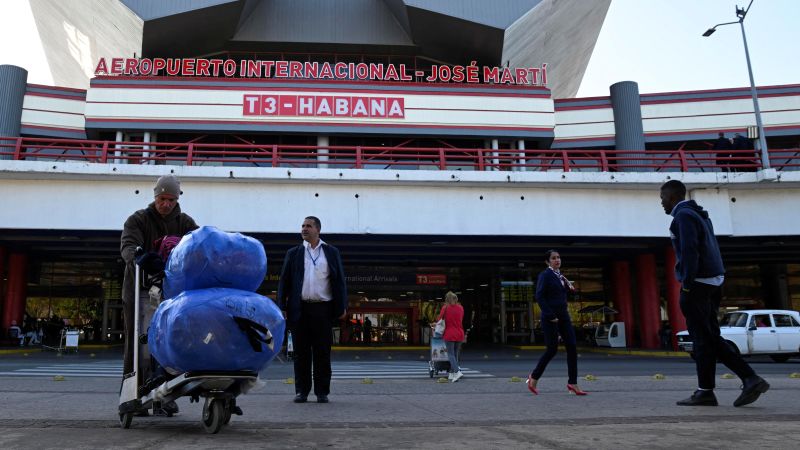
Canada’s largest airline announced it would suspend flights to Cuba due to a lack of aviation fuel on the island. The move comes as a U.S.-orchestrated squeeze on the country’s oil supplies has forced Havana to ration health, transportation and school services.
Air Canada suspended flights to Cuba on Monday, but said it would continue to operate “ferry flights” to bring about 3,000 customers home, while other airlines said they would continue flying to the Caribbean country but would reconsider their logistics.
Air Canada, which operates an average of 16 flights a week to Cuba, said in a statement that “the remaining flights will be subject to technical stops where necessary to allow Air Canada to transport additional fuel in tankers and refuel on the return journey.”
Spanish airlines Iberia and Air Europa said they would continue to fly to the island, but flights from Madrid to Havana would have to land in the Dominican Republic for refueling. Meanwhile, American Airlines, Delta Air Lines and Aeromexico told CNN they would continue flying, with American saying its planes could carry enough fuel for the return flight.
The development comes as the United States seeks to cut off Havana, a longtime communist enemy, from receiving oil supplies from neighboring countries, a move that is exacerbating the Caribbean island’s long-standing fuel crisis. Cuba warned airlines on Sunday that it would not be able to supply jet fuel from February 10 to March 11.
In 2025, Cuba received more than 754,000 visitors from Canada, more than any other country, according to Cuba’s National Institute of Statistics and Information. In the same year, more than 110,000 tourists came from the United States, more than 56,000 from Mexico, and more than 46,000 from Spain.

The blow to the country’s tourism industry follows an announcement by the city of Havana to allocate hospital resources and prioritize emergency medical care as part of nationwide austerity measures in response to the energy crisis.
Under this measure, hospitalizations and surgical activities will be limited as much as possible.
Health Minister José Ángel Portal Miranda said on Monday: “[The measures aim]to significantly maintain these essential services, realign capacity, focus resources where they are needed most and ensure continuity of services to the population.”
Other emergency measures announced by the government in response to the energy crisis include shortening school hours, postponing major sporting and cultural events, and reducing transport services.
With fuel supplies dwindling, Cubans face constant power outages and long lines at gas stations.
Cuban officials say existing economic sanctions by the United States are the main cause of the energy crisis, but critics also blame the government’s lack of infrastructure investment.
Carlos Fernandez de Cossio, Cuba’s deputy foreign minister, told CNN last week that his government was ready to have “meaningful” dialogue with the United States to address differences, but was not prepared to discuss regime change.
US President Donald Trump said Cuba could avoid a complete economic shutdown by striking an “agreement” with the United States that could require the return of property confiscated from Cuban exiles who left the island after the 1959 revolution.

President Trump also called on Mexico to halt oil shipments to Cuba, but Mexican President Claudia Sheinbaum said she wanted to find a diplomatic solution that would allow her country to continue shipping oil to Cuba without being affected by U.S. tariffs.
“These sanctions that are being imposed on countries that sell oil to Cuba are very unfair, very unfair, because sanctions that affect the people of Cuba are not right. Some people may agree with the regime in Cuba, some may disagree, but the people should never be hurt,” Sheinbaum said.
Mexico is traditionally Havana’s second-largest oil supplier after Venezuela, but its contribution has become even more important as supplies from Caracas have already been disrupted following President Nicolás Maduro’s capture by US special forces.
The Mexican government shipped more than 800 tons of humanitarian aid to the country on Sunday, and Sheinbaum promised more.
“We will help the Cuban people as we have helped people in need,” she insisted.
Russia, Cuba’s longtime ally, said on Monday that the situation in the country was “truly critical.”
Kremlin spokesman Dmitry Peskov accused the United States of holding a “chokehold” on Cuba.
He said the Russian government was discussing ways to resolve the issue or at least provide assistance.
“We are in intensive contact with our Cuban friends through diplomatic and other channels,” he said.
