

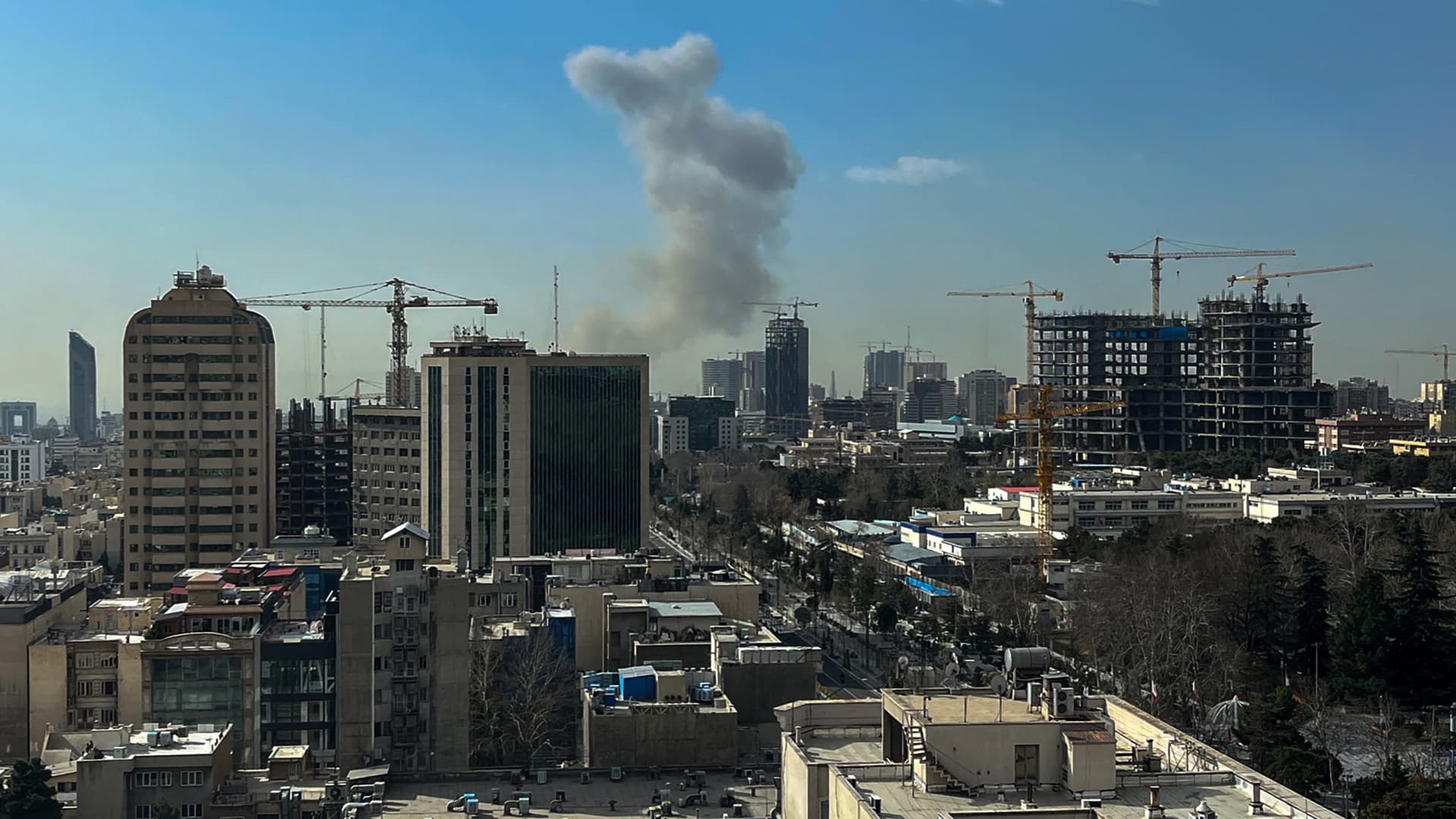
Top Shot – Smoke rises after a reported explosion in Tehran on February 28, 2026. (Photo courtesy of AFP, Getty Images)
AFP | Getty Images
The escalating conflict in the Middle East has raised concerns that the United States’ pursuit of regime change and Iranian retaliation could destabilize the region from the Gulf to Europe, and world leaders are scrambling to assess the impact.
The United States and Israel launched a joint attack on Iran over the weekend, killing the Islamic Republic’s supreme leader Ayatollah Khamenei and sparking a wave of Iranian attacks across the region.
President Donald Trump made clear in a video message Saturday following the first wave of U.S. and Israeli attacks against Iran that his goal is to “eliminate the immediate threat from the Iranian regime, which is an evil group of very hardline and fearful people.”
Geopolitical analysts warned Saturday’s airstrikes could be the opening salvo in a sustained military campaign aimed at dismantling the Iranian regime, as the United States seeks to assert supremacy over the world’s most important oil-producing region.
“The scale of the attacks by the United States and Israel, and the clear goal of regime change in Iran, suggests that the military conflict could escalate rapidly and unpredictably,” said Lexon Liu, president of Asia Group, a business consultancy. “There is a significant immediate risk of regional and potentially global escalation, as Iran may now respond using all available options.”
“The last attack was targeted at Iran’s nuclear weapons program,” said David Silvey, a military history professor at Cornell University, referring to last June’s 12-day war in which the United States and Israel launched airstrikes that damaged three of Iran’s major nuclear facilities.
But “this is going to be much broader and will cover command and control, command and leadership, and the military and secret police in general,” Silvey said. “Since a U.S. ground war is unlikely in the near term, the goal is to overthrow the regime at home through a popular uprising or palace coup.”
Silvey warned that Iran could respond with retaliatory attacks, including missile attacks on Israeli and U.S. military bases and ships in the Persian Gulf, as well as terrorist activities across the Middle East, Europe and the United States.
“If the regime feels threatened, it will attack harder than it would if it thought it could survive the attack,” Silvey said.
The fire has already spread to other parts of the Gulf region. Iranian missiles target Israel and multiple Gulf states, including the UAE, Qatar, Bahrain, Saudi Arabia, Kuwait, and Jordan, all of which have air bases housing U.S. assets.
“Iran’s long-standing détente with Gulf states may be coming to an end,” said Aisha Chaudhry, head of the Asia Group.

Russia and China are spectators
Both Russia and China have issued statements condemning the United States and are likely to continue doing so as the situation escalates, but analysts say neither is in a position to provide more meaningful material support.
China, a key economic lifeline for Iran amid tough Western sanctions, bought more than 80% of the oil shipped by Tehran in 2025, accounting for 13.5% of all Chinese oil imports by sea. Iran is also a key supplier of military drones and missiles to support Russia’s war effort in Ukraine.
But years of intense war in Ukraine have hollowed out Russia’s ability to project power beyond its borders, said Matt Gerken, chief geopolitical strategist at BCA Research.
With its military overstretched and its economy under continued pressure from Western sanctions, Russia’s influence in the Middle East will further decline, Gerken added.
Iranian Deputy Defense Minister Majid Ebnoreza (left) shakes hands with former Chinese defense attaché to the United States Zhang Li after speaking at the Xiangshan Forum plenary session in Beijing on September 19, 2025.
Greg Baker AFP | Getty Images
But China has refrained from expressing strong support for Iran as the United States continues to strengthen its military presence in the Gulf ahead of the attack. Instead, it focuses on promoting diplomacy and regional security.
Analysts are watching for potential signs of whether this latest Middle East conflict risks derailing U.S.-China diplomatic relations and even President Trump’s planned visit to Beijing later this month.
In a statement Saturday night, a Chinese Foreign Ministry spokesperson urged the United States and Israel to “immediately cease military operations” in the region and restore dialogue, calling for “respect for Iran’s sovereignty, security and territorial integrity.”
President Trump and Chinese President Xi Jinping spoke by phone on February 4, discussing issues such as Iran, Taiwan and trade. “Instead of significantly watering down its message to Iran, Beijing may seek concessions on issues directly related to its interests, such as Taiwan and trade,” said Ahmed Abdou, a fellow at Chatham House, a London-based policy think tank.
Paradoxically, weakening Iran may suit China’s interests. “The more the Iranian regime is weakened by U.S. and Israeli military attacks and domestic unrest, the more it will become dependent on China diplomatically, economically and technologically,” Abdou said.
In the longer term, China is likely to feel pressure to assert its dominance in the region. “China needs to demonstrate power projection in its region to deter U.S. military action and build a sphere of influence,” Abdou said, adding that vulnerabilities in oil supplies could limit options at this point.
failed talks
The military action appears to have dashed, at least for now, any remaining prospects for a negotiated solution to Iran’s nuclear program.
The United States and Iran have held three rounds of indirect talks, focusing on reaching an agreement on Iran’s nuclear and ballistic missile programs and lifting U.S. economic sanctions against Iran.
Gerken said the United States and Jerusalem were unable to obtain guarantees from Tehran for denuclearization and disarmament because the Iranian regime faced “significant vulnerabilities” and decided that “we cannot afford to miss the opportunity to rebuild the region.”
