

For many years, Mahnour Omer did not talk about it.
Omer recalls that his friends at school in Pakistan’s capital Islamabad would blush with embarrassment whenever the topic came up.
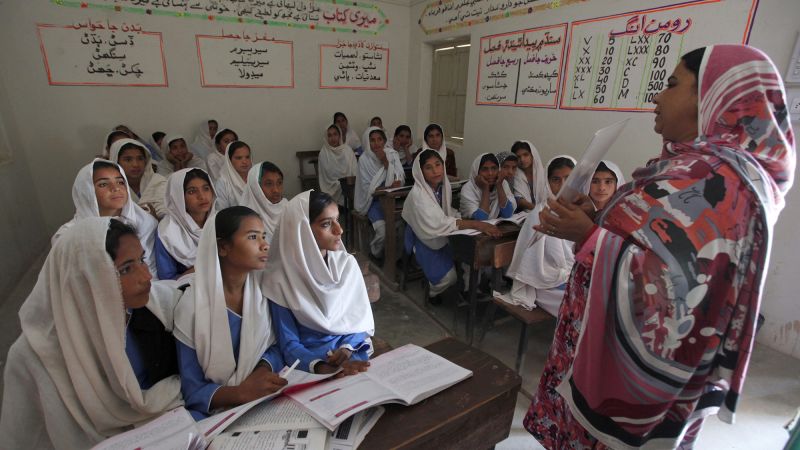
“This has happened many times. A classmate of mine got her period during class,” she told CNN late last year. “The white kameez on her back was bright red. She was shocked. She had no idea what was happening to her.”
Now, the 25-year-old lawyer and her colleague Ahsan Jehangir Khan, 29, are trying to break that stigma and ensure girls and women have access to the sanitary products they need through a groundbreaking lawsuit asking the government to remove taxes on menstrual products and classify them as necessities rather than luxuries.
Several health workers and women’s rights activists supporting the case told CNN that social taboos around sexual health are widespread in Pakistan, with tax policies that prevent some people from purchasing essential menstrual products and worsening gender inequalities in education, health and social services.
“I think what we have started here is not a lawsuit, but a movement to bring period poverty to the forefront,” Omer said.
Omer, the petitioner in the case, and her attorney, Khan, say they hope to replicate the success of similar efforts by governments, including in India and Nepal, to reduce or completely eliminate taxes on antiques.
Khan told CNN that they were “emboldened” by the regional ramifications of the law change, adding: “People and governments in the Global South are talking about this. We should take the lead.”
CNN has reached out to Pakistan’s Ministry of Health for comment on this matter.
Reproductive rights activist Bushra Mahnoor counts herself among the small number of women and girls in Pakistan (about 12%, according to UNICEF) who use commercially available sanitary products instead of homemade alternatives.
Still, menstrual products were a “luxury” in her family’s home, she said, adding that women often lined pads with cotton or used rags to make them last longer than medically recommended.
“Menstruation was very traumatic throughout my childhood,” the 22-year-old from Attock, a small town in northern Pakistan’s Punjab province, told CNN. She started menstruating at age 10, which she said was a “very lonely” time in her life.

Lawyers argue that by taxing sanitary products, the Pakistani government systematically ignores women and girls’ rights to health and education, hinders their ability to fully participate in public life, and violates Article 25 of the constitution, which prohibits discrimination on the basis of gender.
Under the 1990 Sales Tax Act, domestically manufactured sanitary napkins were subject to an 18% sales tax and imported sanitary products were subject to a 25% customs duty, according to a legal petition released by Omer and Khan in October.
According to UNICEF, this surcharge, along with other local taxes, means women in Pakistan face a 40% surcharge on sanitary products, pricing out the most vulnerable.
It reported last year that as of mid-2025, nearly 45% of the country’s population will live below the World Bank’s global low-middle income poverty line of $4.20 (about 1,175 Pakistani rupees) per day.
Essential goods are straining scarce household budgets, with consumers paying about PKR 363 for 12 eggs and PKR 2,186 for a kilogram of flour, economic data firm CEIC Data cited Pakistan Bureau of Statistics figures for 2025.
Meanwhile, a pack of 10 sanitary napkins on the market costs an average of 400 to 485 Pakistani rupees, or $1.43 to $1.73, which may not be enough to last a woman or girl for a month.

Omer said the failure to implement laws aimed at protecting women is reinforced by taboos around menstruation, which limit public discussion.
Following a hearing in late November, a Rawalpindi court ordered the government to “timely respond” to the lawyers’ arguments in order to move forward with the case, Omer said.
In the meantime, Omer hopes the government will take her complaint seriously. “With taxes like these, half of our population experiences the cost of inequity every day,” she told CNN last week.
Mahnoor, a reproductive rights activist, said that after she started menstruating, her body felt like a stranger. This is an all-too-common experience for girls in Pakistan, according to one health worker, who cited a lack of educational resources about the physical changes that come with puberty.
“When girls get their periods, they think they might have cancer,” said Dr. Azra Ahsan, a gynecologist based in the port city of Karachi. “They think they’re going to die until they tell someone.”
In a society where men are often the breadwinners and in charge of household finances, and where menstrual products are out of reach for many, women’s health care needs tend to take a backseat, Ahsan said.

Those trying to provide sexual health education are being ostracized and discouraged, doctors told CNN.
Ahsan said knowledge gaps exist across income and education levels, which contribute to the spread of misinformation. Lack of access to toilets, running water, and menstrual products in public places excludes many girls and women from public life. In a 2024 report, UNICEF said one in five girls in Pakistan misses school due to their menstrual cycle, “losing at least one year of education.”
Mahnoor said some students avoid walking to class because they can’t get sanitary pads if their clothes are dirty. She added that her class teacher skipped a section in the textbook about menstruation, which meant to her that she was “not allowed to know and learn about my body.”

She recalled that once, another female teacher sent a student home after she started her period and asked her to stand at the edge of the classroom until her parents came to pick her up. “She had to take notes, write, do all her work standing up just because she was bleeding,” Mahnoor added. “It was really cruel.”
She explained that the school did not have sanitary products to provide the girl. “If she had been sitting there might have been stains on her clothes, which would have been even more embarrassing.”
Issues related to menstruation do not end at school. Mahnoor added that employers don’t always provide bathroom breaks, meaning some women, especially apparel workers, don’t have time to get up from their workstations and change their sanitary pads.
Over the past few years, seasonal flash floods exacerbated by the climate crisis have trapped women in Pakistan in a “terrible, awful cycle” of period poverty, lawyer Omar said.
The reality can be “painful” for people spending time in flood relief camps, said Mahnoor, who co-founded the nonprofit Mahwari Justice in 2022 and distributed sanitary products to people in flood-hit areas.
Women have little choice but to wash their rags in the floodwaters, the activist told CNN, adding that without sun they may not be able to dry the rags. Some people are forced to use headscarves as makeshift padding. Some people rely on “free bleeding” or mix mud or sand into the rag to increase its absorbency, she says. This increases the risk of chafing, skin disorders, urinary tract infections, and vaginal infections.

If a girl or woman wants to relieve herself in a secluded area for privacy, she could be at risk from “people who want to prey on her,” Mahnoor added.
Beyond the physical health risks, doctors and lawyers warn that the social stigma surrounding menstruation has a corrosive effect on women’s mental health and sense of self. Ahsan said some religious groups prohibit menstruating women from entering communal living areas.
As a result, women, especially girls, feel they are being “punished for bleeding,” Mahnoor said, adding that men are also complicit in remaining silent on the issue.

Ms Omer said she and Ms Khan had been “pleasantly surprised” by the “encouraging” response from a wide range of society, including the national media, as the case progressed.
The two lawyers hope this will encourage discussion about reproductive rights, adolescence and sexual health across Pakistani society, especially for those currently in their teens and 20s. “It’s time to go beyond just protesting. It’s time to actually start challenging what we can (do) through legal reform, advocacy and lobbying in the right circles,” Omer said.
“As new generations come in, people are becoming a little more vocal about topics that were previously taboo,” she added. “They’re very candid.”
Correction: This article has been corrected to accurately identify where the legal petition was filed.
