

Dhaka, Bangladesh
—
Every day, Shakil Khan rides his bicycle through Dhaka’s relentless traffic, delivering goods and picking up passengers across the city. But these days, people spend hours waiting in long lines at gas stations to fill up their bikes within the government’s fuel purchasing limits.
Khan is one of tens of millions of Bangladeshis suffering from oil and gas shortages as US and Israeli military strikes against Iran hit fuel supplies around the world.
“My daily income is decreasing because of the oil shortage,” Khan said as a line of motorbikes snaked behind him through the streets of Bangladesh’s capital.
Thousands of miles away, the Strait of Hormuz, one of the world’s most important energy arteries, has also come to a virtual standstill as missiles and drones criss-cross the Persian Gulf and Iran steps up attacks on ships.
Like many countries in Asia, Bangladesh relies on imports of oil and gas from abroad, and fears of potential supply shortages are prompting governments across the region to launch new policies.
As the world’s richest nation leads a costly war, one think tank estimates the United States is burning through $890 million a day, but those with the least financial means are feeling the most severe and immediate impact on their wallets.

Millions of people are being told to turn down their air conditioners, turn off their lights, avoid traveling to meetings and perhaps even work from home to save energy.
In a historic move on Wednesday, members of the International Energy Agency unanimously agreed to release 400 million barrels of oil. This will be the largest emergency stockpile release in history.
The United Nations has warned of catastrophic consequences if the unrest continues.
“The resulting ramifications extend far beyond the region, impacting energy markets, shipping and global supply chains,” the agency said in a report on Tuesday.

Escalating conflict in the Middle East is compounding damage to an already uncertain global economy due to U.S.-imposed tariffs and unrelenting trade disruption.
South Asia in particular is highly dependent on oil and gas imports from the Middle East, making it extremely vulnerable.
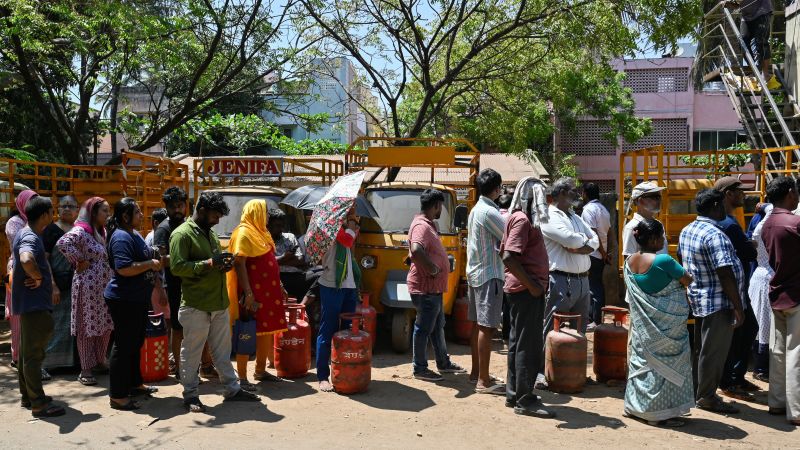
In the northern Indian city of Gorakhpur, Ajay Kumar joined the line of people waiting to fill gas cylinders outside a distribution center at 3 a.m.
“This situation has been going on for the last 10 days,” he told local news agency ANI. “If you don’t come to the center on time, half of the people will go home empty-handed.”
India, the world’s most populous country, is one of the world’s top importers of liquefied petroleum gas (LPG), which its residents use for everything from cooking to powering many of its vehicles.
Ravi, who gave only his first name, said people at ANI were facing “many hardships” due to the shortage. “Yesterday I had to cook a meal on the stove,” he said.

India imports about 85% of its LPG and sources about 50% of its liquefied natural gas (LNG), which is essential for fertilizers, electricity and transportation, from the Middle East, according to analysis firm Kpler.
India’s Ministry of Petroleum and Natural Gas, struggling to contain the fallout, earlier this week ordered refineries to ramp up production of LPG solely for domestic consumption. The government has also activated emergency powers to divert fuel from industrial users to maintain supplies to households.
Neighboring Pakistan has also announced extreme austerity measures, including school closures and working from home. Prime Minister Shehbaz Sharif said government institutions would also not be allowed to buy new furniture or air conditioners.
The fallout was felt in South Korea, which imposed a cap on fuel prices for the first time in nearly 30 years. This is a big step considering Japan’s status as the world’s leading economy. It is one of the world’s leading exporters and a key member of the G20.
President Lee Jae-myung also advised the government to work to ensure that supply ships do not pass through the Strait of Hormuz, and to crack down on oil refineries and gas stations to prevent price gouging.
Thailand ordered government workers to conserve energy by canceling overseas travel and working from home, and urged people not to panic buy.

The Philippines also announced that some civil servants will be required to work four days a week and set their air conditioners to a temperature of at least 24 degrees Celsius (75 degrees Fahrenheit).
“There is an urgent need to take stringent energy conservation measures to further reduce energy use by government operations,” the government statement said.
Back in Bangladesh, there were lines around gas stations until late at night.
Raisul Islam Omar said he used to line up at gas stations twice a day to get his car running. “Every day, I buy oil once in the morning and once in the evening,” he said as cars lined up behind him. “That’s impossible.”

In response to the shortage, India is expected to supply around 5,000 tonnes of diesel to the country through a pipeline, which will help “maintain adequate fuel reserves for power generation, transportation and agriculture,” state broadcaster All India Radio said.
But for those on the ground, the unprecedented intervention offers little reassurance as concerns mount over how long the crisis will last.
“If the situation continues like this, there will be a lot of pressure on the economy,” said Mohammad Joynal, another Dhaka resident who was queuing for fuel.
“We’re going to be in a very, very bad situation.”
