

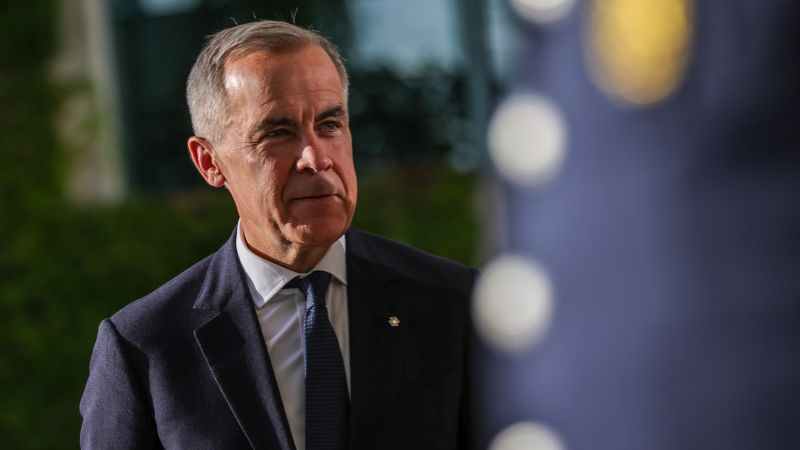
Canada announced Friday that Prime Minister Mark Carney will head to Washington next week to meet with President Donald Trump for what is being billed as a “practical visit.”
A statement from the Prime Minister’s Office said Tuesday’s visit will “focus on the shared priorities of new economic and security relations between Canada and the United States,” but Carney is under pressure from his home to negotiate Canadian tariff relief as tariffs for the automobile, steel, aluminum, timber and energy sectors.
According to Canadian government data, President Trump’s tariff regime has hit the Canadian economy hard, reaching unemployment rates of 7.1% in August, the highest level since May 2016.
Carney won the election in April with a harsh message to Canadians, warning that relations with the US will change dramatically over the next few years.
“Based on the consolidation of our economy, strict security and military cooperation, our old relationship with the United States has ended,” Carney said in March shortly after Trump imposed a 25% tariff on cars and parts. “It’s clear that the US is no longer a reliable partner.”
To that end, Carney pursues close ties with other Western countries, with the UK and France courting on their first visit as prime ministers abroad, and working with Australia on their new Arctic radar system.
Carney showed that for months after the election, he called for “respect” from Trump and asked the president to remove the proposal that Canada should become “51st state.”
However, President Trump recently revived the idea in a speech to military leaders when he spoke about his proposed “Golden Dome” missile defense system, which proposed “Golden Dome” missile defense system that could potentially protect both Canada and the United States.
“Canada called me a few weeks ago. They want to be a part of it. How about that, why not join our country? Become 51, become 51, become 51st and get it for free.”
Earlier this week, Canada’s top trade negotiator Dominique LeBlanc said Canada still has leverage in trade negotiations, as the trade war also hurt American companies.
“We believe that domestic pressure from US senators, governors, business leaders and union leaders will create opportunities that could lead to agreements with the US administration,” LeBlanc said while testifying to Canadian Congressional Committee.
In addition to sectoral tariffs, Canada, the US and Mexico have launched talks on the renewal of the trade agreement negotiated by the first Trump administration and launched in 2020. It is expected to expire in 2026.
When the Canadian Prime Minister made his first visit to the United States in May, Trump grew annexation almost immediately while meeting Carney in an oval office, declaring that he “intended” a union between Canada and the United States.
“As you know from real estate, there are some places that are never sold,” Carney told the president. “Never say it,” Trump replied.
The annexation question seemed to sink for a while afterwards. In July, Carney claimed in an interview with CNN’s Christian Amanpool that Trump is no longer interested in annexing Canada. “He praises Canada,” Carney told Amanpool. “I think it’s fair to say that maybe (he) is craving Canada.”
