

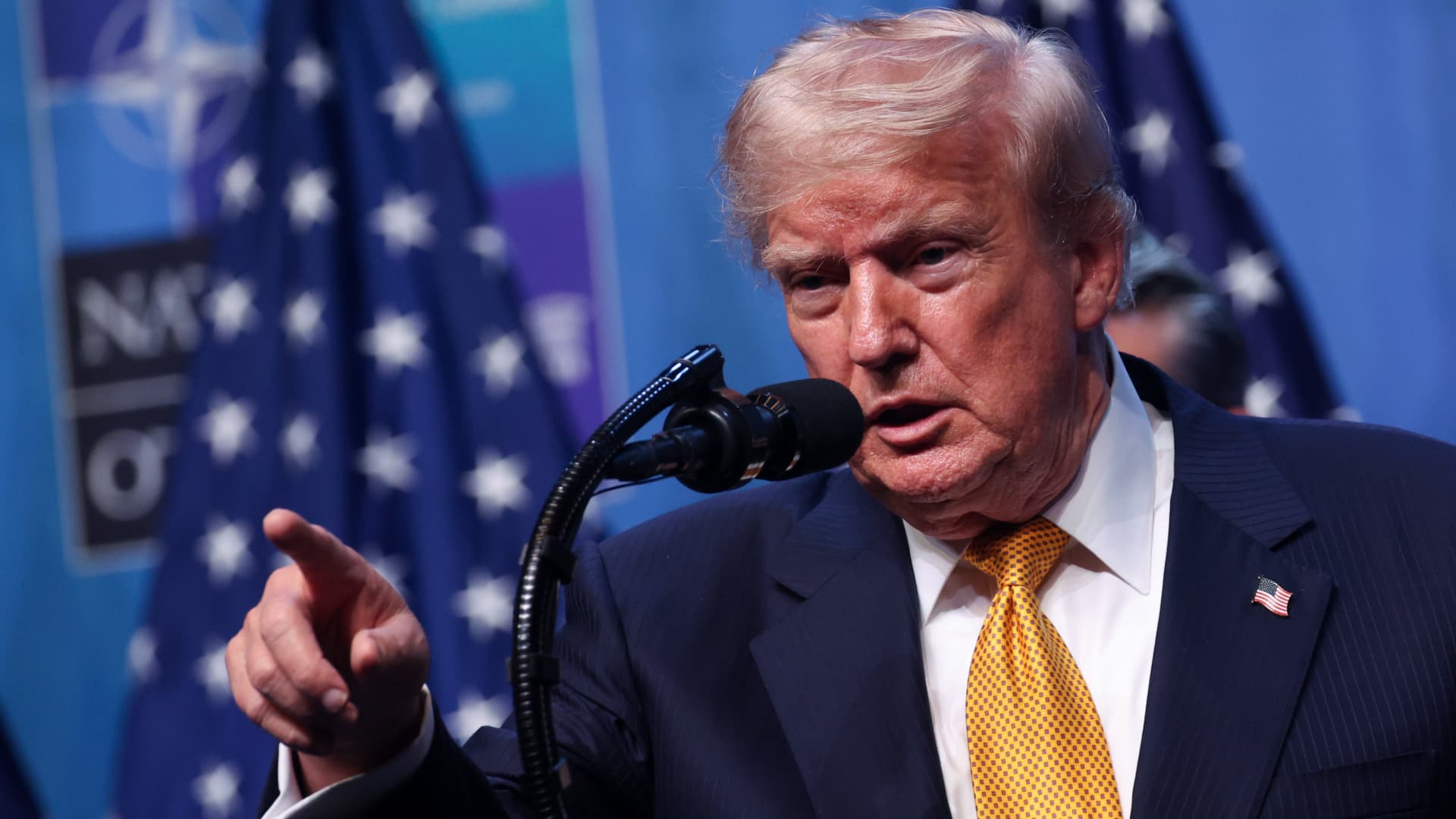
US President Donald Trump speaks during a press conference during the 2026 NATO Ankara Summit in Ankara, Turkiye, July 8, 2026.
Beata Saurzernul Photo | Getty Images
Hello, my name is Justina Lee from Singapore. Welcome to another edition of CNBC’s Daily Open.
The latest developments in the Middle East, including the proposed 20% tariff on cargo transiting the Strait of Hormuz, are causing oil prices to soar.
U.S. benchmark indexes fell overnight on waning hopes for a Middle East peace deal and a sell-off in tech stocks, but futures were little changed ahead of earnings and inflation data.
What you need to know today
Energy concerns have resurfaced following US President Donald Trump’s proposal to impose a 20% tariff on cargo transiting the Strait of Hormuz.
“From now on, the United States will be known as the ‘Guardian of the Strait of Hormuz,'” Trump claimed in a post on Truth Social. President Trump also called on the United States to reimburse “all costs for all shipments necessary to carry out the work that provides safety and security to this highly volatile region of the world.”
Oil prices soared more than 9% on Monday, the biggest single-day increase since 2020, following President Trump’s decision to reopen a blockade of Iran. U.S. assurances that more than 8 million barrels of oil were transported through the Strait of Hormuz with military aid did not dampen energy concerns. Prices rose more than 2% in Asian trading on Tuesday.
Recent developments related to the Middle East have affected US stocks, with the S&P 500 index down 0.8%. The Nasdaq Composite fell 1.6%, and the Dow Jones Industrial Average fell more than 100 points (about 0.3%).
But stock futures were little changed as traders sought reprieve from upcoming earnings and inflation data.
Asian markets also opened lower as a risk-off mood took hold as investors awaited the release of Chinese trade data later in the day, while Singapore reported second-quarter economic growth of 5.7%, beating market expectations, on the back of strong manufacturing growth.
—Justina Lee
And finally…
UK signs landmark trade deal with Switzerland in key services sector
The UK and Switzerland announced a free trade agreement in services on Monday. The deal is expected to increase UK exports by billions of dollars and ease travel between the two countries.
It is the sixth trade deal Britain has struck in the past two years and comes as the ruling Labor Party seeks closer ties with Europe as part of its post-Brexit reset. Although Switzerland is not a member of the European Union, it is deeply integrated into the European single market through a network of bilateral treaties.
The British government estimates that the free trade agreement will ultimately result in additional exports to Switzerland amounting to 5.2 billion pounds ($6.96 billion) a year over the next few years.
A separate agreement would also allow travelers between the two countries to use electronic gates to reduce waiting times at airports, while also eliminating data roaming charges for visitors.
—Joseph Wilkins
