

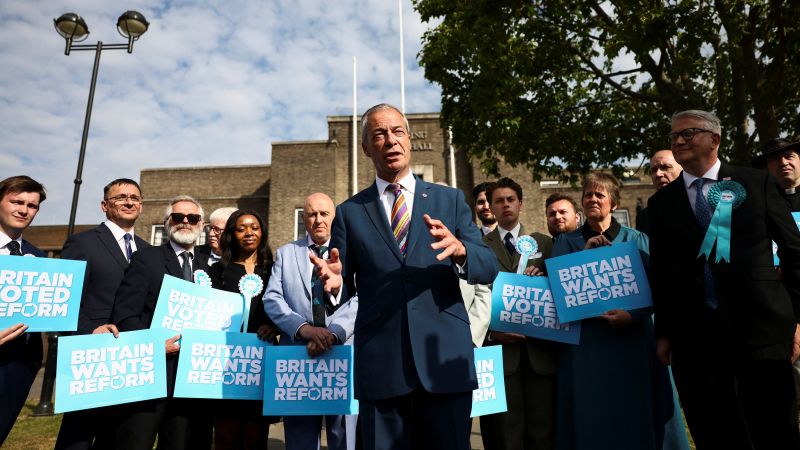
Like his ally US President Donald Trump, Nigel Farage has enjoyed a Teflon-like political career, with his blunt and combative communication style brushing aside potential scandals.
Throughout his rise to fame as the voice of Britain’s populist far-right, architect of Brexit and chief anti-immigration activist, he has largely ignored any accusations of wrongdoing. His populist party, Reform UK, leads most national opinion polls and has a huge influence on British politics, given that it has just eight out of 650 MPs.
But that momentum has stalled in recent weeks.
The Reformers made a big breakthrough in May’s local elections, which do not affect the composition of the central government but provide important insight into the public mood, but translating the gains into an increase in seats is proving difficult for the party. It lost a strong by-election this year to the left-wing Green Party and the ruling centre-left Labor Party, respectively, and now faces a challenge from the right with the rise of Restore Britain, led by former Reform MP Rupert Lowe.
And perhaps more importantly for a party whose political fortunes are effectively inseparable from its leader’s own personal brand, Mr Farage himself has come under unprecedented scrutiny over some of his financial dealings.
On Sunday, he and his supporters were again forced to deny charges of violating Congressional rules after The Sunday Times reported that they had failed to disclose gifts and payments from George Cottrell, a cryptocurrency financier and gambler who was indicted by U.S. authorities in 2016 for money laundering, wire fraud, extortion and racketeering conspiracy, served eight months in prison, and reached a plea deal with prosecutors.
The allegations come three months after the Guardian newspaper reported that Mr Farage had received a £5 million ($6.7 million) gift from crypto billionaire Christopher Harbourne shortly before he announced he would stand for parliament in the 2024 general election. While other scandals, such as Farage’s racism allegations during his school days, have barely stuck, this one has.
An awkward interview went viral in which Mr Farage tried to rebut questions and claimed “no one cares” about the payments. He is under investigation by Parliament’s standards watchdog and was referred again to it over the allegations in Sunday’s report. These investigations have also spotlighted Mr Farage’s unusually high income outside of his role as an MP.
MPs are allowed to have side jobs unless they provide paid parliamentary advice, but publicly available records show that Mr Farage has declared more than £2 million in other income since becoming an MP in 2024. According to the Financial Times, this is more than 20 times the basic salary earned by MPs and is the second-highest salary in this parliament, after former chancellor Rishi Sunak.

Reform Treasury spokesman Robert Jenrick told BBC Sunday that “no rules were broken” over allegations that Mr Cottrell allowed Mr Farage to stay in his London townhouse, paid staff to change Mr Farage’s social media presence and paid for Mr Farage’s security even before he became an MP.
Mr Jenrick sought to characterize these gifts as “purely personal”, a category normally reserved for gifts from family members, meaning they did not need to be disclosed under parliamentary rules even if they were made in the year before Mr Farage was elected to parliament.
A spokesperson for Mr Farage also reiterated his defense to CNN, calling the story “baseless and contrived.”
Mr Farage has significantly cut back on the number of press conferences he gives in the months since the Guardian article broke, a period that coincided with two months of campaigning for local elections and the Makerfield by-election.
The watchdog investigating him has not yet reported its findings, but the consequences would be significant if Farage were to rule against him. He could be suspended if he is found to have seriously breached parliamentary rules. A suspension of more than 10 days could trigger the start of a process that could lead to by-elections.
However, Mr Farage has overcome many previous controversies and his party currently holds an advantage in opinion polls. It remains to be seen whether this story will be different, arriving at Mr Farage’s strongest political moment.
