

The 2026 FIFA World Cup will be a unique tournament in many ways.
From the largest participation in the competition’s history to three host nations, the 39-day tournament promises to be the most epic version of football’s marquee event.
Recommended stories
list of 4 itemsend of list
The 2026 edition will also blend technology and gaming to improve the match-watching experience for fans and make the sport more sophisticated for players.
Al Jazeera Sports provides you with the latest information on the upcoming World Cup.
1. Match ball with sensor
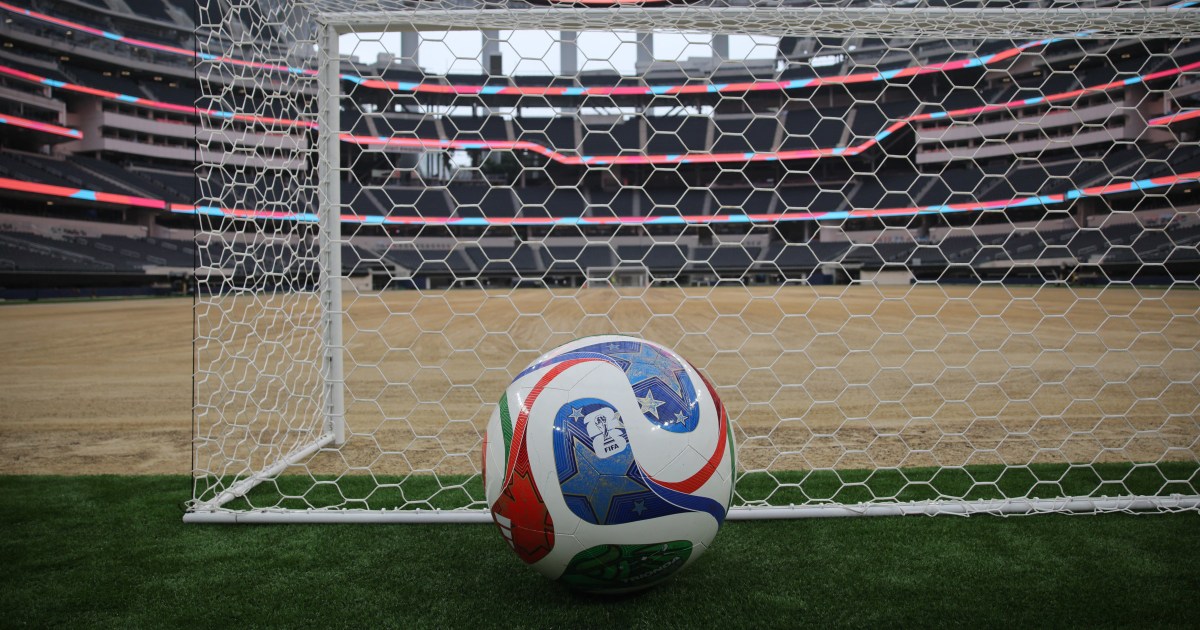
Trionda, which means “three waves” in Spanish, is the official match ball for the 2026 World Cup to be held in the United States, Mexico, and Canada. But what’s so special about this adidas ball?
A small inertial measurement unit (IMU) sensor chip is built into the ball, allowing it to understand every element of the ball’s movement. The sensor captures data 500 times per second, tracking the ball’s acceleration and granular movement in three dimensions.
“This technology will transmit accurate data in real time to the Video Assistant Referee (VAR) system to enhance match officials’ decision-making, including in relation to offside incidents,” FIFA said in a statement.
Simply put, the sensor tells you “what the ball is doing in 3D space,” as FIFA’s head of research and standards Nicholas Evans explained in a BBC video.
2. AI-enabled 3D player avatar
The use of technology goes beyond the game ball. Players are just a part of it.
A series of artificial intelligence (AI) innovations were announced earlier this year as part of FIFA’s partnership with Lenovo, the world’s largest computer manufacturer.
This includes AI-enabled 3D player avatars.
World Cup players will be digitally scanned to create accurate 3D models. Each scan takes about one second and is described by FIFA as “capturing highly accurate body part dimensions, allowing the system to reliably track players even during fast or impaired movements.”
“AI-enabled 3D player avatars represent a significant development in semi-automated offside technology,” FIFA’s January release said.
“Furthermore, the 3D model will be integrated into the host broadcast, allowing offside decisions made by the VAR system to be displayed in a more realistic and appealing way to fans in the stadium and to viewers around the world.”
Referee body cameras, which are already being trialled in major soccer leagues around the world, will also be used in all 104 games, giving fans a view of the playing field as if they were on the pitch themselves.
3. Robot dog
Mexican police will rely on dogs to fight crime at the World Cup. It’s not a dog type, it’s a robot type.
The quadruped robots are designed to enter dangerous areas and broadcast live video to security forces to monitor them before taking action during tournaments.
The animal-like robot, which was purchased by the Guadalupe City Council, part of the Monterrey metropolitan area, for 2.5 million pesos ($145,000), will be deployed “in case of any altercation,” Guadalupe Mayor Hector Garcia said.
The robot dog’s purpose is to “assist early intervention of police officers and protect their physical safety,” he added.

4. Advanced semi-automatic offside technology
Are you frustrated that linesmen are too slow to raise the offside flag? It could be over.
FIFA will introduce advanced semi-automatic offside technology, which will allow authorities to make quicker decisions rather than waiting for a move to develop.
Semi-automatic offside technology was designed to detect offsides in near real time, but previously only alerted referees if a player was offside by more than 50cm. However, the improved version allows for more accurate decisions by sending a signal when a player is more than 10 cm offside.
Officials can receive real-time audio alerts directly in their earphones without having to wait for notifications from VAR.
However, there are some limitations. This can only be used for positional offsides, not for subjective calls, and does not allow you to select the closest call. They also cannot interpret whether a player interfered with play and may not be able to determine an offside call if the player is on the ground or too close.
Nevertheless, FIFA believes this new technology will reduce frustration for viewers and players, and reduce the chance of injury from unnecessary play when the offside flag is due to be raised.

5. Fixed hydration breaks
There is a three-minute hydration break between each half of the World Cup, which FIFA introduced to prioritize player welfare.
Weather and temperature conditions are not favorable and a break will be taken around the midway point (22 minutes) of each half.
Manolo Zubirria, Chief Tournament Officer for the 2026 FIFA World Cup in the United States, said: “There will be a three-minute hydration break for each match, regardless of where the match is played, regardless of whether it is covered or not, (or) regardless of the temperature. There will be a three-minute hydration break on both sides from whistle to whistle.”
“Of course, if there is an injury (stoppage) at the 20 or 21 minute mark and it continues, this will be dealt with on the spot with the referee,” he added.

Al Jazeera’s dedicated page for the 2026 FIFA World Cup allows you to track the progress of the match with all the latest news, match developments and live text commentary, and stay up to date with group standings, real-time results and schedule.
