

What are your hobbies? It’s a simple question, but one that bothers me.
I’ve always been curious and interested in learning new things, and I’ve always had a hard time choosing one or two areas to focus on. After years of frustration, I finally decided that my hobby was “gathering new experiences” and made a plan. Every year I decide to do some new experiences that challenge and change me.
In 2025 I decided to climb Everest. Well, almost.
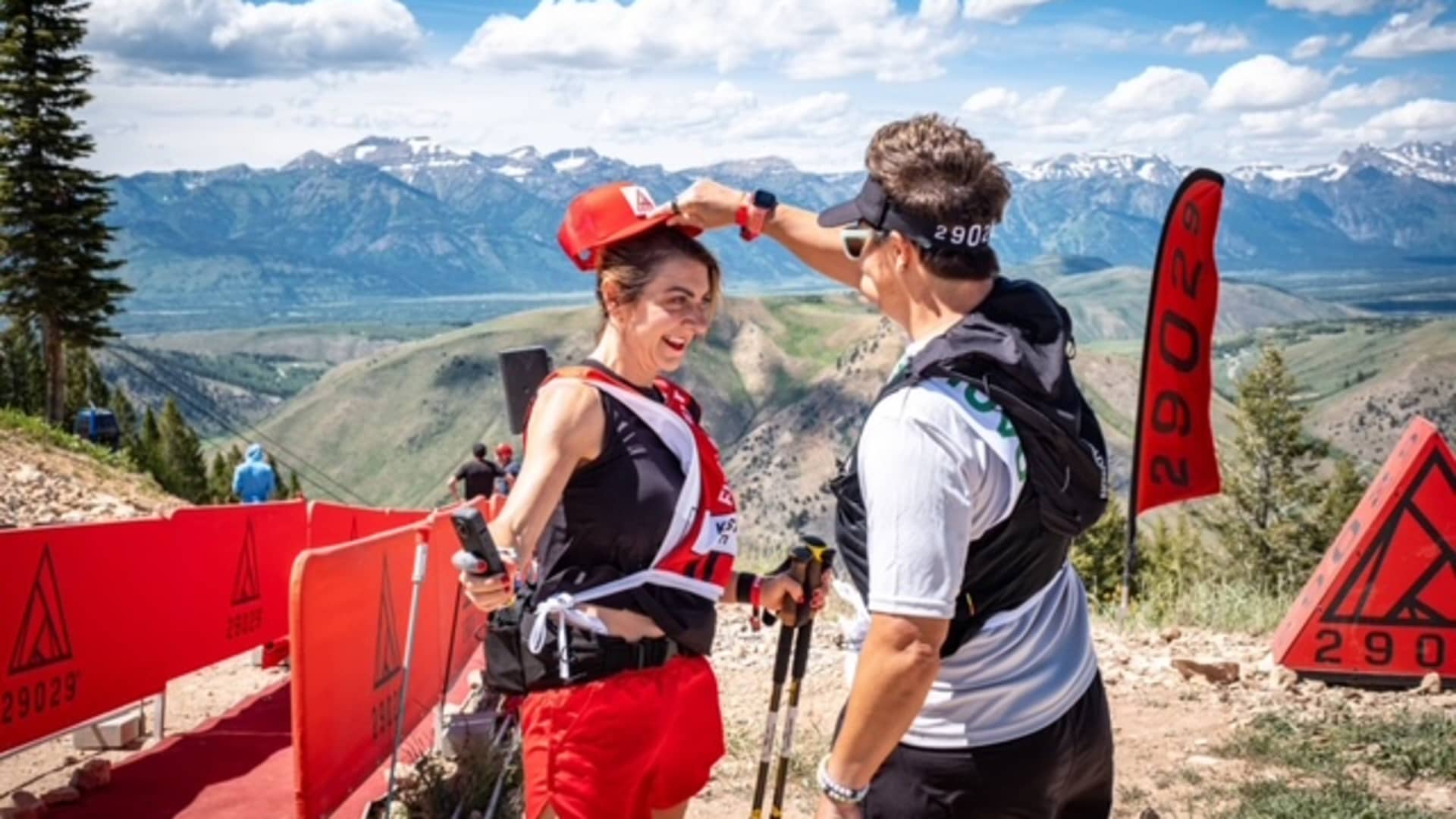
I signed up for an endurance event called the 29029 Challenge in Jackson Hole, Wyoming. The idea was to climb a small mountain 19 times within 36 hours, climbing a total of 29,029 feet (equivalent to Mount Everest in vertical terms). Imagine a procession of 300 people hiking up a steep slope, taking a chairlift back down from the summit, and repeating the loop continuously for a day and a half.
When I registered, I felt excited and nauseous at the same time. I had never tried anything even close to that. What do you need? Will I be able to dig deep enough when the inevitable pain and doubt come? How do I find time for training to fit into my consultant’s travel schedule?
We were proud to earn the coveted Red Hat, which is awarded to participants who complete the event. But it was never the real prize. The real victory was learning how to be someone else. In other words, I learned how to be a person who can give my all and keep moving forward even when my body (and mind) begs me to stop. That new version of me now shows up better at work and at home.
Write down your commitments to follow through.
I travel a lot as a consultant, so there’s always a reason not to train. I’ve found that the more I write down exactly what I’m working on and why, rather than keeping everything in my head, the easier it is to find ways to apply it.
For 20 weeks, I trained in snow, rain, and heat. From early morning until late at night, across multiple countries and states. No matter the situation, no matter what mood I was in, I kept showing up. By the time I stood at the foot of a mountain in Wyoming, I knew I had put in the effort to prepare for whatever was to come.
“The real victory was learning how to be a different version of myself,” Elmer said, “and now I can behave better at work and at home.”
Provided by Christy Elmer
I now write down all my personal commitments and review them regularly to keep them top of mind. For example, during the winter I had a goal to improve my skiing and start doing blue (or intermediate) running. By writing down those goals and looking at them weekly, I was able to spend more time actually skiing and watching videos to improve.
I learned specific tactics to maintain discipline.
One technique I discovered was to focus on the step at hand, just the next workout, or just the next 800 meters, instead of thinking about a bigger, scarier end goal.
Another technique I discovered was to find value and even enjoyment in the training itself. In difficult moments, I convinced myself that they were free opportunities to build my mental strength and resilience.
Since this experience, both techniques have helped me get through other difficult but necessary tasks at home and at work.
This year, I’ll be tackling the 29029 trail. This involves completing three mountain marathons over three consecutive days. That’s an audacious goal for someone new to marathons and trail running.
Every week I review my goals and training plan and mark them on my calendar, so all I have to do is take the next step at hand. And when work gets tough, I remind myself to be present and value the experience and how it contributes to my growth.
I discovered a valuable source of fuel to propel me forward
I surrounded myself with coaches and mentors who had previously participated in Everest climbing events and spoke with them frequently. By tapping into their wisdom and experience, I was able to learn new skills, build confidence, and regain motivation when I was down.
“When we embrace mountaineering, it changes who we are and what we believe we are capable of,” Elmer says.
Provided by Christy Elmer
I also found reasons to celebrate victories, no matter how small, along the way. One time, I celebrated with my husband because I didn’t get a blister while training.
The most important thing was to create some simple, specific sentences to tell myself why I was taking this challenge, and to say them to myself often. One of my favorites is “Let the challenges make you stronger.”
I enjoyed the transformation
Whether it’s for an individual or an organization, change is never easy. Embracing mountaineering changes who we are and what we believe we are capable of.
I encourage everyone to pursue experiences that challenge themselves and make a difference. After climbing that mountain 19 times in 36 hours, I found a new me. My identity includes endurance athlete and bestselling author. This is because of the work I put in and the discipline I maintained in both endeavors.
Now I’m ready to take on challenges I couldn’t have imagined a year ago.
Kristy R. Ellmer is a managing director and senior partner at BCG, former chief transformation officer, and co-author of How Change Really Works: Seven Science-based Principles for Transforming Your Organization. She led BCG’s transformational practices and co-founded BCG’s Behavioral Science Lab. Her TED talk about navigating change with confidence has been viewed by more than 500,000 people, and she has spoken at companies including Kroger, Valley Bank, Whirlpool, Aetna, Hershey, BHP, and J.Crew.
Do you want to get ahead at work? Next, you need to learn how to make effective small talk. In CNBC’s new online course, “How to Talk to People at Work,” expert instructors share practical strategies for using everyday conversations to increase visibility, build meaningful relationships, and accelerate career growth. Sign up now!
