

When gangs set fire to the FIFA Goal Center in the Haitian capital this year, it wasn’t just the main stadium that went up in flames. It was the epicenter of Haiti’s youth sports, a training ground for talent, and home to the dreams of young athletes in a country stricken by violence.
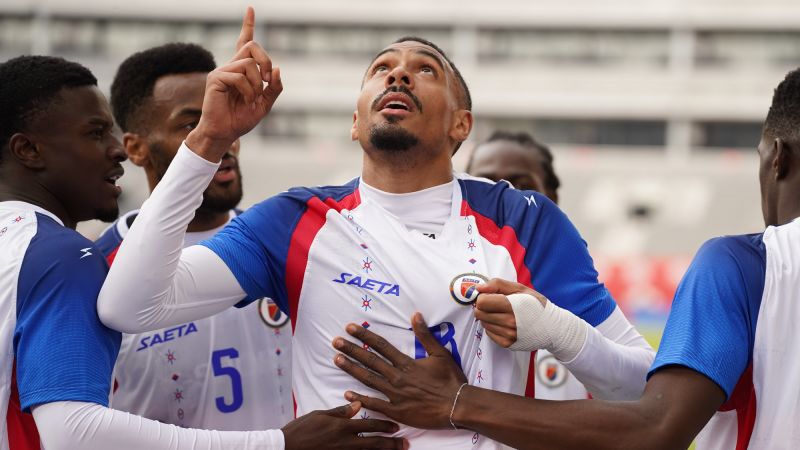
A few months ago, Louisius Deedson, a former up-and-coming athlete, was helping the Haitian national team make history in Curacao. By defeating Nicaragua in a World Cup qualifier, Haiti secured a spot in the world’s biggest single sporting event for the first time in more than 50 years.
The streets of Port-au-Prince were alive with euphoric fans in a brief respite from the turmoil and overlapping crises that have engulfed the country.
“It’s been a long time since I’ve seen the Haitian people come together like this,” said Deedson, 25, who scored one of Haiti’s two winning goals in the November game. This is a remarkable achievement for the national team, which was forced to train abroad due to the unstable situation in the country.
According to the United Nations, gangs control an estimated 80 to 90 percent of the capital, including areas that are home to some of the country’s biggest stadiums. Situated in downtown Port-au-Prince, Silvio Cator is where the national team trained for decades, including during their final and only World Cup appearance in the 70s.
However, the team has not used this system for many years as armed groups have become increasingly powerful in the country, especially after the assassination of former Haitian President Jovenel Moïse in 2021 created a power vacuum.
The stadium is currently being used by people seeking refuge from gangs, which control key routes into the capital and are holding up vital supplies in the Caribbean country facing a worsening hunger crisis. Fear permeates every aspect of life in some parts of Haiti, and the world of sports is no exception.
Deedson now plays in stadiums controlled by gangs, and laments the fact that these important facilities are not available to Haitian children who hope to one day play for the national team.
The Haitian midfielder, who currently plays for Major League Soccer’s FC Dallas, is from the Tabaré neighborhood of Port-au-Prince. Although the 2010 earthquake and armed group attacks made daily life difficult, Deedson was spared the worst. As a teenager, he immigrated to the United States to pursue a soccer career and education.
“I think it was best for me to move to the United States at this time,” he told CNN.

Many of the national team’s players are born, raised, and reside abroad, such as in France, where they play in European soccer leagues. Even when representing Haiti in the World Cup qualifiers, he was unable to play Haiti’s home games or practice in Haiti’s stadiums due to the turmoil in the country, and his French coach was unable to travel to the Caribbean country. They are instead training in Florida and New Jersey for the tournament.
Woodensky-Pierre grew up in Haiti, is one of the few players on the national team who still lives there, and is the only player currently playing in the country’s soccer league.
He was from the poor Cité Soleil district of Port-au-Prince, and started playing soccer with his father at an early age, before leaving the neighborhood to live with his mother. Like many other Haitian children, he faced financial barriers to a promising soccer career.
“There was a moment when I felt like we wouldn’t get this far because things were so difficult and we didn’t have any support,” he said on CNN’s Zoom show from Port-au-Prince. “I didn’t grow up in a wealthy family. My mother was a street vendor and my father always had a side job. Soccer was all I had.”
Even today, economic turmoil and armed violence weigh on employment opportunities for many Haitians, making it difficult for families struggling to make ends meet to finance sports-related expenses such as equipment, travel, and programs.
Pierre eventually won a soccer scholarship and was able to attend school.
However, his hometown of Cité Soleil remains a hotbed of armed attacks. Médecins Sans Frontières (MSF) suspended its operations in the region on May 11, with dozens of people injured in armed clashes and hundreds of people evacuated to medical facilities.
Pierre currently plays as a midfielder for the Haitian soccer team Violette Athletic Club. The club is part of the Haitian Soccer League, which continues to operate amidst overlapping crises in the country. On May 10, Pierre’s team won the final match of the national championship at the Parc Sainte-Thérèse stadium in the Petionville district of Port-au-Prince. It is one of the few areas in the capital that is not completely gang-infested.

By being named in Haiti’s final squad for the World Cup as a player to play for Haiti, Pierre hopes that this will open up opportunities for other young talents to play in the domestic league one day.
In his country, where around half of Haiti’s gangs are made up of minors, according to the United Nations, youth sports are not only a way to empower children who have grown up in violence, but also a way for vulnerable groups to participate.
This is one reason why Haiti’s Ministry of Youth, Sports and Civil Activities wants to build more sports facilities, but its ambitions have been hampered by violence in many places.
“Every time we see a child with a gun, we feel like we’re going to be killed,” Louis-Alex-François, the ministry’s communications director, told CNN. “Our prayer is that that fear stops so that we can be with our young people and children and offer them a better alternative, a better future.”
Pierre’s former agent, France-based Jérôme Salbert, said Pierre’s background gave him the grit and resilience he needed to excel in his soccer career.
“The fact that he was born in a tough part of Haiti… he developed a warrior spirit,” Salbert told CNN.
Salbert scouted Woodensky remotely but was unable to watch him play in person due to security travel restrictions, particularly at Port-au-Prince’s international airport. He says that’s just one reason why many Haitian soccer players are unable to sign with agents who can provide them with international opportunities to advance their careers.
“Due to the fact that the country is in a humanitarian crisis, the players sometimes face great instability. They are young and cannot be trusted easily, so sometimes they live with gangs around their homes,” Salvato told CNN.

“For me when I was young, being able to go to school with my friends and play soccer every day, twice a day was everything,” Deedson said of his childhood memories spent on the soccer field at Port-au-Prince’s landmark Sports Center.
But today, the surge in violence creates a completely different situation for sports enthusiasts.
“I know there are a lot of very talented kids in Haiti, but they just want a chance to show themselves,” Deedson said. “There’s a lot of talent that’s being wasted right now.”
His own childhood home in the Port-au-Prince area was partially destroyed in a gang attack last year. It was the house his parents had worked so hard to build and raised him and his sister in. Other members of his family in Haiti had to flee gang attacks.

“It’s not just my family, it’s everyone in Haiti,” Deedson said. Even from Texas, he stays connected to what’s happening in the Caribbean country and hopes things get better.
He hopes Haiti’s historic participation in the World Cup can somehow help with that.
