

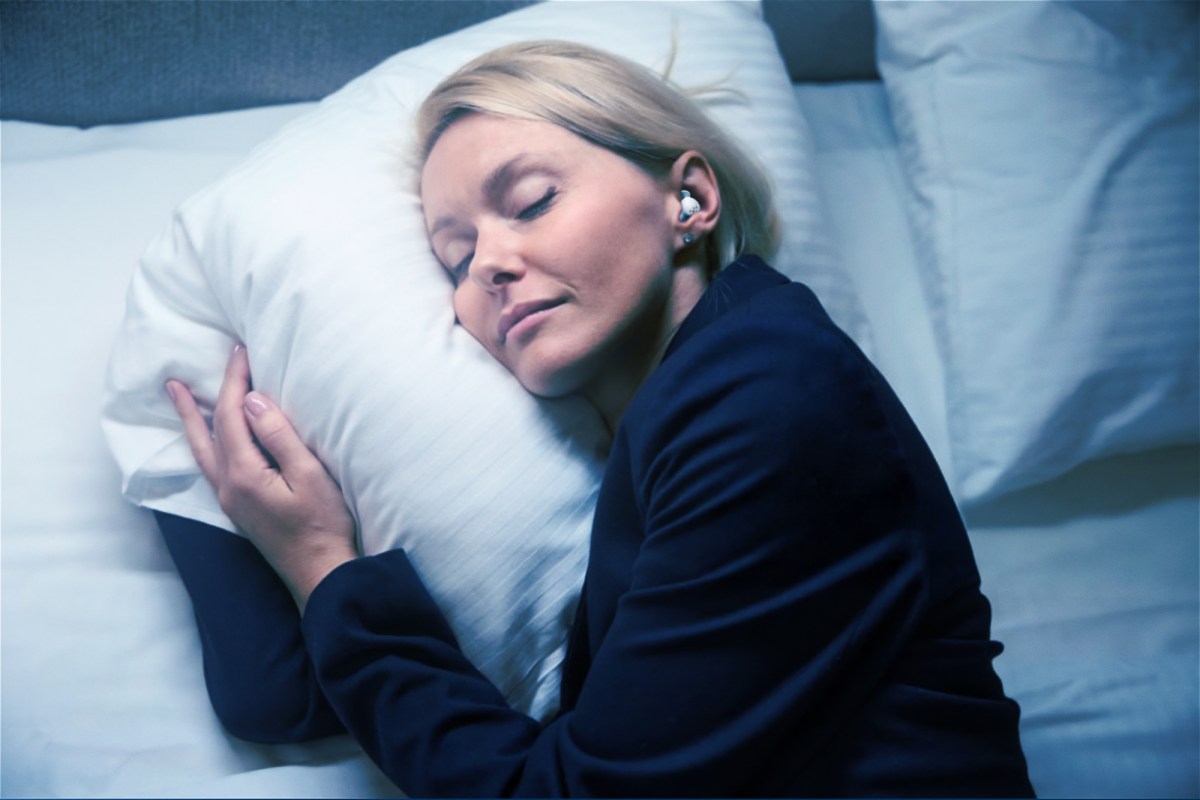
Traditionally, sleep earbuds have been designed to mask external noise and promote sleep with calming sounds. But today, a Boston-based startup called SOND announced a new type of earphones designed to actively intervene to help you sleep better.
SOND, founded by two MIT graduates, including Bose’s former head of global sleep, emerged from stealth on Wednesday with $7 million in funding. Along with the funding, the company announced its debut product, Dreambuds. It is a closed-loop, in-ear system that captures 12 physiological signals from the wearer and acts on them in real time to help consumers sleep better.

The initial investment of $7 million was provided by E14 Fund (an MIT-affiliated fund), Crosslink Capital, Ubiquity Ventures, Alumni Ventures, Meach Cove Capital, and Boston Scientific co-founder John Abel.
For the device to work, it tracks signals such as breathing, heart rate variability, cardiopulmonary coupling, sleep staging, body position, snoring, and seismic cardiography (SCG, or the mechanical vibrations of the chest wall produced by the beating heart).
This sensor data is streamed in real-time to a cloud-based AI sleep coach that selects sleep audio programs or generates them on demand, learning over time which programs work best for each individual user.

Users can also interact directly with the AI sleep coach by talking, asking for sleep insights, and asking for specific sleep programs from SOND’s proprietary library of over 500 audio programs. (Users can also stream podcasts through the case if they wish.) The AI coach can also generate audio on request, such as sleep stories on specific themes.
Notably, the startup is co-founded and led by CEO Yadid Eisenberg. He previously worked as head of sleep products at Bose, where he launched Bose’s Sleepbuds 2 and ran the company’s other sleep product portfolios. When Bose decided to strategically exit the sleep business, Eisenberg recognized an opportunity to create a startup focused on new products in this space and founded SOND in February 2022.
“At this point, I was spending a lot of time on physiology, sensors, audio…I knew I was going to do it,” Eisenberg told TechCrunch, sitting at an outdoor cafe with co-founder and CTO Amir Lazarovic (former senior software engineering manager at Google) and a prototype Dreambuds device.

The co-founders met at MIT, and that meeting also had something to do with sleep. Lazarovich, who was researching distributed systems, had just moved into a family dormitory and didn’t have a mattress. Eisenberg offered him to use one from his room instead. A chance encounter about 14 years ago led to a lifelong friendship.
After graduating from MIT, Ayzenberg founded a startup called The Sync Project that maps music to physiological factors such as heart rate and heart rate variability. The startup was acquired by Bose four years later, which ultimately led to his work on the second generation of Sleepbuds.
Eisenberg said Bose customers often wanted Sleepbuds to do more than just noise cancellation, they also wanted sensors to track their sleep and help them sleep better. However, technology at the time wasn’t yet at a stage where it was possible to bundle a large number of sensors into a small form factor like AirPods while still conserving the device’s battery. But by the time Bose retired from sleep wearables, things had changed.
However, Ayzenberg cautioned that Dreambuds should not be thought of as something like Bose’s Dreambuds III. Instead, he admits that earphones from competitor Ozlo are likely the next step.
“We did something completely different. Maybe the form factor is earphones, but that’s it,” he said.

The system itself runs end-to-end without the need for a phone. Instead, the Dreambuds’ charging case included Wi-Fi, Bluetooth, an OLED display, physical buttons, and a speaker. The latter will help you wake up with an alarm even if you fall asleep before putting on the earphones.
The goal is to eliminate the need for users to pick up their mobile phone to control the sleep technology system.
“We have a joke: Giving someone with insomnia a phone is like having an AA meeting at a liquor store,” Eisenberg says with a laugh. “The idea here is that just by removing the bud, your sleep schedule will resume,” he explains. “You can switch to a different sleep plan, and you can double-tap and say to your coach, ‘I’m having trouble sleeping. I want this, I want that.'”

A sleep coach can help you with specific sleep issues by looking at data on what has worked for you in the past, such as breathing techniques, calming tracks, soundscapes, and binaural beats. Eisenberg acknowledged that the AI coach will never speak to you unless you do a double-tap gesture, which could frighten or creep you out.
Lazarovich added that the AI coach responds based on the user’s current context. “For example, if you talk to someone just before bedtime, they’ll ask, ‘Are you ready to relax?’ But if you talk to them after they wake up, they’ll ask, ‘How was your night?'” he says.
In addition to hearing results from the AI coach, Dreambuds owners can see their data and hypnosis plan (sleep cycle graph) in a companion app to learn more about their sleep patterns.

The buds themselves have a unique look because the team placed the sensors facing outward and chose an artistic pattern for the sensors rather than trying to hide the technology. The buds also feature wide-frequency drivers for high-fidelity audio, as well as a microphone and sensor for motion detection.
SOND is conducting some comfort studies and betas, and aims to mass produce the device by Q2 2026, following a crowdfunding campaign to raise additional funds. The company is currently accepting reservations on its website.
If you buy through links in our articles, we may earn a small commission. This does not affect editorial independence.
