

Angry young men in eastern Congo on Sunday night attacked a hospital treating Ebola patients at the epicenter of the recent Ebola outbreak, forcing medical staff to scramble to evacuate patients as gunfire rang out nearby.
It was not immediately clear whether anyone was injured in the attack on Mombwal General Hospital, but the hospital’s chief medical officer, Dr. Richard Rokdu, told The Associated Press that the attackers had demanded the bodies of two relatives.
Lokdu said by phone that there had been gunfire and health care workers were trying to evacuate patients and staff.
“Mombwal General Hospital is on full alert,” he added. He knew nothing about the details of the unfolding chaos.
The attack was the third in a week on health facilities where health workers are struggling with a lack of resources to treat suspected Ebola cases, highlighting the challenges of the outbreak, which the World Health Organization has declared a public health emergency of international concern.
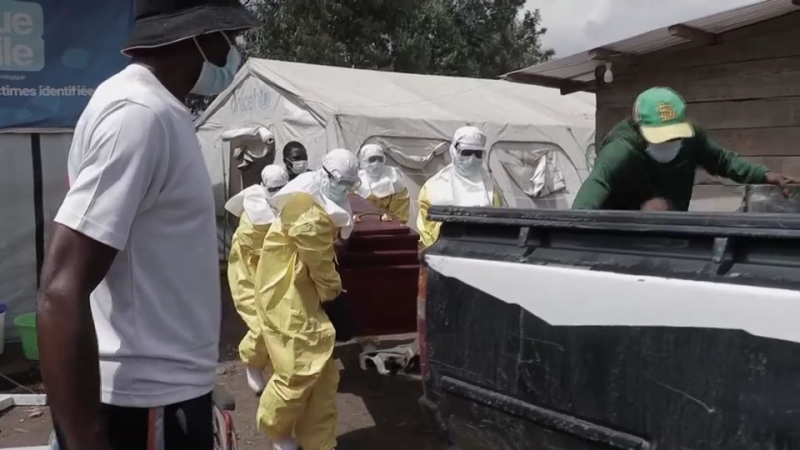
The bodies of people who died from Ebola are highly contagious, and as people prepare for burials or gather for funerals, it could lead to further spread of infection.
In the wake of the outbreak, Congolese authorities have mandated that the dangerous process of burying suspected victims should be supervised as much as possible, a move that could prompt protests from families and friends. On Friday, the government announced a ban on funeral wakes and gatherings of more than 50 people in northeastern Congo to curb the spread of the virus.
On Saturday, a group of residents of Mombwal, in Ituri province, attacked and set on fire a tent set up by the humanitarian organization Médecins Sans Frontières for infected and confirmed Ebola patients.
Rokdu previously said 18 people suspected of having Ebola left the facility during the attack and are now missing.
On Thursday, another treatment center in Rwanpara town was burnt down after the family was barred from collecting the body of a local man suspected of dying of Ebola.
The WHO said the outbreak posed a “very high” risk to Congo, moving it from its previous “high” classification, but said the risk of the disease spreading globally remained low.
Earlier on Sunday, the Congolese Ministry of Communications announced in X that there were 904 suspected cases of Ebola, most of them in northeastern Ituri province. This is a significant increase from the more than 700 suspected Ebola cases previously announced.
The ministry also announced that the total number of suspected Ebola-related deaths was 119, but the total number was 220 when the figures announced separately for each region were added up. Officials could not immediately be reached to explain the discrepancy.
There is no vaccine available for Bundibugyo virus, a rare type of Ebola. The virus spread undetected in Ituri for weeks after the first death was reported in the town of Bunia, the state capital, in late April, but authorities tested negative for another, more common Ebola virus.
The International Federation of Red Cross and Red Crescent Societies announced on Saturday that three of its volunteers had died in an outbreak in Mongbuwal. The agency said three medical workers were believed to have contracted the virus on March 27 while processing bodies as part of a humanitarian mission unrelated to Ebola.
If confirmed, it would significantly delay the spread of infection.
