

U.S. and Iranian officials have suggested they may be close to agreeing a framework to end the war after Qatari and Pakistani mediators met in Tehran.
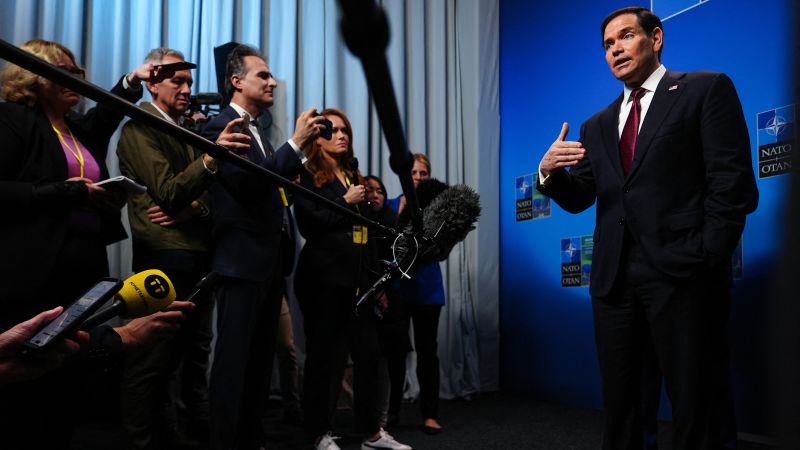
“There may be news later today. There is no news right now, but there may be news a little later today. Maybe not. I hope there is, but we don’t know yet,” Secretary of State Marco Rubio told reporters in New Delhi on Saturday.
The mediation effort comes after US President Donald Trump met with senior national security officials to discuss next steps in the war, including the possibility of restarting fighting.
Rubio said diplomatic efforts are still going on behind the scenes and the United States remains focused on preventing Iran from acquiring nuclear weapons and addressing its stockpile of enriched uranium.
“There is some work being done as I speak to you right now,” Rubio said. “There’s a chance you’ll have something to say later today, tomorrow, or a few days from now.”
Meanwhile, Iran’s Foreign Ministry said that the Iranian government is focused on finalizing the memorandum of understanding through Pakistan-mediated talks.
The memorandum focuses on ending the war, ending the U.S. naval blockade of Iran and releasing Iran’s blockaded overseas assets, but not its nuclear program, Foreign Ministry spokesman Esmail Baghaei said on Saturday.
“Sanctions are definitely part of the negotiation agenda, but at this stage we are not discussing the nuclear issue, so there will be no negotiations on the details of sanctions relief,” the semi-official FARS news agency quoted Bagai as saying.

Multiple regional sources told CNN there was cautious optimism about the negotiations.
One local official said, “The situation is moving in a good direction.”
“The impasse is over,” another source familiar with the talks said, but it was not immediately clear whether this referred to an impasse over key deadlock points or simply the wording of the memorandum.
Chief among the disagreements is what will happen to Iran’s highly enriched uranium stockpile, its domestic enrichment program, and navigation through the Strait of Hormuz, which Tehran has effectively blocked.
After holding talks in Tehran on Friday and Saturday, Pakistan’s military chief, Field Marshal Asim Munir, left for Islamabad in the late afternoon local time.
Baghaei said the text of the memorandum includes 30- and 60-day deadlines, but these have not yet been finalized.
“Over the past week, the perspective has gotten closer,” he said. “We’ll have to wait and see what happens over the next three or four days.”

Baghai said any mechanism regarding the Strait of Hormuz should be agreed between Iran, Oman and countries bordering the waterway, and that the United States has “nothing to do” with the Strait of Hormuz.
Iran’s chief negotiator, Mohammad Bagher Ghalibaf, took a defiant stance after meeting with Munir, warning that Iran “will never abandon the rights of our country and its nations, especially when dealing with a party that has never shown good faith and where there is no trust.”
“Our military has been rebuilding during the ceasefire, but if President Trump makes the mistake of restarting the war, there is no doubt that it will be even more tragic and bitter for the United States than the first day of the war,” Ghalibaf said, according to a report on Iranian state television.
“We feel like we are getting closer to a final agreement, but there are still challenges,” Fada Hussein Maleki, a member of Iran’s National Security and Foreign Policy Council, said in an interview with semi-official ISNA, adding that further talks would be held on Saturday.
