

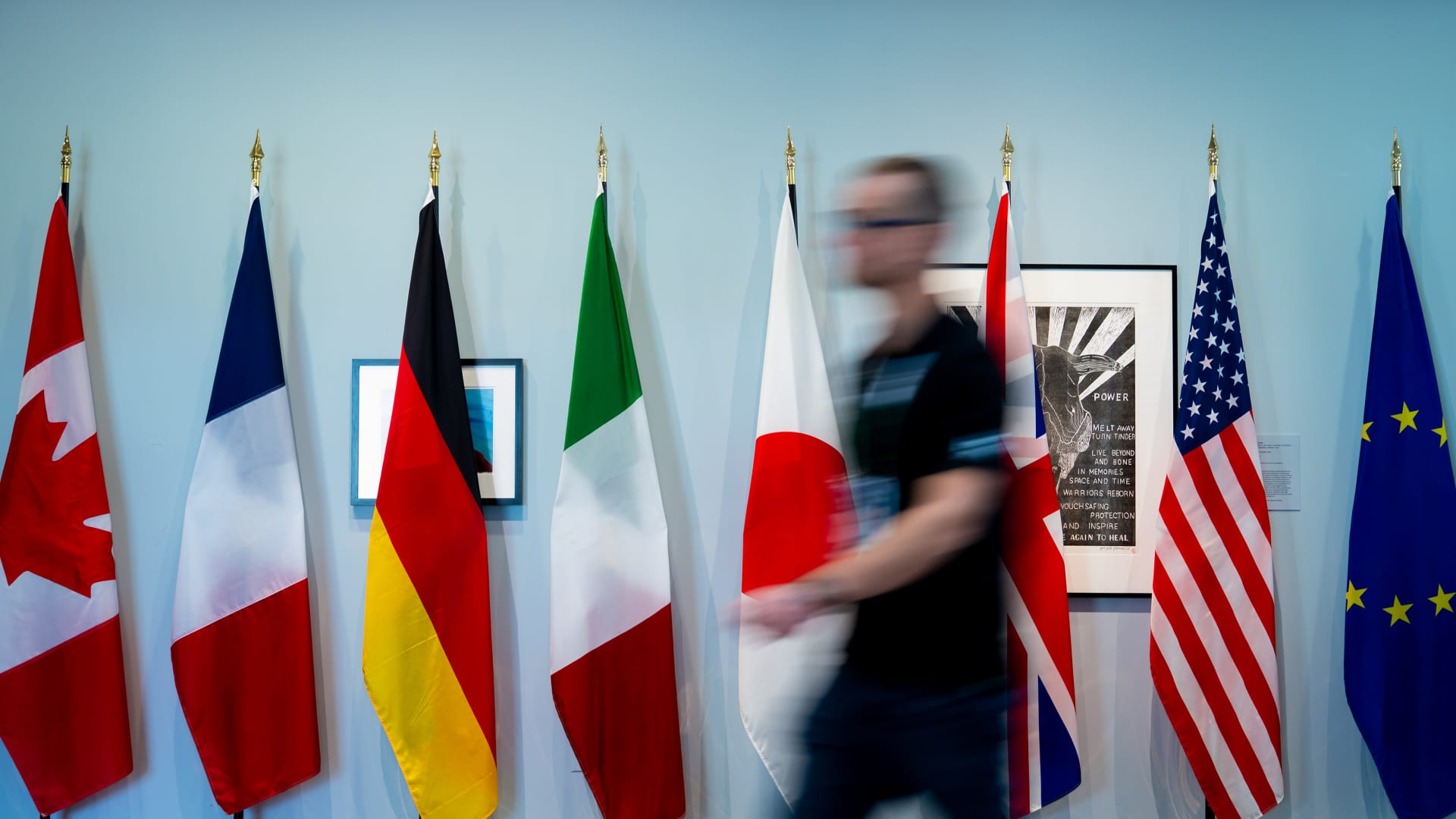
Flags of Canada, France, Germany, Italy, Japan, the United Kingdom, the United States, and the European Union fly in front of the Group of Seven (G7) summit on Saturday, June 14, 2025, in Banff, Alberta, Canada.
Bloomberg | Bloomberg | Getty Images
Hello, my name is Leonie Kidd and I’m from London. Welcome to today’s Daily Open Newsletter.
Bond market stress is intensifying and shows little sign of abating. For the G7 Finance Ministers and Central Bank Governors meeting in Paris, this means debt pressures will continue to rise as borrowing costs continue to rise.
The big question is: to what extent are we willing to acknowledge the risks of a recession?
What you need to know today
G7 finance ministers and central bank governors will meet in Paris later on Monday, with the economic shock triggered by the Iran war topping the agenda.
“Opening the Strait of Hormuz and bringing the conflict to a lasting end is paramount to reducing the economic impact,” Eurogroup President Kyriakos Pierakakis said in a statement.
Borrowing costs across the G7 countries have soared in recent weeks, raising long-term inflation concerns, while global oil inventories are falling at a record pace.
Another high-stakes meeting this week will do little to calm nerves.
Russian President Vladimir Putin will visit Beijing and meet with Chinese President Xi Jinping, days after US President Donald Trump’s visit.
The two leaders will “discuss current bilateral issues, ways to further strengthen the comprehensive partnership and strategic cooperation between the Russian Federation and the People’s Republic of China, and exchange views on important international and regional issues,” the Kremlin said.
Meanwhile, the White House is touting a series of agreements following the visit to China. China plans to purchase at least $17 billion of U.S. agricultural products annually through 2028. US officials also said China would address rare earth shortages, but this was not mentioned in a corresponding statement from the Chinese side.
The trading week in Asia-Pacific got off to a negative start, with stocks generally falling on geopolitical uncertainty.
In a post on Truth Social on Sunday, President Trump said “time is running out” for Iran, warning that “there will be nothing left” if action is not taken soon, adding: “Time is of the essence!”
However, the case of Kospi in South Korea is a different story. After a sharp decline last weekend, the index is back on the rise. Volatility rose to near-record levels after foreign investors sold $13 billion worth of domestic stocks last week.
Ryanair reported in its earnings news that the group’s profit after tax for the 2026 financial year increased by 40%, and chief financial officer Neil Sorahan told CNBC’s “Squawk Box Europe” that the airline plans to fly a full schedule this summer as fuel supply issues ease.
— Leonie Kidd
