

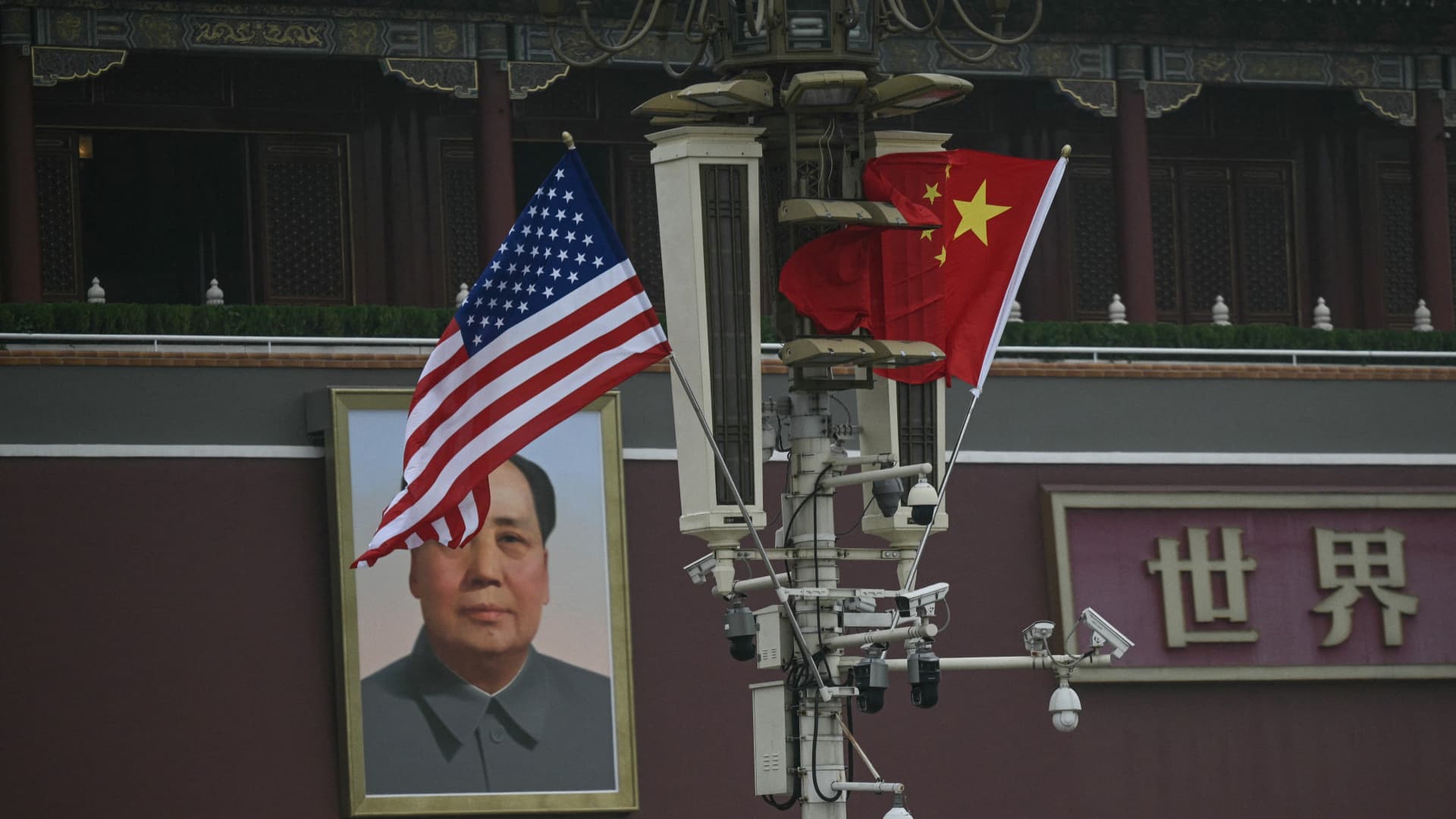
Flags of the United States and China are raised in front of a portrait of late communist leader Mao Zedong on Tiananmen Square in Beijing, May 15, 2026.
Brendan Smialowski AFP | Getty Images
BEIJING — U.S. President Donald Trump’s visit to China this week made a major contribution to strengthening the fragile trade ceasefire with China and stabilizing bilateral relations.
The visit was delayed by more than a month because of the Iran war, but President Trump and Chinese President Xi Jinping concluded their two-day summit on Friday and announced plans to meet again this fall.
Changes since the summit include:
Geopolitical cooperation between the US and China
Xi’s warning to Trump that mishandling Taiwan would plunge U.S.-China relations into a “major crisis” dominated headlines at the start of the talks, according to English-language state media.
Oil prices also rose after President Trump told Fox News in a pre-recorded interview that China would agree to buy U.S. oil and support negotiations with Iran. He did not say when the purchases would begin or in what quantities.
China has not yet confirmed plans to purchase U.S. oil, and the U.S. government has not yet said anything about Taiwan.
“I think there was a consensus on both sides, but there was no substantive discussion on Taiwan, which is not surprising,” said Yue Hsu, chief China economist at the Economist Intelligence Unit. “Further discussion about Iran has highlighted that the two countries do indeed have things in common. The fact that both sides want to call the talks a victory at least points to friendly relations.”
“There are limits to what China can realistically do because the Iranian regime operates in survival mode and puts its own interests and agenda above all else,” she said.
Trade ceasefire established
Both the US and China have not yet announced specific details of the agreement. However, President Trump’s invitation to Xi to visit the United States on September 24 means the two leaders can meet face-to-face again before the one-year trade truce expires in October 2025.
The deal lowered tariffs and lifted rare earth regulations after tensions between the two countries escalated in early 2025.
According to state media, Xi said the United States and China had agreed to a constructive “strategic stability” framework for the next three years.
“Strategically, China appears to be trying to turn President Trump’s willingness to make deals to stabilize the relationship into a long-term operational framework for U.S.-China relations,” said Jack Li, an analyst at China Macro Group.
business win
President Trump told Fox News that China will order 200 Boeing jets, up from the 150 the company had expected. However, this was less than half of the 500 aircraft that many had originally expected.
Nvidia The company also reportedly received the green light from the US to sell its H200 chip to a major Chinese company, sending tech stocks higher.
Boeing CEO Kelly Ortberg and Nvidia CEO Jensen Huang both accompanied President Trump to Beijing. Executives including Apple CEO Tim Cook and Tesla Inc.’s Elon Musk and more than a dozen U.S. business leaders participated in talks with Chinese Premier Li Qiang on Thursday.
The opening remarks and readings offered no details beyond China’s pledge to further open its markets to foreign business, something that has been gradually realized over the past few decades.
The U.S. economic delegation was much smaller than the more than 30 leaders who accompanied President Trump on his trip to Saudi Arabia last year.
“I don’t think the goal was to get every CEO to sign a contract,” said Gary Dvorchak, managing director of Blueshirt Group. “I think the purpose of that was to kind of flex American power and show what a great power America is from an economic standpoint.”
“This also demonstrates the high level of cohesion between the U.S. government and the private sector,” he said.
