

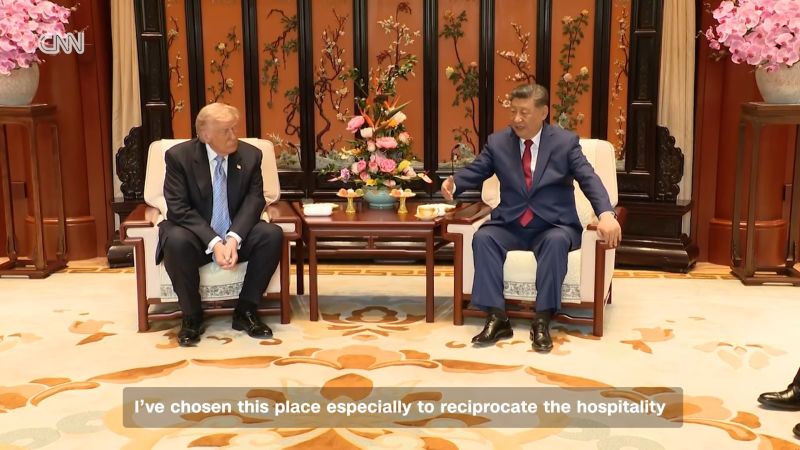
US President Donald Trump spent his last morning in Beijing at Zhongnanhai. Zhongnanhai is a secret and heavily guarded leadership stronghold of China’s ruling Communist Party.
President Trump and Chinese President Xi Jinping strolled through the pristine garden, with Trump admiring roses and President Xi Jinping offering to send seeds, before meeting over tea and lunch.
The center of power in China, the venue is sometimes compared to the White House and the Kremlin. Only a handful of American leaders have ever crossed the centuries-old red ocher wall that separates this compound from the rest of the capital.
Security is extremely tight, with access to the premises supervised by an elite unit responsible for the safety of party leaders. Images of the enclosure are heavily censored and hidden on digital mapping platforms.

President Xi says he chose the Zhongnanhai venue as a mutual benefit for President Trump to invite him to Mar-a-Lago.

Mr. Xi himself called for caution on Friday, saying he had chosen the site as a thank you for Mr. Trump hosting him at his Mar-a-Lago resort in Florida in 2017. The meeting marked the first meeting between the two men, just months after President Trump took office for his first term.
Zhongnanhai (named for the two large lakes on the property) “is where the leaders of the (Communist) party and China’s central government, including me, work and live,” Xi told Trump on Friday.
“Since the establishment of the People’s Republic of China in 1949, we (the Communist Party) have come here, including Chinese leaders such as Mao Zedong, Zhou Enlai, Deng Xiaoping, Jiang Zemin and Hu Jintao,” Xi said.

See in photos: President Trump visits China
Zhongnanhai was once a court garden used by emperors to relax and enjoy their leisure time when they were not living and working in Beijing’s Forbidden City.
On Friday, President Xi boasted of the garden’s centuries-old history and pointed out the age of various trees on the grounds, including a large tree that he said is about 490 years old. “There are trees elsewhere on this property that are more than 1,000 years old,” Xi told Trump.
At one point, Mr. Xi invited Mr. Trump to touch the trees, expressing his gratitude for the life and history of the garden.
Later, during a walk, Trump told Xi: “It’s a nice place. I like it. You’ll get used to it.”

After China’s imperial era ended in 1912, Zhongnanhai was repurposed as the presidential palace. Decades later, after Communist victory in the civil war, Chairman Mao Zedong established it as a center of political power.
At the time, Mao Zedong deliberately did not choose the Forbidden City as his office because he wanted to distance the new China from the failed imperialism of the past. And working and living in the former emperor’s palace would have contradicted the Communist Party’s ideology of “serving the people.”
Since then, Zhongnanhai has undergone large-scale demolition and renovations, including adding office buildings and swimming pools. Today, this 1,500-acre site is home to repurposed pavilions and temples that are synonymous with the party’s elite.
During Xi and Trump’s walk, the pair posed for photos in front of a room that was once used for ballroom dancing and showing foreign and Chinese films when the party leadership first moved to the compound, according to a video released by Chinese state media.

Former US President Richard Nixon met with Mao Zedong in Zhongnanhai during his landmark visit in 1972. It was the first visit to China by a US president.
Thirty years later, President George W. Bush also entered Zhongnanhai with then Chinese President Jiang Zemin. The last US president to visit Zhongnanhai was Barack Obama, who met with Xi there in 2014, during which the two discussed modern Chinese history, state media reported.
At the time, President Obama was invited to tour the rarely seen Yingtai artificial island, which stands isolated in the middle of a lake in the Zhongnan Sea. This hidden island has special historical significance and was once the place where emperors were imprisoned after being stripped of power in a failed coup d’état at the end of the Qing Dynasty.
