

Panipat, India —
In a dusty, dark cotton recycling unit, Rajesh stands next to a shredding machine, feeding white fabric into its sharp blades.
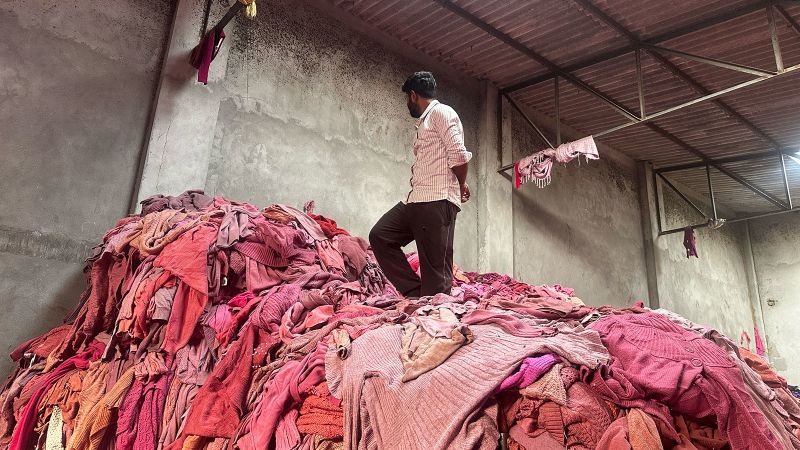
These are the remains of discarded clothing from countries such as the United States, Britain, and Japan, which arrive on trucks in Panipat, a city in northern India, and are overflowing in piles of discarded clothing.
Inside the warehouse, clothes are stacked to the ceiling. One unit removes zippers and buttons from discarded clothing. Elsewhere, the fibers are spun into yarn, dyed, bleached, and rewoven into rugs, carpets, and blankets.

Workers move quickly through the unit, sorting scrap by color and fabric and feeding it into a system designed to keep up with the pace of global consumption. Some clothing still has charity shop price tags on them. Others appear to have been lightly worn.
Panipat is the end point of fast fashion. Fast fashion is a modern trend in which people buy more clothes but wear them for less time. Clothing is typically not designed to last, and more than 1 million tons of clothing are brought here each year to be reused.
In theory, this looks like a circular solution to fast fashion’s waste problem. But in reality, each step has devastating costs for the city’s people and its environment.
A fine layer of cotton clings to the stubble on the veteran textile worker’s jaw and settles in the wrinkles of his face. Even more dangerous is the small fiber particles that can get into your throat and lungs. “I’ve been coughing all day and I’m short of breath,” says the worker, who CNN called Rajesh to try to protect his job.
Rajesh has been breathing this air for decades and has a dry cough. Still, he has no choice but to continue. The industry supports hundreds of thousands of jobs in and around Panipat and attracts immigrants like him from impoverished areas who rely on modest but steady incomes.
The chemicals used in textile manufacturing pose health risks to workers who inhale the textiles. When CNN visited three clothing recycling facilities in early February, no workers were wearing masks or other protective gear.


But the risks for Panipat’s textile industry do not end there.
Reeta Devi works in the clothing recycling sector to support her husband, who has been unable to work since his foot was injured by a machine in the same industry in August last year. “I have to work,” she says. “I have three children.”
Known as India’s ‘textile city’, Panipat is located just north of Delhi and its industry relies primarily on informal labor. Most workers here have no health insurance or formal benefits. If you become ill or injured, you may lose your income and receive little or no support from your employer.
Now streaming: How fashion recycling is polluting this Indian city. Upgrade to see the full report.
Rita’s work comes with its own burdens. “When there’s a lot of dust, it’s difficult to breathe,” she says. Some workers like Rita accept the risks of the job because there are few other job options in the city. “This kind of work is fraught with problems,” she says.
A few kilometers away, another former textile worker, Sanagar Alam, echoes similar sentiments. He used to work in a dye factory and points out a boil on his neck, which he says was caused by chemicals dripping onto his skin. “When you work with chemicals, vapors come out,” he told CNN. Workers are paying their own medical costs, he said. “The company won’t pay for it.”
At one dye factory visited by CNN, workers handled hot, heavy chemicals with their bare hands. Steam rose from machines in the cramped space, a sharp chemical smell hung in the air, and dyed wastewater flowed into exposed drains, leaving floors slippery and dirty.
There were no gloves or masks in sight, nothing to separate the workers’ skin from the corrosive material or their lungs from the smoke.
When asked about the situation inside these dyeing factories, Nitin Arora, president of Panipat Dyeing Association, said it was the responsibility of the workers to use the safety equipment provided by the factories.
“The workers are not educated. That’s why they don’t wear masks,” he told CNN. “The owner provides everything…but they take off their masks and keep them aside. What can the owner do?”
CNN reached out to several government agencies, including the Haryana labor ministry, the Pollution Control Board and the National Green Tribunal, for comment on the reported water pollution and health concerns, but did not receive any response.
Most of the textile workers treated by pulmonologist Dr. Bhawani Shankar have strikingly similar symptoms, all related to exposure to garment factory dust.
They arrive with difficulty breathing, which worsens over time. “As the disease progresses, it can lead to fibrosis,” the pulmonologist says, noting that at that point the damage is almost irreversible.
Northern India already has some of the world’s most polluted air, a toxic mix of vehicle and industrial exhaust, burning crop residue and construction dust.
Shankar says the working conditions in Panipat’s recycling department are contributing to poor health. “Continuing to breathe the same air every day will definitely shorten your lifespan.”

However, the damage is not limited to that. Waste from the textile dyeing and bleaching process is often discharged into open drains, and its effects reach far beyond the factory walls to the water systems on which millions of people in and around Panipat depend.
Water in these regions is transitioning from a resource to a risk. It is still used for washing, irrigation and farming in many nearby villages.
The 2022 Household Survey found that nearly 93% of families reported a serious health problem over a five-year period, with work-related illnesses becoming more prevalent and long-term conditions on the rise.
“There is no one here who is not affected,” said Dr Vikas Sharma, a resident of Shimla Gujran village in Panipat district. “Everyone is suffering from this water. Fifteen years ago, we didn’t see diseases like this.” Sharma’s community has seen a significant increase in cases of skin diseases, allergies and cancer. He himself suffers from asthma.
The government has reportedly issued notices to shut down illegal bleaching facilities allegedly linked to industrial pollution in Panipat and sealed some facilities and wells. But Dr Shiv Singh Rawat, a former irrigation department official, says not enough is being done. “There is a lack of accountability from all sides,” he told CNN. “From the government, from industry, and from the public.”
In areas around the city’s textile clusters, wastewater from dye factories flows through open drains that cut through farmland and residential areas. In some areas, water is contaminated with chemical residues.


Rawat said the wastewater treatment system was not used consistently. “Some forces claim to have them, but everyone gets away with it,” he says.
Rawat said the toxic acidic wastewater ends up in the Yamuna River, a critical water source for millions of people in northern India, including Delhi.
India’s environmental tribunal, the National Green Tribunal, had previously pointed to regulatory gaps in the textile sector, saying some companies continue to discharge untreated wastewater despite existing rules.
The court is currently hearing a petition alleging that Panipat’s textile recycling industry is illegally discharging industrial waste and emissions.
CNN has contacted multiple government agencies about the illegal bleaching equipment, but has not received a response.
The aftermath of fast fashion is hard to ignore in Panipat. It lingers in the air and flows down open drains, posing a daily hazard to workers and nearby communities.
Discarded clothing continues to arrive in the city, where it is sorted, shredded and woven again before being put back into the global supply chain.
These clothes may have a new life, but the people here will pay the price.
