

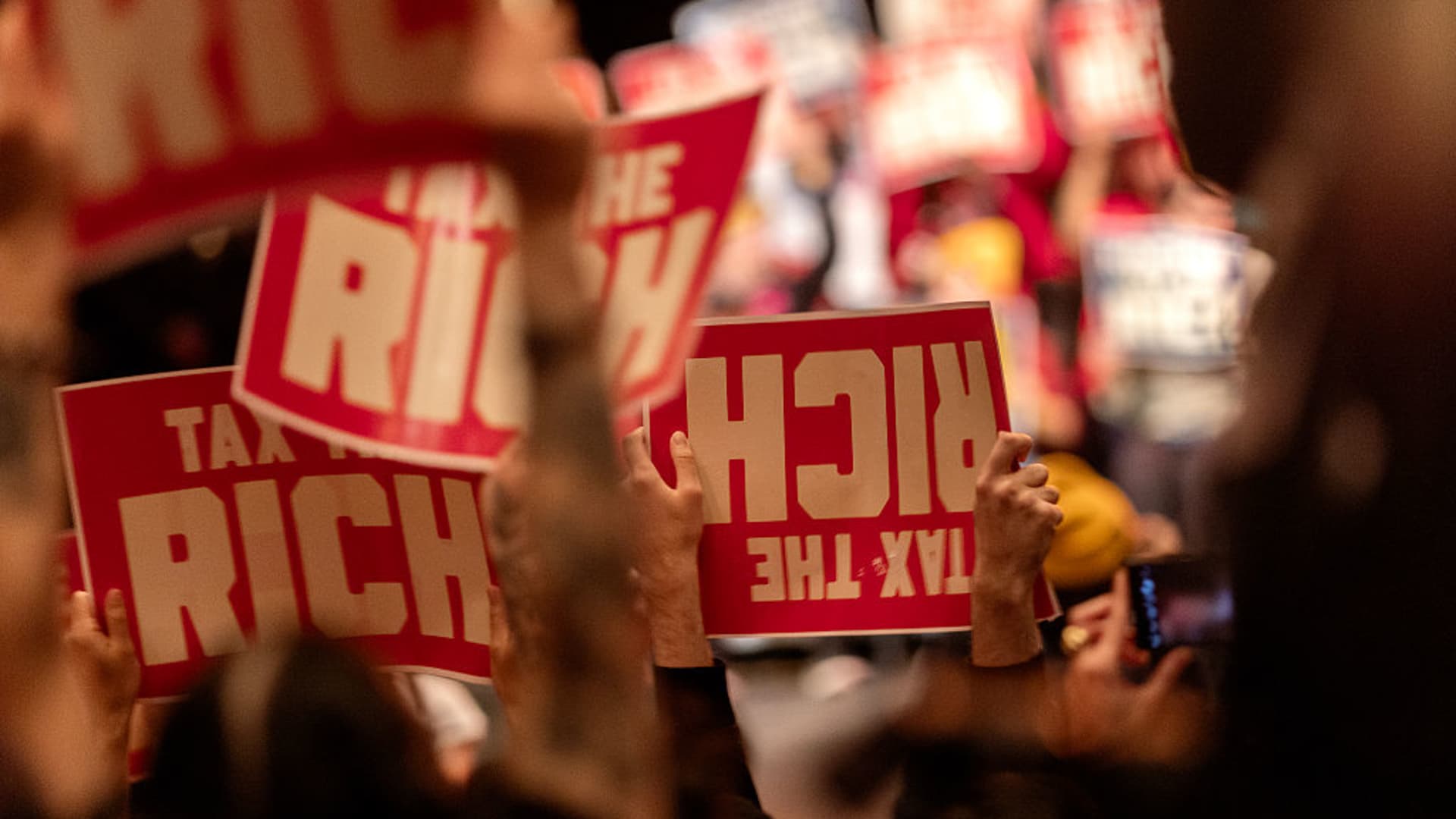
Tax the Rich political rally sponsored by Democratic Socialists of America and featuring Sen. Bernie Sanders, March 29, 2026, at Lehman College in New York City.
Andrew Lichtenstein Corbis News | Getty Images
As fiscal pressures mount, more Democratic states are embracing tax hikes on the wealthy. But experts say these policies could cause future revenue problems.
Jared Walczak, a senior fellow at the Tax Foundation, a nonprofit think tank, said “progressive taxation,” or paying higher tax rates as your income increases, is neither new nor surprising.
The average income tax rate in 2023 was 14.1%, with the top 1% of taxpayers paying an average of 26.3%, according to the Tax Foundation, which analyzed the latest IRS data.
But with an increasing focus on generating more revenue from high earners and the wealthy, “there are fundamental challenges to this,” Walczak said.
In 2022, voters in Massachusetts approved a 4% tax on residents making more than $1 million a year, and in late March, Washington enacted a millionaire tax that would impose a 9.9% tax on residents making more than $1 million a year. In April, the state of Maine added a 2% surcharge on incomes over $1 million a year.
According to a tracking study released in February by the Center on Budget and Policy Priorities, states such as the District of Columbia, Maryland and New York have also increased income taxes on high-income earners in recent years.
States like California, Rhode Island, and Virginia are also raising state taxes on the wealthy.
Last week, New York City Mayor Zoran Mamdani and New York Governor Kathy Hochul proposed a “pied-à-terre tax” that would impose an annual surcharge on vacant second homes in New York City worth $5 million or more.
Lucy Dadayan, a senior researcher at the Urban-Brookings Tax Policy Center, said that while some states are increasingly raising taxes on high earners, other states are aggressively cutting income taxes.
“We’re seeing disparities in state tax policies,” she said.
Starting in 2021, more than 20 states, the majority of states that levy personal income taxes, have lowered their top marginal tax rates, while a small number of states and the District of Columbia have raised their top marginal tax rates, according to a February report from the Tax Foundation.
This shows “different fiscal priorities and different approaches to economic growth,” Dadayan said.
Supports tax increases on the wealthy
Recent data suggests that some Americans support raising taxes on the wealthy.
“We’re in a much more populist political environment right now, on both the left and the right, but this rhetoric works,” Walczak said.
A Pew Research Center survey of about 8,500 people conducted in late January found that about 60% of U.S. adults said they felt wealthy people “don’t pay their fair share” in federal income taxes.
Another poll conducted by Fox News found that the top concern about federal income taxes was that “wealthy people aren’t paying enough taxes.” The company conducted a survey of 1,000 registered voters in late March.
The Fox News poll found that the issue ranks highest among Democrats and independent voters, while Republicans are more concerned about government spending.
Meanwhile, a separate Bipartisan Policy Center survey found that a minority of taxpayers in both parties said they were willing to raise taxes on the wealthy to address the federal deficit. The nonprofit think tank conducted a survey of 1,200 taxpayers in late March.

The problem of taxing the wealthy
Many Americans support raising taxes on the super wealthy, but the federal government’s proposals have failed to gain support.
Policy experts say that with Republicans in control of Congress and the White House, tax increases on the wealthy are unlikely. However, several Democratic politicians have proposed new tax increases ahead of the midterm elections.
Some policy analysts have criticized the idea, saying these changes may not provide stable revenue sources for states that raise taxes.
Walchuk said that because the highest earners have business and capital gains relative to their wages, “we’re talking about a small number of individuals whose incomes are very unstable.”
“We’ve made incredible gains in the market over the last few years,” he said. “But that’s not always the case.”
Adam Michel, director of tax research at the Cato Institute, a libertarian think tank, also said the wealth tax would raise less revenue than expected.
“Investors have strong incentives to move their portfolios toward assets that are harder to value, easier to protect, and more easily moved across borders, rather than their most productive uses,” he said in a January Substack post. “This is not a real economic activity, but an encouragement to tax avoidance.”
