

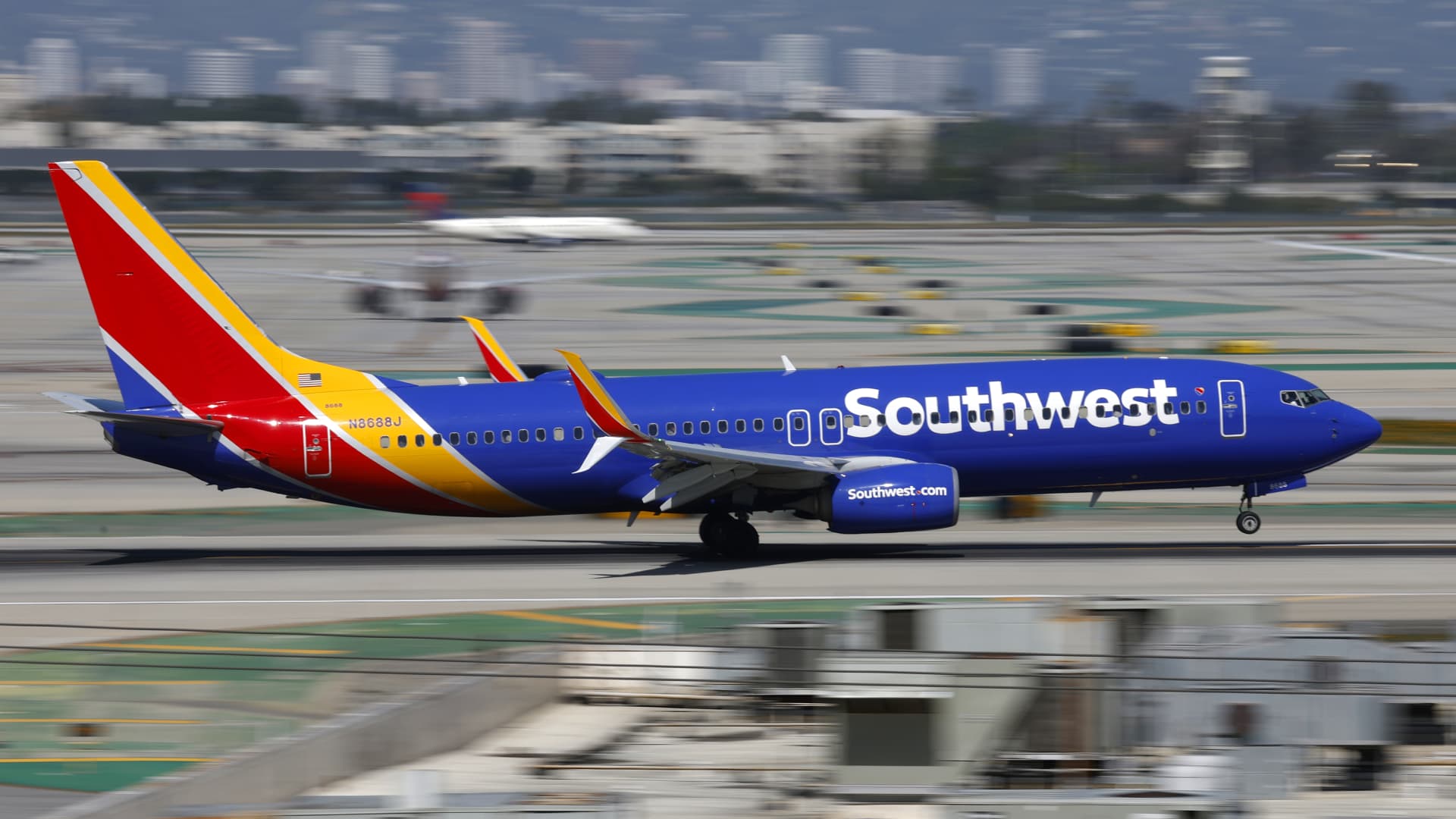
A Southwest Airlines Boeing 737 arrives from Chicago and lands at Los Angeles International Airport on March 7, 2026.
Kevin Carter | Getty Images
southwest airlines Due to soaring fuel prices, second-quarter profits are expected to be lower than analysts’ expectations, and the company has decided not to update its full-year forecast for 2026.
Southwest expects earnings per share of 35 cents to 65 cents for the quarter, compared with the 55 cents expected by analysts surveyed by LSEG.
The company said in January that it expected its new initiatives to pay off, forecasting earnings of $4 per share this year. Southwest Airlines has been aiming to increase revenue through checked baggage fees and seat reservation fees.
“Achieving this outcome will require lower fuel prices and/or improved earnings performance to offset higher fuel costs. We will update this guidance as appropriate,” Southwest said in Wednesday’s earnings call.
Airlines have lowered their full-year forecasts or withheld further guidance, citing fluctuations in the price of jet fuel, which is typically their biggest expense after payroll. It is also scrapping capacity expansion plans to cut costs, so airfares could rise if fewer seats are sold.
Southwest said it expects production capacity to be flat in the second quarter, up just 1%, and unit revenue to increase by as much as 18.5%, up from 16.5% a year ago.
Chief Executive Officer Bob Jordan told reporters Wednesday after the earnings call that customers were willing to continue booking despite higher fares.
“Demand is really strong… across all sectors,” he said.

According to LSEG consensus estimates, here’s what the company reported in the first quarter compared to Wall Street expectations:
Earnings per share: 45 cents vs. expected 47 cents Earnings: $7.25 billion vs. $7.27 billion expected
Southwest earned $227 million, or 45 cents a share, in the first quarter, compared with a loss of $149 million, or 26 cents a share, a year earlier.
Revenues increased nearly 13% to $7.25 billion from $6.43 billion in the year-ago period.
