

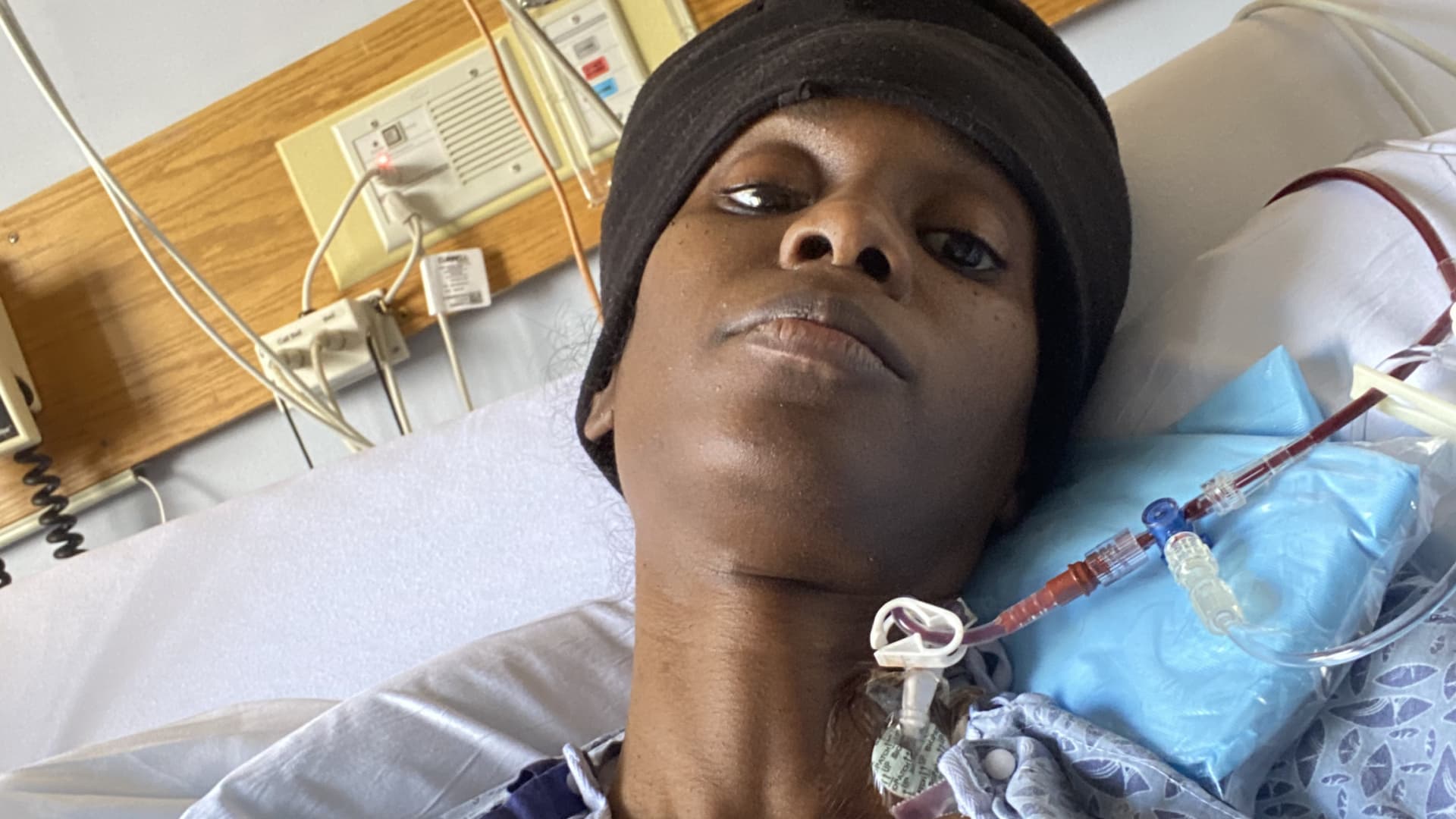

In 2020, Marion Jones was living in Boston and working for a green energy company when she decided it was time to see a doctor. For about a year, she had persistent health problems.
“In my case, I started getting a burning sensation in different parts of my body. It probably lasted about 10 seconds and then moved to other parts of my body,” she said.
She made an appointment when she started experiencing excruciating back pain.
The first doctor he saw couldn’t explain his symptoms, but the second suspected multiple sclerosis, or MS. An MRI quickly ruled out MS, and Jones returned to her normal life.
But after months of persistent headaches, a friend convinced her to visit the emergency room. Doctors prescribed muscle relaxants and released her, but just 72 hours later, Jones found herself back in the hospital. This time I had difficulty moving the right side of my body.
It was at Beth Israel Lahey that Jones received the news that would change her life forever. She was diagnosed with neuromyelitis optica (NMO). This is a rare autoimmune disease that primarily affects the optic nerve and spinal cord.
Also known as “MS’s cousin,” NMO usually causes severe, rapid, and devastating attacks on the optic nerves and spinal cord, which can cause permanent vision loss or paralysis.
Things quickly deteriorated for Jones. The flare-up left her partially paralyzed, and doctors admitted her to the hospital’s intensive care unit.
Jones was admitted to the ICU after being temporarily paralyzed as a result of her rare disease diagnosis.
Marion Jones
However, Jones needed more specialized care due to his limited ability to walk and care for himself, and was eventually admitted to Encompass Rehabilitation Hospital in New England, which specializes in inpatient rehabilitation.
It was a particularly devastating blow to Jones, who had been an avid runner before her diagnosis.
“In 2019, I ran 35 5kms in 35 weeks…I couldn’t walk or go to the bathroom, which was something I never thought would happen to me,” Jones said.
Jones, who had no family in Boston, said the doctors and therapists at Encompass put her on the road to recovery from day one.
“They really became family to me while my family was gone. They were very patient with me,” Jones said.
Dr. Daniel Lyons, medical director of Encompass Rehabilitation Hospital of New England, was a member of that team.
“Marion had a situation where her autoimmune disease contributed to her cervical spinal cord injury. In short…she had a spinal cord injury. She had lost strength in her arms and legs, she had lost sensation. She also had a lot of pain and muscle tension from the spinal cord injury,” Lyons said.
Jones was diagnosed with NMO, lost the ability to walk, and was forced to use a wheelchair.
Marion Jones
Jones’ rehabilitation schedule was grueling, requiring three hours of intensive treatment each day. But Lyons said the effort paid off. “She has made incredible progress since she was admitted to the rehabilitation hospital and was using a wheelchair rather than a walker. In a relatively short period of time, she progressed from walking on parallel bars to using a walker, and by the time she was discharged from the inpatient rehabilitation hospital, she was able to walk short distances with the walker.”
Jones’ outpatient treatments continued, and during one of them, her therapist challenged her to run on a treadmill. It was difficult for Jones, who could only run for about 30 seconds, but he said it rekindled his desire to run again.
“After the session, I went home and went out on the bike path and said, ‘Let’s see if I can do a little ride,'” Jones said. “As the weeks went on, a minute turned into a half mile, and that half mile turned into a mile. And that’s when I started and really started to feel like running again.”
Eventually, she returned to her original form. Jones says she had no intention of running a marathon, but that’s where her path led her. Since her diagnosis, Jones has run six marathons.
A rare disease has left Marion Jones unable to walk. Through grueling therapy sessions, she learned to run again and is now competing in marathon races.
Marion Jones
On Monday, she will run the Boston Marathon. When she crosses the finish line, she will be awarded the Abbott World Marathon Majors Six Star Finisher Medal, which is only awarded to runners who complete all six of the world’s most prestigious races.
In the run-up to the race, Jones is raising money for Beth Israel Lahey Hospital, where NMO was diagnosed and treated. Jones calls moving back to Boston a “full circle moment” for her.
“Doctors didn’t know if I would ever walk again,” she said. “To be able to run in Boston knowing what my body has endured and overcome, it’s a victory lap…a victory lap of celebration. And I’m not just running for myself, I’m running for the rare disease community.”
For more stories like this that impact the rare disease community, click here to sign up for the CNBC Cures newsletter.
