

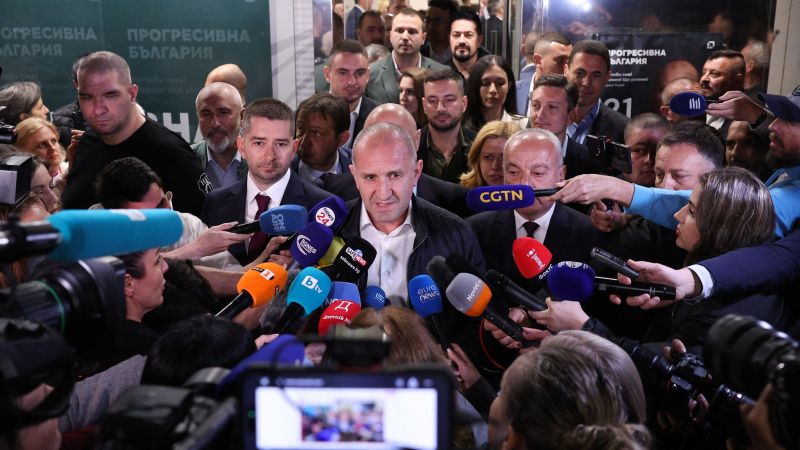
Sofia, BulgariaReuters —
Pro-Russian former president Rumen Radev won a landslide victory in Bulgaria’s parliamentary elections, with official results revealed on Monday. This could shatter long-dominant political forces and bring EU and NATO members closer to Moscow.
The performance, which beat poll predictions, is one of the strongest results for a single party in a generation and may signal a temporary end to the chronic instability that has led to eight elections in five years.
Radev’s Bulgarian Progressive Party won 44.7% of the vote after 97.52% of votes were counted, suggesting the possibility of sole rule, but Radev has not ruled out forming a coalition with pro-European groups or smaller parties.
Progressive Bulgaria’s tally is significantly higher than the pro-European We Continue the Change-Democratic DB (PP-DB) coalition’s 12.8% and the 13.4% of former Prime Minister Boyko Borisov’s long-dominant party GERB.
Radev, a Eurosceptic and former fighter pilot who opposed military support for Ukraine’s war against Moscow, resigned from the largely ceremonial Bulgarian presidency in January to run in parliamentary elections after mass protests ousted the previous government in December.
He rode a wave of discontent over political instability in the Balkan nation of 6.5 million people. The country’s voters are tired of the corruption and veteran political parties that have dominated politics for decades.
“We now have a chance to see what people have been expecting to see change,” Evelina Koleva, a manager at a digital marketing company in the capital Sofia, told Reuters.
The European Union and Russia welcomed Radev’s victory. In a post on X, Antonio Costa, president of the EU’s European Council, wrote: “Congratulations to Rumen Radev on his complete victory… We look forward to working with you at #EUCO towards our common agenda for a prosperous, autonomous and secure Europe.”
The Kremlin said it was encouraged by Radev’s desire to resolve the issue with Russia through realistic talks.
Mr Radev’s campaign has drawn comparisons with Hungary’s pro-Kremlin former Prime Minister Viktor Orbán, who has spoken of improving relations with Russia and restoring the free flow of Russian oil and gas to Europe.
Radev also criticized the European Union for being overly reliant on renewable energy.
But Radev has been vague about policy, and it is not yet clear how much he will change the foreign policy of Bulgaria, a Black Sea nation on the southeastern side of the EU that joined the eurozone in January, a move that Radev has criticized.
Analysts do not expect him to try to block Bulgaria from adopting the euro or block broader EU aid for Ukraine.
On Sunday Radev said he was ready to work with the PP-DB on judicial reform and that Bulgaria would “strive to continue on the European path.”
Ahead of Sunday’s vote, Emil Dechev, Bulgaria’s caretaker interior minister, said authorities had made progress in tackling election fraud, with more than 400 people detained on suspicion of vote-buying and other fraud, more than the 72 people arrested for similar crimes in the last election in 2024.
Bulgaria has developed rapidly since the fall of communism in 1989 and joined the European Union in 2007. Life expectancy has risen sharply, unemployment is the lowest in the EU, and the economy has had stronger safeguards in place since the introduction of the euro.
However, it lags behind EU countries on other indicators. The cost of living has become a particular issue since Bulgaria joined the euro. The previous government collapsed amid protests over a new budget that proposed higher taxes and social security contributions.
“The country’s main challenges are the economic and demographic crisis,” said Tihomir Bezrov, a senior researcher at the Center for Democracy Studies in Sofia.
“The winning camp doesn’t seem to have many ideas on either issue.”
