

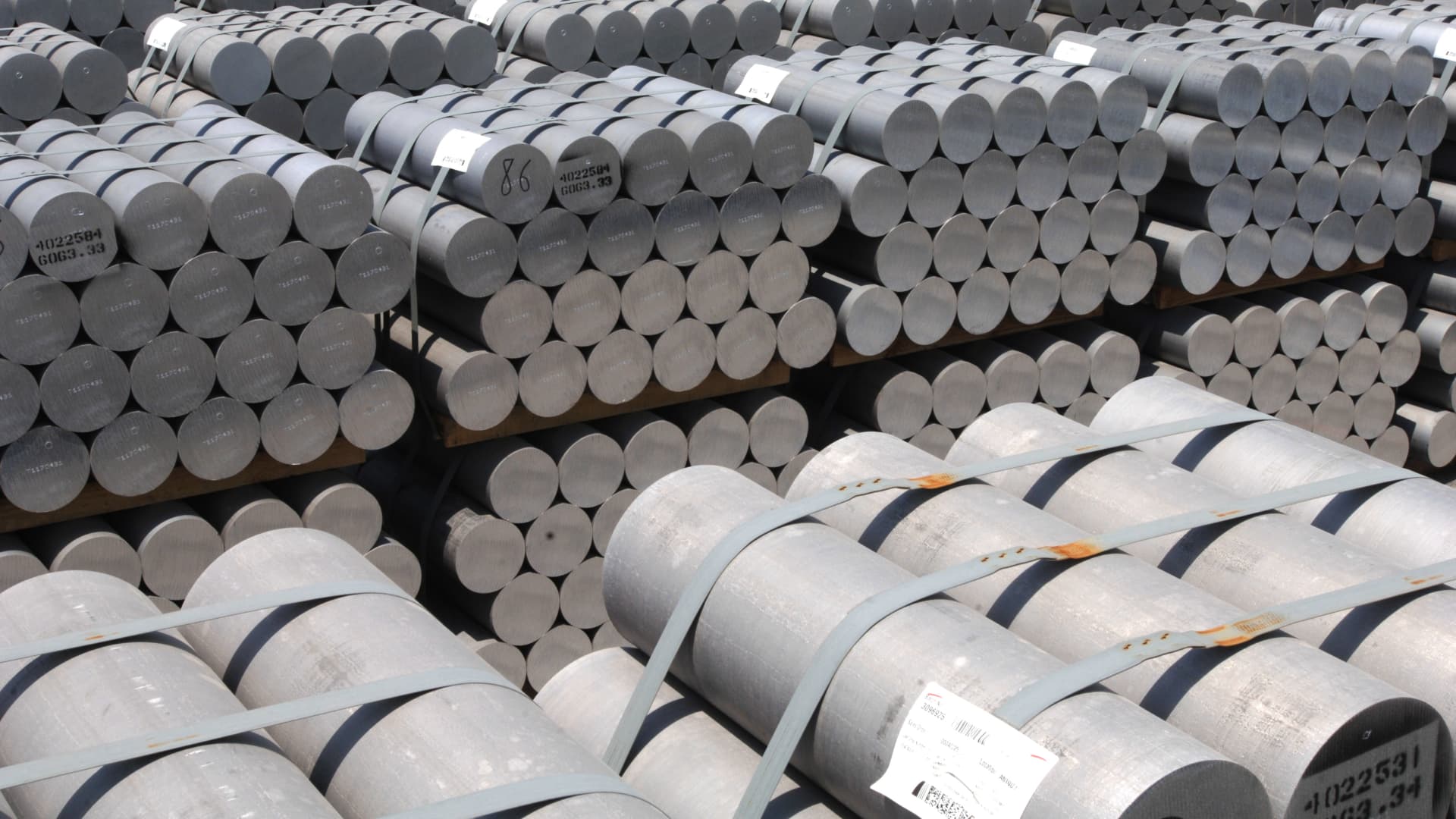
BAHRAIN – APRIL 17: Aluminum ingots seen at Aluminum Bahrain BSC factory in Bahrain on Tuesday, April 18, 2006 (Photo by Phil Weymouth/Bloomberg via Getty Images)
Bloomberg | Bloomberg | Getty Images
Aluminum Bahrain, which is based in the world’s largest metal smelter, said on Sunday that its facilities had come under attack by Iran, as the US-Israel-led war extended into a second month.
The company, known as Alba, said in a statement that the attack occurred on Saturday.
“Alba is assessing the extent of the damage to our facilities and remains focused on maintaining operational resiliency and the safety of our employees,” Alba said.
The company announced on March 15 that it had reduced capacity by 19% of its annual production of 1.6 million tonnes “as an operational measure to maintain business continuity amid the continuing supply and transportation disruptions affecting the Strait of Hormuz.”
Production cuts have raised concerns about a global metal shortage. Aluminum prices rose to a four-year high earlier this month, but have since pared some of their gains. It remains 4.3% above the February 27th level.
Aluminum may be the most abundant metal on Earth, but it is critical to the functioning of the global economy. It is an essential material in electronics, transportation and construction, as well as other industries such as solar panels and packaging.

LME aluminum
Iran has responded to the U.S. and Israeli attacks that began on February 28 by launching missiles and drones at its regional neighbors.
The United Arab Emirates announced on Sunday that its air defenses were dealing with a recent salvo of incoming missiles.
Houthis join the fight
On Saturday, Iran-backed Houthi fighters announced they had launched missile attacks against Israel, the group’s first time participating in a war.
Analysts told CNBC that the Houthis could seek to cut off maritime traffic through the Bab el-Mandeb Strait, which separates the Arabian Peninsula from the Horn of Africa, through which ships must pass to reach the Red Sea and the Suez Canal, further increasing pressure on global trade.
On Saturday, Danish shipping giant Maersk, widely regarded as a barometer of global trade, responded to reports of drone activity and explosions in Oman’s Salalah port.
The Bab el-Mandeb Strait is estimated to account for 12% of maritime oil trade and 8% of liquefied natural gas trade in the first half of 2023.
Iranian forces have already effectively closed off the Strait of Hormuz between Iran and the Arabian Peninsula, through which about 20% of the world’s oil supplies passed before the war.
Oil prices closed at their highest in more than three years on Friday, as President Donald Trump’s pivot to negotiations with Iran failed to ease market concerns about major supply disruptions in the Middle East.
US crude oil prices rose 5.46% to close at $99.64 per barrel. Brent crude oil prices, the international benchmark, rose 4.22% to settle at $112.57.
President Trump’s move to give Iran a 10-day extension to open the strategic strait did not alleviate supply concerns. The president said in a social media post Thursday that negotiations with Iran are “progressing very well” despite “false statements to the contrary by fake news media and others.” Iran says it has not engaged in any negotiations.
As part of the announcement, the US president said he would suspend attacks on Iranian energy infrastructure until April 6.
On the other hand, the expansion of the US military presence in the Gulf raises concerns about a ground invasion, potentially prolonging the war and increasing uncertainty in the global economy.
U.S. Central Command confirmed that the 31st Marine Expeditionary Unit, made up of approximately 3,500 sailors and Marines, arrived in the Middle East on Saturday.
According to a statement published in
Iran on Sunday threatened to target American and Israeli educational institutions in the region unless the United States condemns attacks on Iranian universities, according to Iranian media that quoted the military as saying. It posted images of the damage to Tehran University of Science and Technology and claimed that it was caused by a US attack.
diplomatic efforts continue
The economic fallout from the war extends far beyond the Middle East, and President Trump is under increasing pressure to end Iran’s stranglehold on the Strait of Hormuz.
Pakistan announced on Saturday that Saudi Arabia, Turkey and Egypt would send top diplomats to Islamabad for talks on ending the war.
Pakistan’s Foreign Ministry said in a statement on Sunday that Foreign Minister Ishak Dar met his Turkish counterpart Hakan Fidan and discussed the Iran conflict, among other things.
