

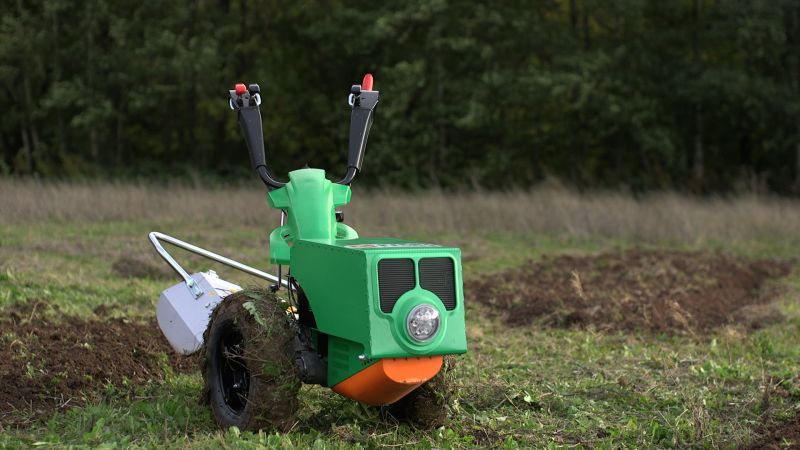
Electric tractors powered solely by sunlight have the potential to increase crop yields for farmers in sub-Saharan Africa and, in doing so, improve access to electricity.
Developed by Aftrak, a spin-out company from Loughborough University in the UK, the waist-high “micro electric tractor” propels itself forward with power, and is operated by the farmer while walking behind it. It features a steel “hardpan breaker” that pierces the layer of compacted soil commonly found on the surface of hand-tilled fields in sub-Saharan Africa.
Breaking through this layer and creating deep trenches allows roots and rainwater to penetrate the soil, slowing soil erosion and maximizing water absorption, making the soil more resistant to drought.

It’s part of an agricultural technique called deep bed farming (DBF) developed and promoted by Tierni, a nonprofit organization that works on food security and poverty. Tierni claims that DBF can more than double crop yields and increase farmers’ incomes by up to nine times.
The tractor is part of Aftrac’s broader effort to bring arrays of easy-to-assemble solar panels to rural Africa, starting in Malawi, where only 15.6% of the population had access to electricity in 2023. In rural areas, the number dropped to 6%.
Tierni says solar power deployment efforts can run into problems if people don’t feel a sense of ownership or economic benefit. Combining solar power with tractors could increase farmers’ income, allowing them to pay for electricity and solar panel maintenance in the long run. Aftrak calls this an “autonomous model of decentralized energy access.”
Dr Jonathan Wilson, Aftrak’s project leader and lecturer in sustainable energy systems at Loughborough University, said any energy solution must economically empower local communities.
“We need to address the revenue shortfall,” he told CNN. “We need to address food shortages, and then we can also address power shortages.”

Tractors cost about $3,500 each, and solar arrays cost about $1,500 per module. The plan is to sell the technology to agricultural cooperatives, independent farms, and non-profit organizations, possibly at a discount, so they can continue to use the technology.
Aftrak said it is also considering introducing an “Uber-like leasing app” that would allow farmers to rent tractors powered by central solar arrays by the hour.
Since 2005, Tierni has been developing DBF to increase crop production in Malawi. Isaac Monjo Chhabra, director of Tieni Malawi, which is partnering with Aftrac, said the technique, which is done by hand with a pickaxe, can be time-consuming and arduous. Mechanization “will enable farmers to generate more surplus for the market and lift them out of the chronic poverty they have suffered for decades,” Chhabra said. “We believe we can achieve that with Aftrak and deep bed farming.”
Aftrak was awarded the $1 million Milken Motsepe Green Energy Award in 2024. With funding from awards, donors and Tierni’s connections, Aftraq began testing the system in Malawi. The company has installed solar panels in primary schools and maternity clinics, and is testing a tractor-panel combination in Muzam, a rural village of 58 people in the north of the country.
Arnold Soko, 74, head of Muzam village, who grows corn, beans and pumpkins, told CNN: “Before Aftrak was built, we used hoes to dig the soil, but it was hard work. It could take three to four days.” “Right now it might take a day or two with a tractor.”

After a day on the farm, farmers use the solar grid hub’s modules to charge their tractors. Each module generates 7.5 kilowatt hours (kWh) per day. This is enough to charge one tractor or power up to five homes. This allows people to access the internet and connect to mobile banking and online educational materials. Wilson said multiple modules can be connected “like Lego” to generate additional power depending on the size of the community.
Sunset in Malawi is around 6pm, and Tierni says electricity greatly extends productivity and educational opportunities, opening doors for small businesses such as seamstresses and barbers.
A solar array has brought lighting, television, refrigerators and irons to Muzam village. Elizabeth Gondwe, a 63-year-old farmer, said, “I am happy because the children are learning well using the light.”
“We used to live in darkness, but (now) we live in light,” Soko added.
Aftraq said it is producing 100 tractors in the UK and will begin production in Blantyre, Malawi, in partnership with Malawi-based renewable energy manufacturing company INFLO Inc. Local craftsmen will be trained to assemble and repair tractor kits.
The company plans to roll out the system to other parts of Malawi, and later to Kenya, South Africa, Ghana and Nigeria. “Our goal is to be sustainable at scale,” Wilson said.
