

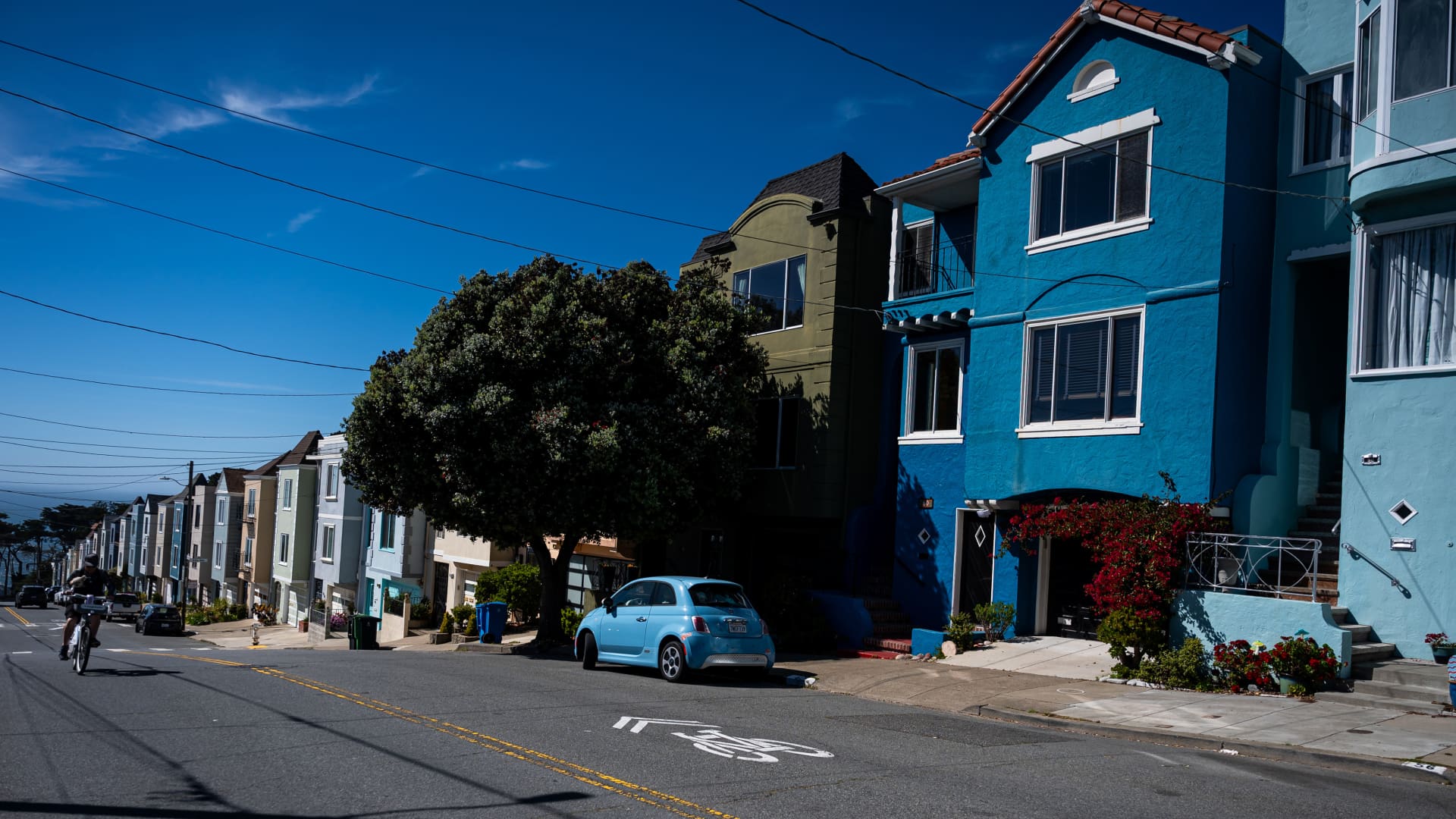
Monday, March 23, 2026 at a residence in San Francisco, California, USA.
David Paul Morris | Bloomberg | Getty Images
The direct impact of the war with Iran on the U.S. housing market is a sharp rise in mortgage interest rates. The day before the strike began, the average interest rate on a 30-year fixed loan was 5.99%, according to Mortgage News Daily. It is currently hovering around 6.5%.
Rising interest rates have curtailed the expected affordability improvements. Not only did mortgage interest rates fall before the war, but the rate of increase in house prices also slowed and the supply of homes for sale increased. All of these favored buyers who were competing against a tight and expensive market.
According to the Mortgage Bankers Association, applications for mortgages to buy homes fell 5% from the previous week as interest rates rose last week. But it’s not just mortgage interest rates.
Zillow expected existing home sales to increase 4.3% this year compared to last year.
“It’s certainly not a strong market, but 2026 will be a ‘reset’ year, meaning the market has turned a corner,” Zillow chief economist Misha Fisher said in a report Tuesday. “However, new uncertainties have emerged through energy prices and inflation concerns, adding new complexities to our outlook.”
Fisher used the mortgage rate hike to raise concerns about inflation and “the possibility of a slight increase in unemployment given the decline in consumer purchasing power due to rising prices.”
Modeling these, we predicted that even if the current scenario continues until the end of April, home sales this year will still increase by 3.48% year-on-year. If it ends on July 1st, the sales growth rate will drop to 2.33%. If it ends on September 1st, the increase will be 1.21%. Finally, if mortgage rates remain 50 basis points higher than their original trajectory and the unemployment rate rises 20 basis points through the end of 2026, Fisher projects a decline of 0.73 percentage points.
However, the impact is already being felt on the new construction market. After announcing disappointing quarterly results on Tuesday. KB Home Full-year forecasts have been revised downward.
“Consumers have faced a variety of challenges over the past two years, and the Middle East conflict that began in late February added to the uncertainty,” KB Home Chairman Jeff Mezger said on a call with analysts. “Against this backdrop, and given that net orders in the first quarter were below the level needed to maintain our previous full-year delivery guidance, we are lowering our order range for the full year.”
Builders are now supplying far more homes for sale, and existing inventory is growing as well, although more in the South and West than in the Northeast and Midwest.
Even before the war began, buyers were canceling contracts at the highest rate since 2017, according to Redfin’s tally. Roughly one in seven homes, or 13.7% of homes under contract in February, were canceled, up from 12.8% a year earlier. Buyers suddenly have the upper hand, with more than 600,000 sellers outnumbering buyers in the market, according to Redfin. This varies widely from market to market, but this is a near record difference.
“The housing market is in a precarious position, caught between long-term improvement and sudden short-term instability as we enter the ‘best time to sell,'” Jake Krimmel, senior economist at Realtor.com, said in a weekly report.
