

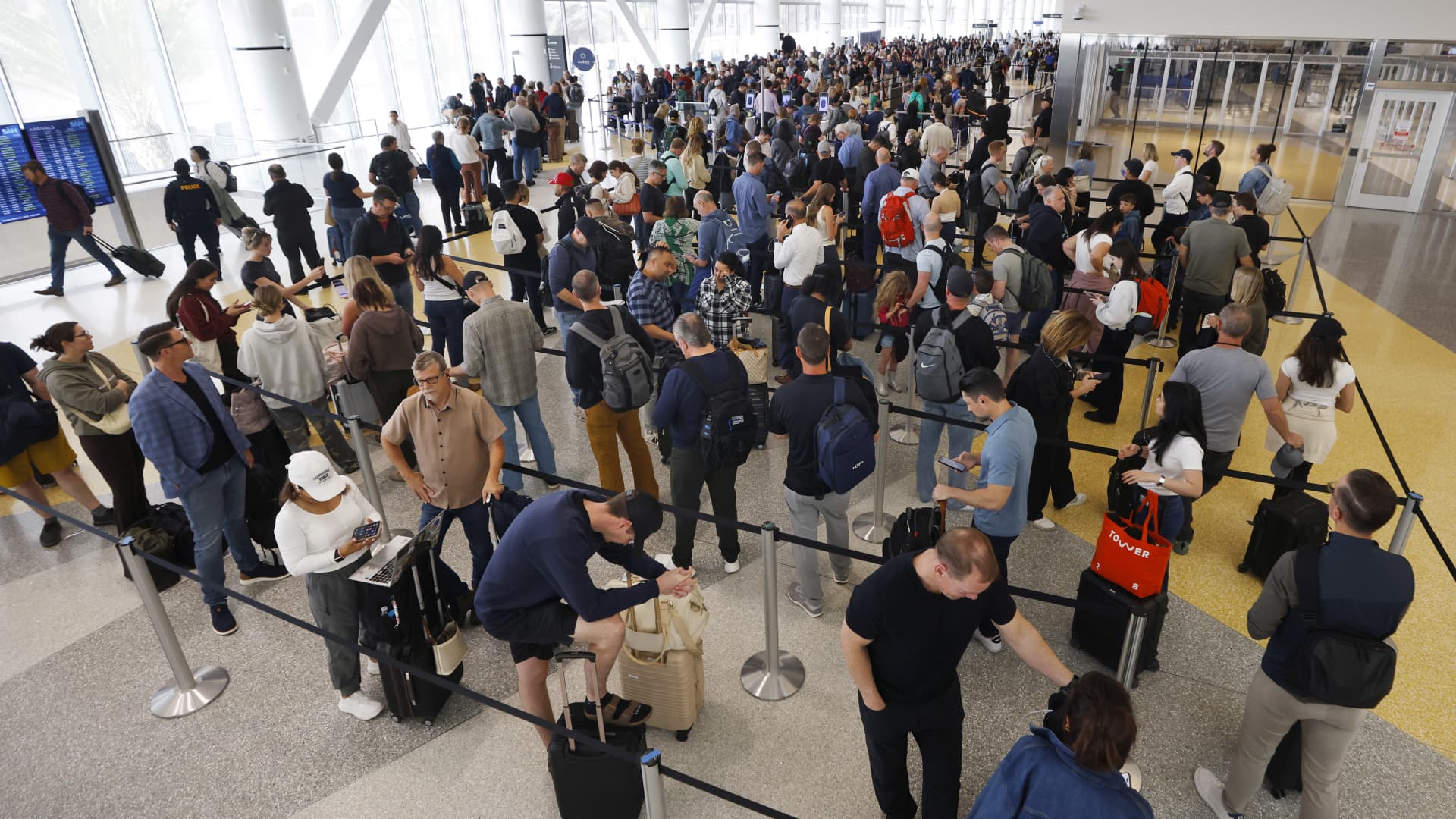
SAN DIEGO, CA – MARCH 23: Travelers wait in a long Transportation Security Administration line throughout Terminal 1 at San Diego International Airport, California, on March 23, 2026.
KC Alfred | San Diego Union | Getty Images
Senate Republicans and the White House appear close to a deal to largely fund the Department of Homeland Security and end a partial government shutdown, as delays at airports worsen in the second month of the shutdown.
Negotiations are still ongoing, but “the deal appears acceptable,” a White House official said Tuesday on condition of anonymity. In addition to funding DHS, President Donald Trump has said he wants to include other changes, such as a ban on transgender care and voter ID measures.
But Democrats say they are not satisfied with the Republican proposal.
At Homeland Security Secretary Mark Wayne Mullin’s swearing-in on Tuesday, President Trump said he would “take a good look” at the compromise funding proposal.
“Democrats have right in front of them” the legal text of a proposal to restart DHS, Senate Minority Leader John Thune, R.S., said at a news conference Tuesday.
“It’s time to end this,” Thune said. “That’s essentially what Democrats have been asking for.”
The agreement includes funding for all of DHS, except for a portion of the Immigration and Customs Enforcement budget. Sen. Lindsey Graham, R-S.C., part of a group of Republicans who met with President Trump at the White House on Monday night, said this would fund 94% of government agencies.
Democrats have not given their blessing so far.
Sen. Patty Murray (D-Wash.), the top Democrat on the Senate Appropriations Committee, said at a news conference Tuesday, “As Democrats have made very clear, we’re going to immediately fund TSA, FEMA, Coast Guard, and CISA while talks continue on ICE and border security. We’re also making it clear that if we’re talking about funding parts of ICE and CBP, we absolutely have to take some significant steps to rein in them.” She also said the meeting with the White House was “productive.”
A compromise would end the shutdown that began on February 14, ahead of a busy travel week leading up to Easter and school spring break. Due to the government shutdown, DHS employees have not been paid, with some not reporting to work or working without pay. Repeated government shutdowns, most recently last fall, ended with flight suspensions due to staffing shortages for essential government employees who were not receiving regular paychecks.
The deal also includes plans for Republicans to push through partisan legislation that would supplement ICE funding, include a national voter ID mandate and a version of the Trump-backed election bill, the SAVE America Act, that would require proof of citizenship for registration, Graham said. This does not include some of the ICE reforms that Democrats have called for, such as requiring a judicial warrant for agents to enter private property and banning the use of masks.
Thune said discussions about such changes would be conditional on “whether we can actually fund ICE.”
“Negotiations are ongoing, they’ve sent us an offer, we’re going to send them an offer back, and I can assure you there are important reforms in there,” Senate Minority Leader Chuck Schumer of New York told reporters on Tuesday, according to MS Now.
The latest proposal to reopen the agency comes as Transportation Security Administration lines swell at airports as agents face missed paychecks for the second time this week and are skipping work. The Trump administration sent ICE agents to some U.S. airports this week, purporting to assist TSA officers.
DHS funding expired the month after federal agents shot and killed two Americans in Minneapolis as part of increased immigration enforcement.
Schumer called the situation at the airport “unsustainable” on the Senate floor Tuesday, but the timing for moving on any proposal remains unclear.
Sen. John Hoeven, a Democrat, said Tuesday after a meeting in Thune’s office that Republicans were “ready to go.” He called on Democrats, who are also seeking changes to ICE’s immigration enforcement in exchange for their support, to “stop running around.”
“So Democrats need to join us,” Hoeven said. “We need to pay our TSA officers.”
But it’s not just Democrats who need to be on board with this. Conservative Republicans who have supported the SAVE America Act voter ID bill have expressed resistance to trying to trick the bill into passing through a “budget reconciliation” process. It is a procedural measure for budget bills, requiring 60 votes to pass the Senate, whereas most bills require a simple majority to pass.
“It’s hard to imagine how the SAVE America Act could be passed through reconciliation. By ‘difficult’ I mean ‘essentially impossible,'” Sen. Mike Lee (R-Utah), who has led the charge against the voter ID bill in the Senate, wrote on X on Tuesday.
Houben said he has been in talks with Lee and that negotiations will continue.
“All of this is a work in progress. Building consensus takes time,” Hoeven said.
Trouble may also be brewing among the right wing of the House Republican conference. The House Freedom Caucus, which along with Lee and other bill sponsors is pushing the Senate to change filibuster rules to ensure passage, questioned that strategy on Tuesday. Members questioned whether the SAVE America Act would even be considered in the settlement process, citing the chamber’s “esoteric rules.”
“This is gaslighting. The American people are not stupid and will not accept another failure from Congressional Republicans. Pass action now to save America,” the group posted on X on Tuesday.
The strong opposition suggests Republicans may be at odds within the party over the strategy, with leaders and moderates trying to determine whether reconciliation, which senators are supposed to decide on, is possible.
Rep. Brian Still (R-Wis.), chairman of the House committee with jurisdiction over federal elections, on Tuesday distributed a list of election-related proposals that should be considered separately from the funding bill.
These include a proposal that could cut federal funding from states that don’t require voters to show approved identification, but would also allow states to issue free voter IDs to some people. Another proposal would provide states with grants to cover the cost of sharing voter registration data with the federal government. And the third would allocate money to states to amend the federal voter registration form to require proof of citizenship.
— Emily Wilkins contributed to this article.
