

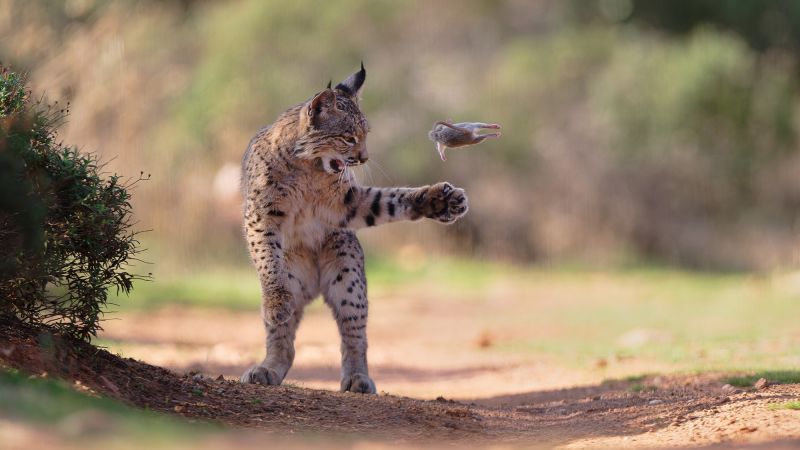
A photo of an Iberian lynx playing with its prey has won the prestigious 2026 Wildlife Photographer of the Year People’s Choice Award.
Standing on its hind legs with one leg out, the lynx appears both playful and predatory, attacking its surroundings as a prelude to killing and eating unlucky rodents.
More than 85,000 people voted in the annual competition run by London’s Natural History Museum, and the photos were chosen from a shortlist of 24. This shortlist was selected from a total of 60,636 entries and is separate from the overall competition, with winners announced in October.

2026 Wildlife Photographer of the Year, People’s Choice Finalist
The winning shot of the People’s Choice competition was captured by Austrian photographer Josef Stefan after spending three days camouflaged in a hideout in Torre de Juan Abad in central Spain.
During that period, the lynx “occurred briefly,” Stefan told CNN. “On the second day, this special moment came completely unexpectedly. He suddenly appeared with a freshly caught mouse in his mouth, lay down close to me, and remained there carefully for some time.”
Shortly thereafter, the lynx began playing with its prey. “He kept throwing the mouse in the air and deftly catching it, keeping it occupied for about 15 to 20 minutes. Eventually he lost interest, grabbed the mouse and disappeared behind the bushes, where he ate it,” Stefan said.
“About 20 minutes later he reappeared, calmly, almost proudly, passing my hiding place and eventually disappearing into the adjacent bushland.”

The Iberian lynx, with its bushy ears and mottled reddish-brown fur, was once one of the world’s most endangered mammals. This is due to years of hunting by humans who mistakenly thought they were killing livestock, resulting in the loss of scrubland and woodland habitat. Back then, Stefan recalls, it was “virtually impossible” to photograph them.
At one point in the early 2000s, there were about 100 left in Spain, said Natural History Museum researcher Natalie Cooper. “Only 62 of them were mature,” she added in a statement released by the Natural History Museum on Wednesday.
However, intensive conservation efforts have increased their numbers, with the adult population reaching about 648 in 2022, according to the IUCN Red List of Threatened Species.
They remain elusive, but now their presence “feels real again,” Stefan said. “With patience, habitat knowledge, and a little luck, we can once again observe, and sometimes even photograph, these fascinating animals.”
“The lynx is therefore not only a rare animal, but also a powerful symbol of how effective conservation can be.”
Four other photos were selected as runners-up in the contest. It includes an image of a flock of underwater flamingos surrounded by power lines, their pink color reflected by the setting sun overhead. Two bear cubs are fighting and playing even as cars approach. A sika deer carries the severed head of a rival still stuck in its antlers. Three polar bear cubs were curled up with their mother and resting.
Editor’s note: Call to Earth is a CNN editorial series dedicated to reporting on the environmental challenges facing our planet and their solutions. Rolex’s Perpetual Planet Initiative has partnered with CNN to promote awareness and education on key sustainability issues and inspire positive action.
