

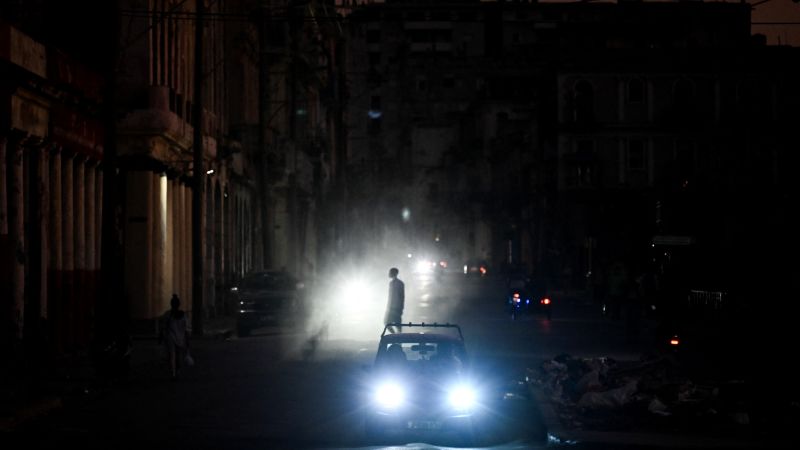
Cuba is working to restore power after another island-wide power outage left more than 10 million people without power.
A problem at a thermoelectric power plant in Camaguey state caused a “complete disconnection” of the electricity grid on Saturday, causing cascading effects, operator Union Electrica de Cuba said.
As of Sunday, power had begun to be restored, with Cuba’s Energy Ministry reporting that small-scale closed-circuit systems were “operating in all areas.”
The ministry said it was working to restore power to critical services such as hospitals, water and food distribution.
Cuba on Monday was still recovering from the first nationwide power grid collapse since the United States began cutting off fuel supplies from Venezuela earlier this year. Shortly before Saturday’s outage, the country’s state-run power company reported on social media that a power shortfall of 1.704 megawatts was expected during Saturday night’s busiest hour.
US President Donald Trump has spoken frequently about Cuba in recent weeks, predicting the communist government’s imminent collapse. On Monday, he wondered aloud whether he would ever have the “honor of occupying” the island.
“You know, I’ve been hearing about the United States and Cuba all my life, but when will the United States have the honor of occupying Cuba? That would be a great honor,” President Trump said from the White House. “I think we can somehow take hold of Cuba, yes, take hold of Cuba – whether we liberate it or take it away, we can do whatever we want with it.”
Asked whether the operation to “occupy” Cuba would involve the same level of force that the United States used to detain President Nicolás Maduro of Venezuela, a key ally of Havana, in January, the president declined to say.
Yesterday, Cuban President Miguel Diaz-Canel said in a speech to international activists bringing humanitarian aid to Cuba that his government is aware that “an attack on Cuba may occur” and is preparing accordingly.
Díaz-Canel acknowledged in an address to the nation last week that Cuban officials were in talks with U.S. officials about negotiating an end to the fuel embargo. Since then, the Cuban government has made it clear that it has no intention of negotiating its political system.
The country has been under a severe economic blockade from the United States since Cuban revolutionaries led by Fidel Castro overthrew the government of Fulgencio Batista in 1959. Cuba has weathered previous periods of severe economic uncertainty, including the “special period” when the collapse of the Soviet Union in 1991 cut off the communist government’s main source of external aid.
The current crisis is similarly bleak. Fuel shortages from Mexico and Venezuela have halted virtually all tourism to the island, disrupted education, cut hospital services and left farmers unable to market their produce.
